
Key takeaways
- Guaranteed rent usually costs the landlord through a lower agreed rent, not a separate monthly invoice.
- AMS charges 0% commission, but the fixed rent is normally 85-92% of realistic market rent.
- The right comparison is annual net income after fees, voids, repairs, arrears and time.
- A cheaper-looking traditional letting route can cost more when a tenancy goes wrong.
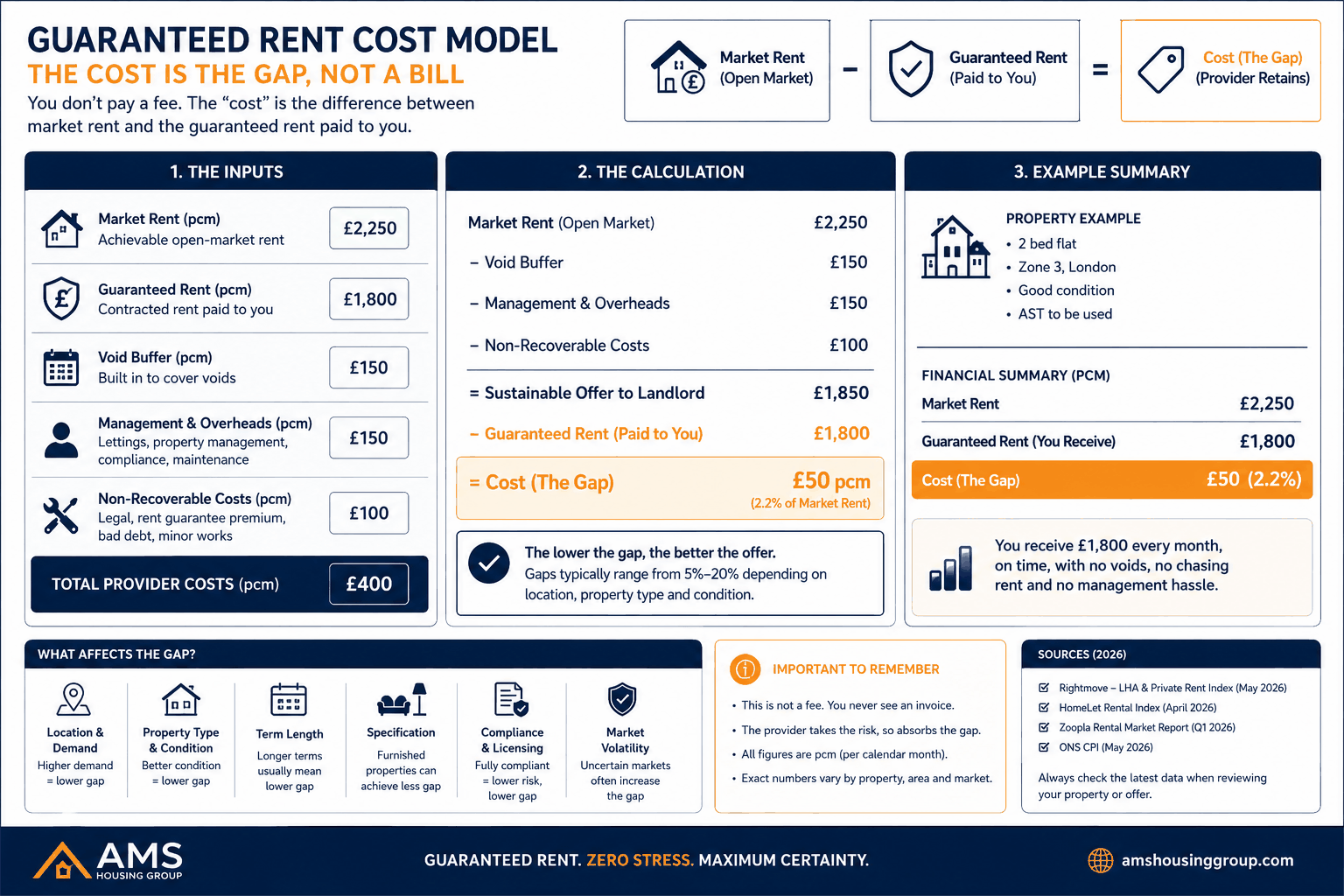
Guaranteed rent cost is often misunderstood because there may be no separate management invoice. The cost is the gap between the open-market rent and the fixed rent the provider agrees to pay.
That gap is not just a fee. It pays for risk: voids, arrears, management, inspections, repairs and the provider’s operating margin.
AMS Housing Group was founded in 2010, manages 500+ properties across all 33 London boroughs and Essex, and works from 29 Longbridge Road, Barking IG11 8TN. This article is written for practical landlord decision-making, not as legal, tax, mortgage or insurance advice. Where your decision affects tax, lending, eviction, trust planning or litigation, speak to a qualified professional before acting.
The cost is the gap, not a monthly bill
If a property could realistically achieve £1,800 pcm and a guaranteed rent provider offers £1,560 pcm, the visible gap is £240 pcm. The landlord should then ask what that £240 is buying.
In the AMS model, the landlord does not pay a separate monthly commission. AMS typically agrees guaranteed rent at 85-92% of market rent and charges 0% commission.
The first existing image should explain the guaranteed rent cost model: market rent, fixed rent, gap and risks transferred.
Related AMS route: AMS guaranteed rent service.
What the gap pays for in practice
The gap can cover void risk, arrears exposure, maintenance coordination, inspections, tenant management and the provider’s margin. A landlord keeping full market rent also keeps those risks.
Traditional letting can still be right for many landlords, but the fees need to be counted properly. Management percentage, VAT, tenant-find fees, renewals, checkouts and maintenance markups can reduce the net figure.
A guaranteed rent comparison should therefore use annual net income, not monthly gross rent.
Related AMS route: full property management in London.
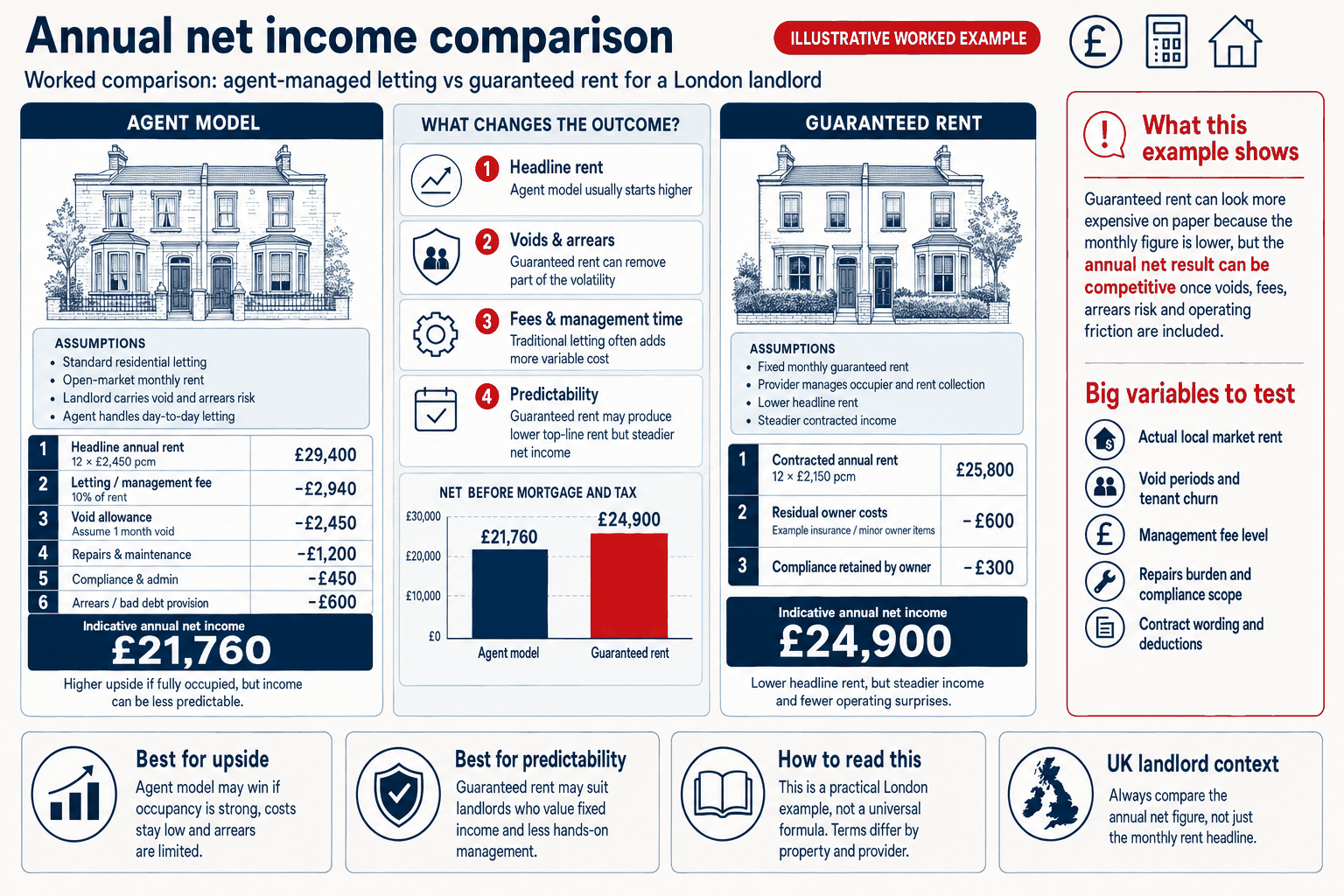
Annual net income: agent model versus guaranteed rent
The second existing image belongs after a worked example. It should show two columns: traditional letting and guaranteed rent, with each cost removed from the annual figure.
A traditional route might look higher until a void month, a tenant change and a repair are counted. Guaranteed rent looks lower at month one but can be stronger in a difficult year.
The comparison should include time as well as money. A landlord who spends evenings chasing contractors or arrears is paying a hidden cost.
Related AMS route: guaranteed rent vs traditional letting.
Why 0% commission is not the whole answer
0% commission is useful, but landlords should still ask what rent is being offered, what repairs are included, how inspections work and what happens at handback.
A provider can advertise no fees and still make the arrangement expensive if the fixed rent is too low or the contract is unclear. Equally, a provider with a fair gap and clear obligations may produce a better net result than a higher-looking agent route.
The question is not “is it free?” The question is “what does the landlord keep, and what risk has been removed?”
Related AMS route: how guaranteed rent is calculated.
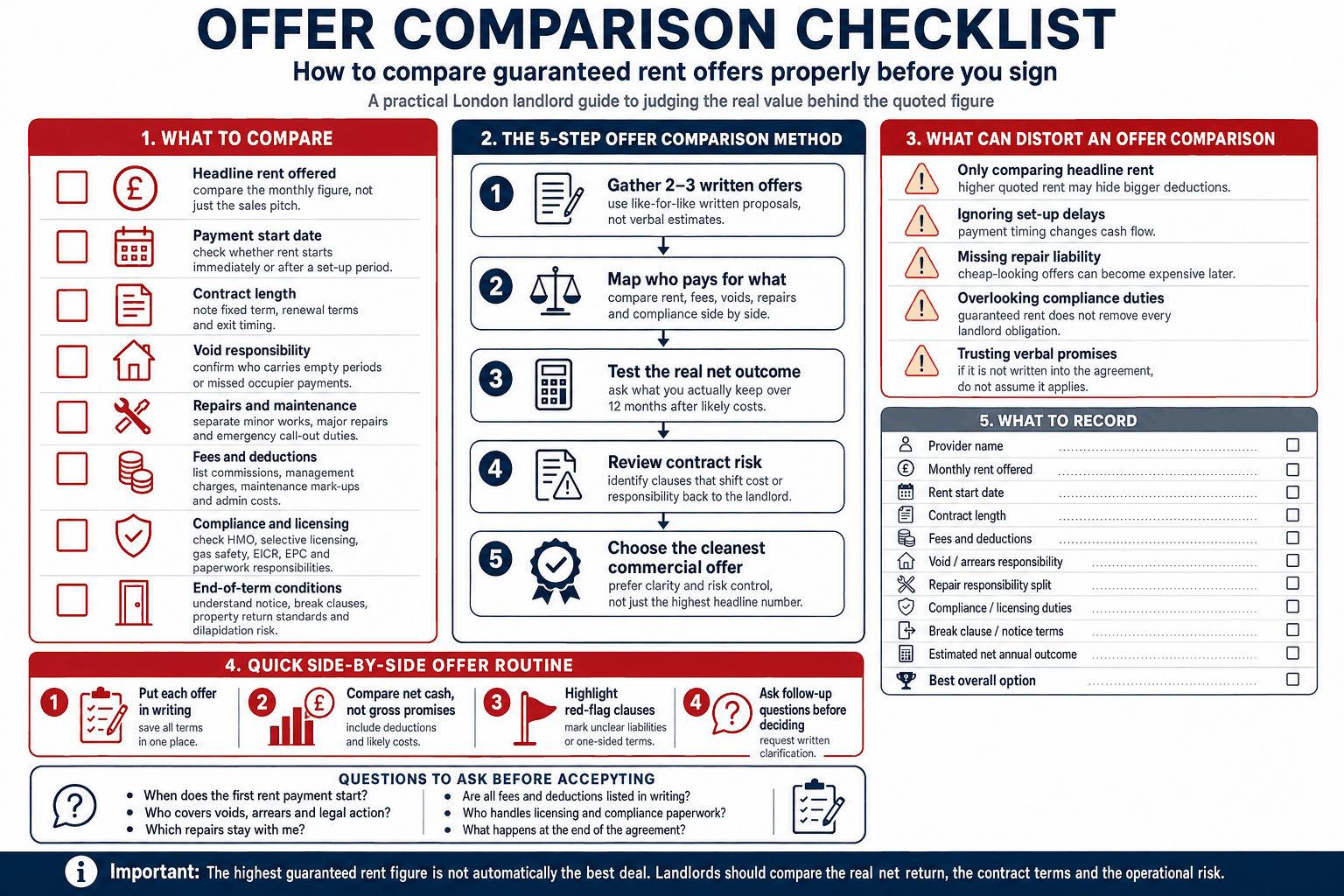
How to compare guaranteed rent offers properly
The third existing image should sit here as an offer comparison checklist. It should cover market rent evidence, agreed rent, repair responsibility, inspection frequency, contract length, handback standard and termination rules.
Ask each provider to explain the calculation line by line. If one offer is much higher, ask why. If one offer is much lower, ask what risk they see. A proper answer should mention condition, demand, works, licensing and management cost.
For AMS, a free valuation is the right starting point because it tests both market rent and fixed-rent viability.
Related AMS route: free property valuation.
The annual net comparison landlords should run
Start with annual market rent, then subtract realistic letting and management costs. Include management fees plus VAT, tenant-find, renewal, inventory, checkout, maintenance, certification and a sensible void allowance.
Then compare the guaranteed rent figure over the same year. The guaranteed rent may be lower each month, but it may remove several deductions and risks. The comparison should show money kept, not money advertised.
Do not use a perfect traditional letting year unless that is genuinely realistic. In London, even a strong property can have repair call-outs, tenant changes or compliance costs.
What a fair guaranteed rent contract should make clear
A fair contract should say the rent, payment date, contract term, repair obligations, access arrangements, inspection process, handback standard and termination provisions. If the landlord cannot explain those points after reading it, the contract needs attention.
Landlords should also ask what happens if the provider wants to change use, sublet, house multiple occupants or work with a council. These routes can be legitimate, but the landlord must understand the use and compliance obligations.
The cost of guaranteed rent is acceptable only when the risk transfer is real and the contract is clear. A vague agreement with a lower rent is not a bargain.
London landlord angle: certainty has a price but so does uncertainty
In London, a void month is expensive because monthly rents are high. A landlord comparing guaranteed rent with traditional letting should price one difficult year, not only the best year.
A fixed rent below market can feel costly until the landlord adds management fees, repair calls, tenant changeover, arrears time and the cost of making decisions under pressure. The value of certainty is most visible when the tenancy is not perfect.
Before signing a guaranteed rent agreement
Read the payment clause, repair clause, handback clause and termination clause together. A good rent figure can be undermined by unclear obligations or a difficult exit.
Ask for a written annual comparison. The provider should be willing to show how the fixed rent compares with market rent after normal landlord deductions. If the answer is only a sales pitch, slow down.
A landlord should also ask how the rent is paid if the property is empty, if the occupant falls into arrears or if repairs are underway. Those are the months when the cost and value of guaranteed rent become visible.
Mini example: why one void month changes the comparison
Imagine a property with market rent of £1,800 pcm. On paper, that is £21,600 a year. If the landlord loses one month to a void, pays 12% plus VAT management and spends £900 on repairs and setup, the net figure can fall quickly.
A guaranteed rent offer at £1,575 pcm produces £18,900 a year before tax. That may look lower than the market route, but it is fixed income and avoids several variable deductions. The “cost” is only clear after both routes are compared over a full year.
This is why AMS talks about annual net income rather than a single monthly headline. It is the only fair way to judge the trade-off.
How contract length affects the real cost
A guaranteed rent agreement over one year and a contract over several years should not be judged in the same way. A longer term can offer greater income certainty, but it also makes handback, repair responsibility and review clauses more important.
Landlords should calculate the cost over the whole term. A small monthly difference becomes large over three or five years. The same is true for the value of removed voids, removed management fees and reduced repair admin.
If the landlord may sell, refinance or move back in, they need to know how the guaranteed rent agreement handles that. The cheapest-looking route can be expensive if it blocks a future plan.
Final cost-comparison check before publication
The article should stop landlords comparing a guaranteed rent figure with a perfect open-market year. The fair comparison is guaranteed rent versus realistic net rent after fees, voids, repairs and arrears risk.
Frequently asked questions
Does AMS charge commission on guaranteed rent?
AMS states 0% commission on its guaranteed rent model. The commercial trade-off is the agreed fixed rent compared with market rent.
Why does guaranteed rent pay less than market rent?
Because the provider takes on risk, management workload and operating costs. A fair offer should explain this clearly.
Is guaranteed rent cheaper than property management?
It depends on the property and year. Compare annual net income after agent fees, voids, repairs and arrears risk.
Can I get a higher guaranteed rent offer?
Condition, location, demand and contract terms affect the offer. An unexplained above-market promise should be treated carefully.
What landlords should do next
Guaranteed rent is not free, but the cost is not a standard agency bill. Compare the gap with the risks removed, then decide from annual net income.
For a property-specific view, request a free valuation from AMS Housing Group, or call 020 3793 2247. AMS is based at 29 Longbridge Road, Barking IG11 8TN and works across all 33 London boroughs and Essex.