
Key takeaways
- Rental income tax is charged on rental profit, but mortgage interest rules can make the cash position feel worse.
- Your other income matters because rental profit is added to it and taxed at your marginal rate.
- Section 24 means finance costs are no longer simply deducted in full by individual landlords.
- Landlords should keep clean records and speak to an accountant before relying on any tax calculation.
Rental income tax is not charged on the rent figure alone. Landlords work out property income, deduct allowable expenses, then pay tax according to their wider income position and tax band.
Start with rental profit, not rent received
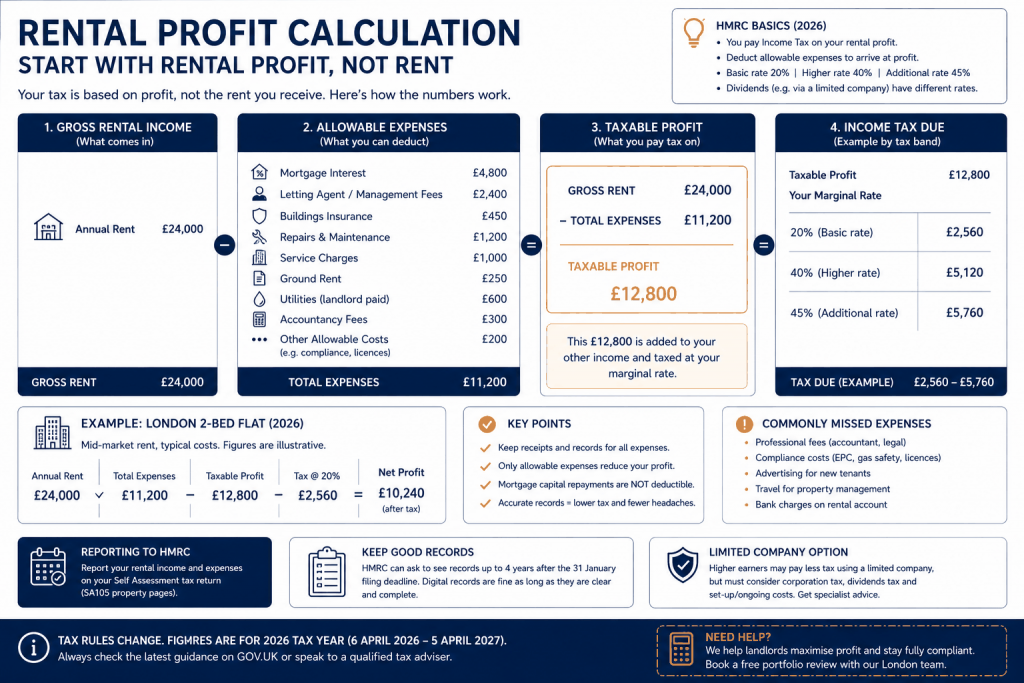
If a property receives £24,000 a year in rent, that is not automatically the taxable profit. The landlord may have allowable costs such as management fees, insurance, repairs, safety checks, accountancy and service charges.
The first existing image should show the rental profit calculation: rent received minus allowable expenses equals property profit before tax adjustments.
The mistake is treating cash in the bank as taxable profit or, the other way round, assuming every outgoing is deductible. Some costs are capital, some are revenue and mortgage capital repayment is not an expense.
Income tax bands and why salary matters
GOV.UK shows the 2026/27 Personal Allowance at £12,570, with basic rate at 20%, higher rate at 40% and additional rate at 45% for England, Wales and Northern Ireland. Rental profit is added to other taxable income.
A landlord earning £55,000 from employment is already in the higher-rate band before rental profit is added. That can make the tax on rental income much higher than a landlord expects from the headline rent.
This is why portfolio landlords should review tax, mortgage and ownership structure together rather than one property at a time.
Section 24
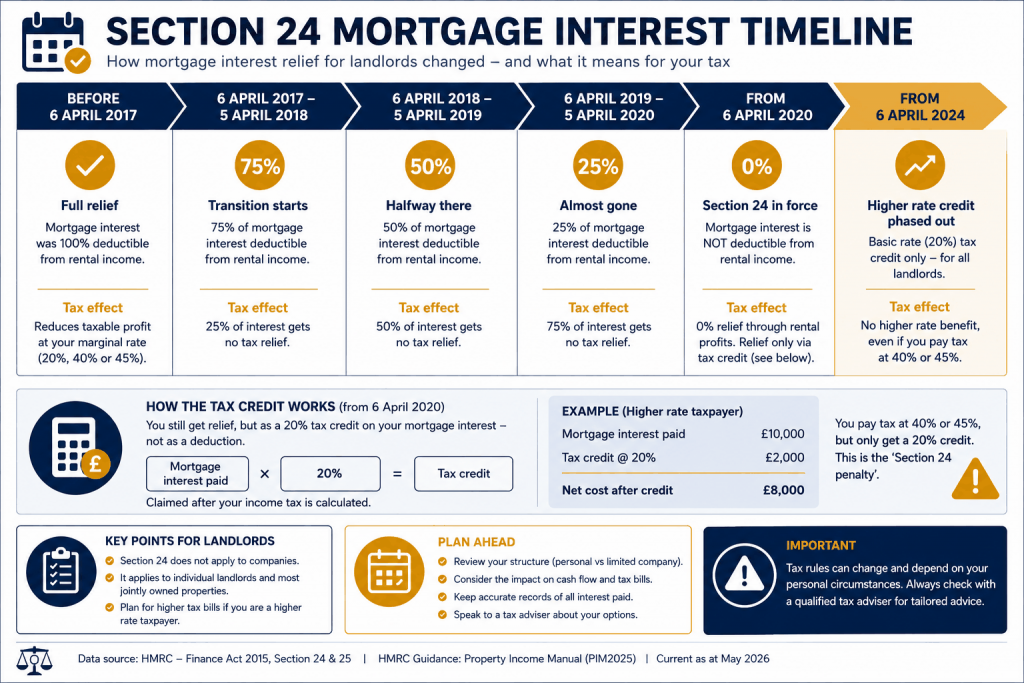
Section 24 changed how individual landlords receive relief for mortgage interest. Broadly, finance costs are restricted and relieved through a basic-rate tax credit rather than being deducted in full from rental income.
The second existing image should present a plain timeline of mortgage interest relief and show why higher-rate landlords can feel the change most sharply.
Limited companies are a separate topic and can have different tax treatment, but incorporation creates its own SDLT, CGT, mortgage and legal issues. Do not switch structure from an article alone.
Allowable expenses landlords should record
Common revenue expenses may include letting agent fees, management costs, repairs, landlord insurance, safety certificates, accountancy and some service charges. Improvements and capital works need separate advice.
Good records make tax easier and also make management better. The same invoice that supports a tax claim can help prove repair history if a tenant or council later questions the landlord’s response.
AMS-managed landlords benefit from organised repair, inspection and rent records, but they still need accountant advice for their personal tax return.
A higher-rate taxpayer example
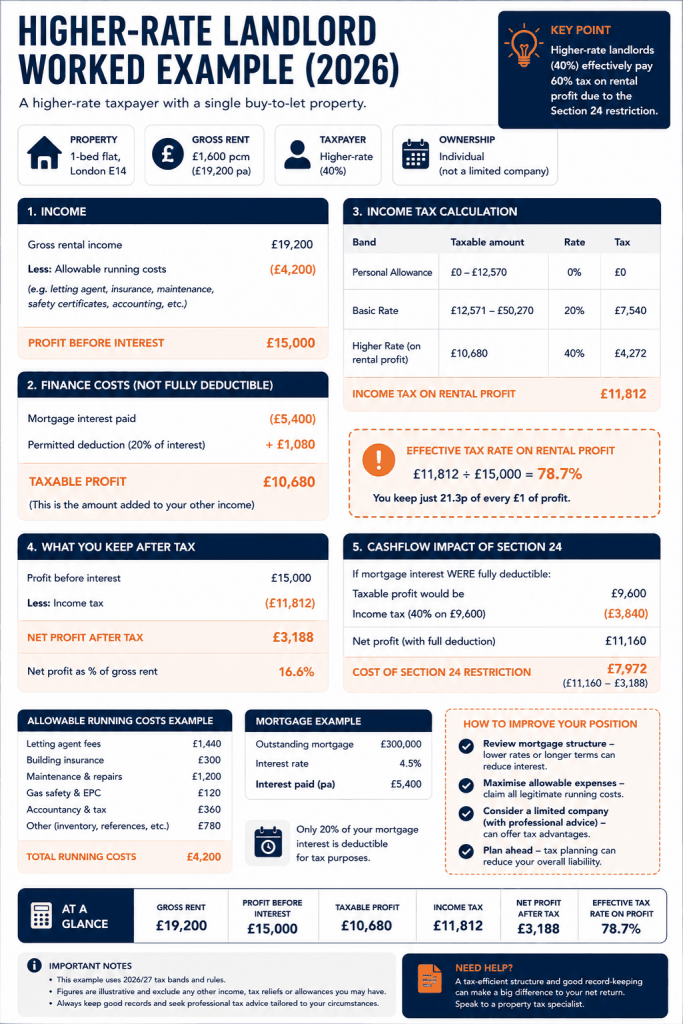
The third existing image belongs here. It should show a higher-rate landlord with rent, allowable expenses, mortgage interest and Section 24 effect in one worked example.
The purpose is not to create a personal tax calculation for every reader. It is to show why gross rent, taxable profit and cash profit are three different things.
A landlord with a £2,000 pcm property and high mortgage interest can still face a tax bill even if the monthly cash surplus feels modest.
Making Tax Digital and landlord record discipline
Landlords with higher property or self-employment income are being brought into Making Tax Digital in stages, so record discipline is becoming more important. Even where the rules do not yet apply, digital records reduce errors.
Separate bank accounts, clear invoices and consistent categories make accountant review quicker. They also make it easier to compare traditional letting with guaranteed rent or full management.
Tax records are not just for HMRC. They help landlords understand whether a property is actually performing after fees, repairs and finance costs.
Why tax should change portfolio decisions
A property that looks profitable before tax can look weak after Section 24, maintenance and management costs. This is especially true for higher-rate landlords with large mortgages.
Landlords should review each property and the portfolio together. One property may create tax pressure while another produces steady income. A sale, remortgage, incorporation or guaranteed rent route should be assessed with professional advice.
AMS can help with property-level figures, but an accountant should confirm the tax treatment. The two views should be combined before major decisions are made.
Tax planning belongs beside rental strategy
Rental income tax should be reviewed before changing rent strategy, borrowing, ownership or management model. A higher rent can increase tax while also increasing workload and arrears exposure.
A landlord considering guaranteed rent should ask an accountant how fixed monthly income, allowable expenses and finance costs appear in their own tax position. The commercial and tax answers should be read together.
London landlord angle: high rents do not always mean high profit
London rent levels can make income look strong, but mortgage interest, service charge, repairs, management and tax can reduce the cash result sharply. Gross rent is a poor measure of landlord performance.
A landlord with several properties should review net income after tax and finance, not just rent roll. The weakest property in a portfolio is often the one with the highest hidden cost.
Before filing or changing strategy
Do not wait until January to organise rental records. Property income should be reviewed during the year so repairs, finance costs and management decisions can be understood before the tax deadline arrives.
Speak to an accountant before changing ownership structure, refinancing, moving to guaranteed rent or selling. Each decision can affect tax differently, and a general article cannot know your full position.
Tax planning should not sit apart from property management. If a property creates high taxable profit but constant repair stress, the best answer may be a management change, fixed-rent agreement, refinance review or sale.
Mini example: rent received is not cash kept
A landlord receiving £2,000 pcm sees £24,000 a year before costs. If management, repairs, service charge, insurance, certificates and accountancy total £5,000, the pre-finance profit is £19,000.
Mortgage interest rules then change the picture for individual landlords. The landlord may not receive the tax result they expected from a simple “rent minus mortgage” calculation. Higher-rate taxpayers can feel this most clearly.
This is why every landlord should keep clean figures before asking “how much tax will I pay?” The answer depends on the property, the finance and the landlord’s wider income.
Records that reduce tax and management mistakes
Landlords should keep separate records for rent, repairs, insurance, service charges, mortgage interest, certificates, accountancy, agent fees and capital works. Mixing these costs makes tax harder and management decisions weaker.
Do not rely on bank statements alone. A payment to a contractor does not explain whether the work was a repair, improvement or capital item. Keep the invoice and a short note of what was fixed.
Clean records also help when comparing routes. If you know the real annual cost of self-management, it becomes easier to compare full management, guaranteed rent or selling a weak property.
Frequently asked questions
Do landlords pay tax on rent or profit?
Landlords pay tax on taxable rental profit, not simply rent received. The exact result depends on allowable expenses and wider income.
Can I deduct mortgage interest?
Individual landlords receive restricted relief for finance costs, generally through a basic-rate tax credit. Ask an accountant for your position.
What tax rate applies to rental income?
Rental profit is added to your other income and taxed at your marginal income tax rate.
Do I need an accountant?
For most landlords with mortgages, multiple properties or high income, yes. Tax rules are too important to guess.
What landlords should do next
Work from records, not memory. Rental tax is a profit calculation, a cash-flow issue and a compliance record-keeping exercise at the same time.
For a property-specific view, request a free valuation from AMS Housing Group, or call 020 3793 2247. AMS is based at 29 Longbridge Road, Barking IG11 8TN and works across all 33 London boroughs and Essex.