
Key takeaways
- Rent guarantee insurance is a claims product; it does not manage the property or remove all arrears risk.
- Most policies rely on correct tenant referencing before the tenancy starts, so a weak file can weaken a later claim.
- Excess periods, claim caps and legal-cost limits matter more now that possession generally depends on a Section 8 route.
- A fixed guaranteed rent agreement is different: the landlord receives an agreed rent under contract rather than claiming after default.
Rent guarantee insurance can help a landlord when a tenant stops paying, but it should not be confused with guaranteed rent. The policy normally pays only after specific claim conditions are met, and the landlord must still manage the tenancy, notices, repairs, compliance and evidence.
Since the 1 May 2026 private-renting changes, the article needs a sharper angle. Section 21 no-fault eviction is no longer available in England, so arrears cases depend on valid possession grounds, evidence and the court process. That makes policy wording, legal-expense cover and claim duration more important than the headline premium.
What rent guarantee insurance is designed to cover
A typical rent guarantee insurance policy protects against unpaid rent after a tenant falls into arrears. Many products are sold with legal expenses cover, which may help with solicitor costs, court fees or possession proceedings if the tenant does not pay. That sounds simple, but the details are in the policy schedule.
Landlords should check the maximum monthly rent covered, the maximum number of months payable, the excess period and whether the policy pays from the first missed rent or only after a waiting period. A £1,600 pcm tenancy with a 60-day excess can leave the landlord absorbing around £3,200 before a claim pays anything.
The safest way to read the policy is to imagine the tenant stops paying today. Ask what documents the insurer asks for, how many days pass before a claim can start, and whether the policy keeps paying if the possession claim takes longer than expected.
The claim journey from first missed rent to payout
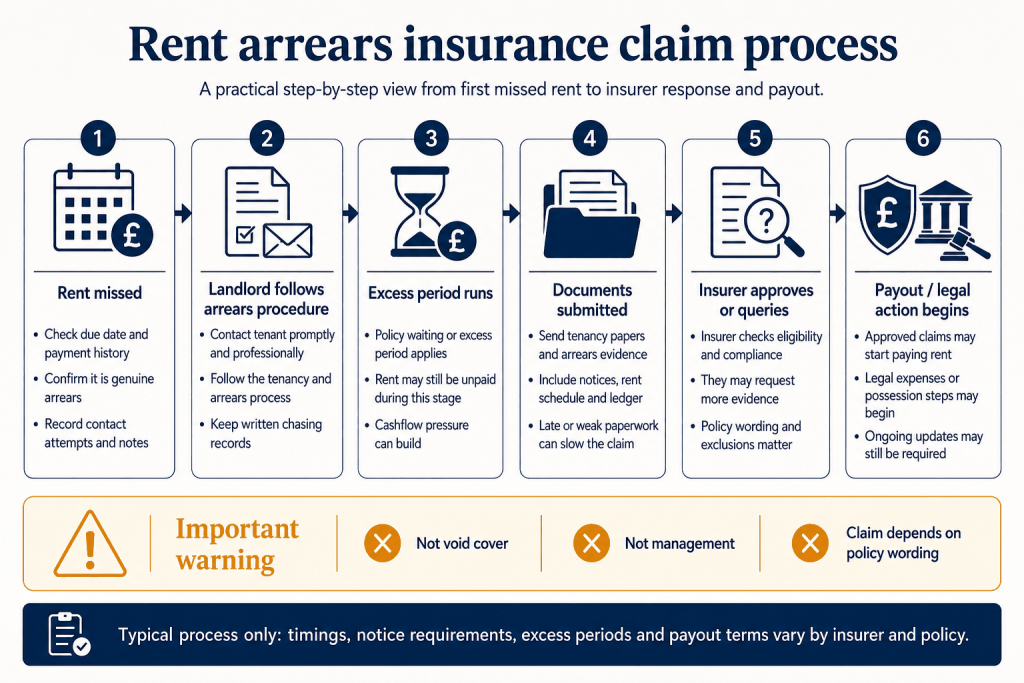
The first missed payment should trigger action, not guesswork. The landlord needs to contact the tenant, record the arrears, check the policy notification window and avoid taking informal steps that conflict with the insurer’s process.
A good claim file normally includes the signed tenancy agreement, deposit record, tenant referencing report, rent schedule, arrears statement, correspondence and evidence that the landlord followed the policy procedure. If the insurer required referencing before the tenancy began, buying the policy after a weak reference file will not fix the problem.
This is where the first existing image belongs. A timeline graphic helps readers see the difference between missed rent, policy notification, excess period, legal action and payout. It also shows why insurance does not create the same predictable cash flow as a fixed-rent agreement.
The exclusions landlords often miss
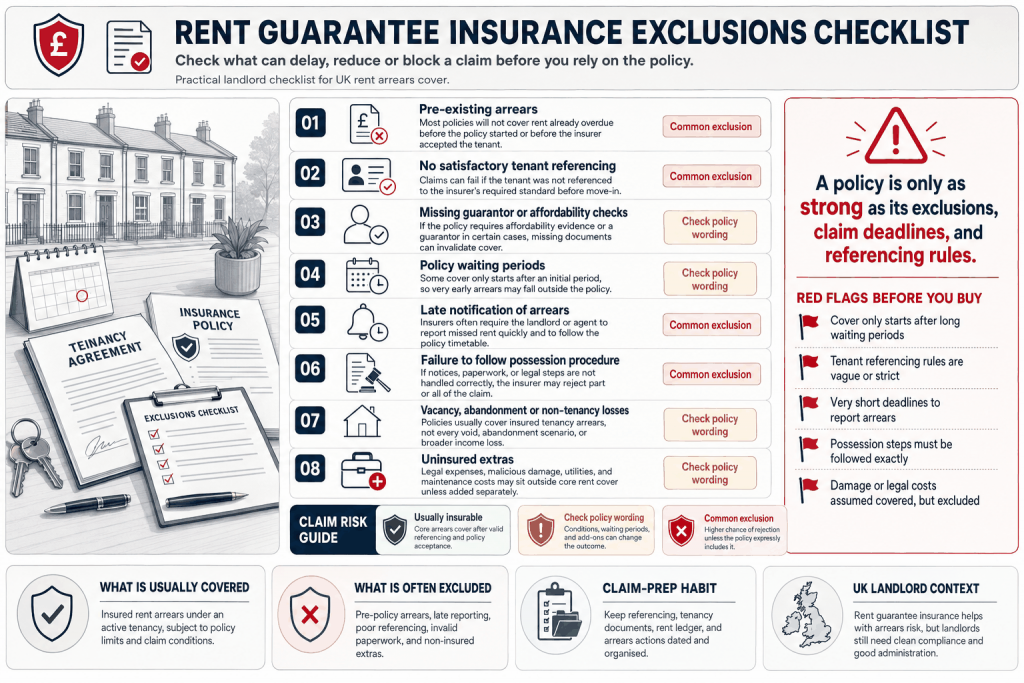
The most common mistake is assuming every missed rent payment is covered. Some policies exclude arrears that began before cover started, tenants who failed referencing, informal tenancies, deposit breaches, licensing problems or rent that cannot be legally recovered because the tenancy paperwork is defective.
Landlords also need to check whether legal expenses are capped, whether the insurer chooses the solicitor, and whether the policy stops paying when the tenant leaves. A short claim cap can be a problem when arrears, court listing and enforcement stretch across many months.
Use the second existing image here as an exclusions checklist. The image should sit after a section that gives the reader a clear policy-reading method, not after a generic list.
Rent guarantee insurance vs guaranteed rent
Rent guarantee insurance and guaranteed rent solve different problems. Insurance helps after a defined default event. Guaranteed rent replaces the income model: the landlord agrees a fixed rent with the provider, and the provider takes on day-to-day occupancy and management risk under the agreement.
Insurance may suit a landlord who wants to keep control, select tenants directly and remain involved in management. Guaranteed rent may suit a landlord who wants fixed monthly income, fewer arrears decisions and one accountable operator. The trade-off is that guaranteed rent is normally set below open-market rent because the provider carries risk and operating cost.
The third existing image should compare these two tools line by line: when money is paid, who manages repairs, who carries void risk, what happens during arrears, and how the landlord’s workload changes.
How the 2026 tenancy changes affect insurance decisions
GOV.UK landlord guidance says the 1 May 2026 reforms abolished Section 21 and moved most private tenancies to assured periodic tenancies. A landlord can still regain possession, but the route must be based on a specific legal ground and a court order where possession is disputed.
For rent guarantee insurance, that means landlords should not just ask “what is the annual premium?” They should ask how long the policy pays, whether it covers Section 8 legal work, and what evidence the insurer needs before supporting a claim.
This does not make insurance useless. It makes it more technical. A strong policy with proper referencing and legal expenses can be part of a sensible risk plan. A cheap policy bought for comfort, without reading the conditions, can give a false sense of safety.
When insurance is enough and when fixed rent is cleaner
Insurance can be enough where the landlord has a clean compliance file, strong tenant referencing, low mortgage pressure, time to manage arrears and enough reserves to cover an excess period. It is usually weaker where the landlord relies on the rent to pay the mortgage every month or cannot absorb several months of arrears.
Fixed rent is worth comparing when the landlord wants income certainty more than the highest possible gross rent. AMS guaranteed rent agreements usually sit at 85-92% of realistic market rent, with 0% commission and inspections every 4-6 weeks. That lower headline rent needs to be compared against voids, agent fees, maintenance exposure and arrears risk.
A landlord with one flat in Barking may choose differently from a portfolio landlord with several houses across Newham, Enfield and Redbridge. The right answer comes from the property, the landlord’s cash-flow tolerance and the quality of the paperwork.
Policy checks before a landlord pays for cover
Before buying a policy, ask for the full policy wording, not only the sales summary. Check the definition of rent, the claim trigger, the excess period, the maximum payout term, legal-expense cover, cancellation rules and whether the insurer requires a specific referencing standard.
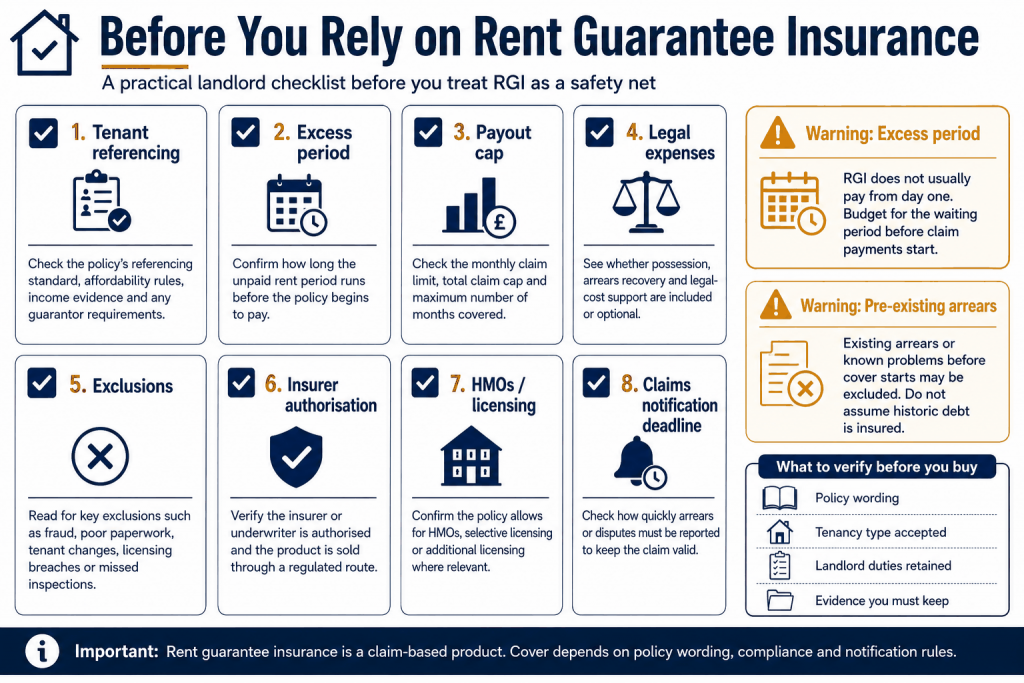
The key test is whether the policy still helps in the month when things are messy. A tenant may pay part rent, dispute repairs, raise a counterclaim or leave belongings in the property. A clean marketing promise does not answer those practical questions.
Landlords should also check who is actually underwriting the policy and whether the broker or administrator is authorised. If there is a complaint, the route to the insurer, broker, Financial Ombudsman Service and FSCS protection should be understood before a claim is needed.
How to compare insurance with self-management reserves
Some landlords decide to self-insure by keeping a cash reserve. That can work for low-risk tenancies where the landlord has strong records and a mortgage position that can survive a bad quarter. It does not work well where one missed rent payment creates mortgage pressure.
A reserve should be compared with the policy excess and claim cap. If a policy costs £300 a year but leaves the landlord covering two months of arrears, the landlord still needs a reserve. If the policy legal cover is capped, the landlord may also need funds for costs beyond that cap.
Insurance is therefore not a replacement for screening, rent monitoring, repair records or compliance. It is one layer of protection. Strong property management remains the first line of defence.
Before renewing or buying a policy
Read the renewal terms as carefully as a new policy. Insurers can change exclusions, limits or notification duties. A landlord who renews automatically may assume cover has stayed the same when the important wording has moved.
Make a one-page claim checklist and save it with the tenancy file. It should state who to contact, when to notify, what documents are needed and what rent schedule the insurer expects. That checklist is more useful than remembering the policy exists after arrears begin.
The claim file landlords should build before anything goes wrong
A rent guarantee claim is easier when the tenancy file has been built from day one. Keep the advert, application, referencing result, signed tenancy terms, deposit record, inventory, rent schedule and every repair message in one place. If the tenant later stops paying, the landlord is not trying to rebuild the story from scattered emails.
The strongest file also shows that the landlord kept their side of the bargain. A tenant who raises disrepair during an arrears case can complicate possession and insurance decisions. Repair records, access attempts and contractor notes help separate genuine maintenance issues from rent default.
For landlords using a letting agent, the management agreement should confirm who keeps these records and how quickly they can be produced. A policy is only as good as the evidence behind the claim.
Final insurance check before publication
The reader should finish this article knowing that insurance is only a backstop. The landlord still needs a strong tenancy setup, clean compliance record, fast arrears action and enough cash to survive the excess period.
Frequently asked questions
Does rent guarantee insurance pay from the first missed rent?
Usually not. Many policies have an excess or waiting period, and the landlord must notify the insurer in the right way. Check the policy schedule before assuming payment starts from day one.
Can I buy cover after the tenant has stopped paying?
Normally no. Existing arrears are usually excluded, and policies often require acceptable referencing before the tenancy begins.
Is rent guarantee insurance regulated?
Insurance and insurance distribution in the UK should be checked through the FCA register, and landlords should understand complaints routes such as the Financial Ombudsman Service and protection such as FSCS where eligible.
Is guaranteed rent better than insurance?
Not automatically. Guaranteed rent is better for income certainty and reduced management workload. Insurance may be better for landlords who want to keep direct control and accept claim conditions.
What landlords should do next
Rent guarantee insurance can be useful, but it is not a rent guarantee service. Read the policy as if a claim has already happened, then compare that outcome with a fixed-rent route before choosing. AMS can help London and Essex landlords compare both options against the actual property.
For a property-specific view, request a free valuation from AMS Housing Group, or call 020 3793 2247. AMS is based at 29 Longbridge Road, Barking IG11 8TN and works across all 33 London boroughs and Essex.