
Key takeaways
- Student HMO gross rent is not annual net income. Summer voids and turnover can change the result.
- HMO licensing, fire safety, room standards and management records are central to the decision.
- Guaranteed rent can smooth income across 12 months if the provider understands HMO operation.
- Not every student HMO suits guaranteed rent; condition, location, room layout and licensing matter.
- AMS can compare student HMO management, guaranteed rent and standard HMO letting before landlords commit.
Student HMOs can look excellent on a spreadsheet. Room rents are higher than a single-let figure, demand can be strong near universities and gross yield looks attractive. The weak point is that the annual result depends on summer voids, turnover, repairs, licensing and management time.
This guide explains when student HMO guaranteed rent is worth comparing and when landlords may be better with specialist HMO management or traditional student letting. It focuses on London and Essex landlords in 2026.
Why student HMO income looks strong on paper
A student HMO can outperform a single let on gross income because rent is usually calculated room by room. A three-bedroom student house near good transport or a university may look far stronger than a family letting on headline rent. But that rent is only useful if rooms stay occupied and the property can withstand higher use.
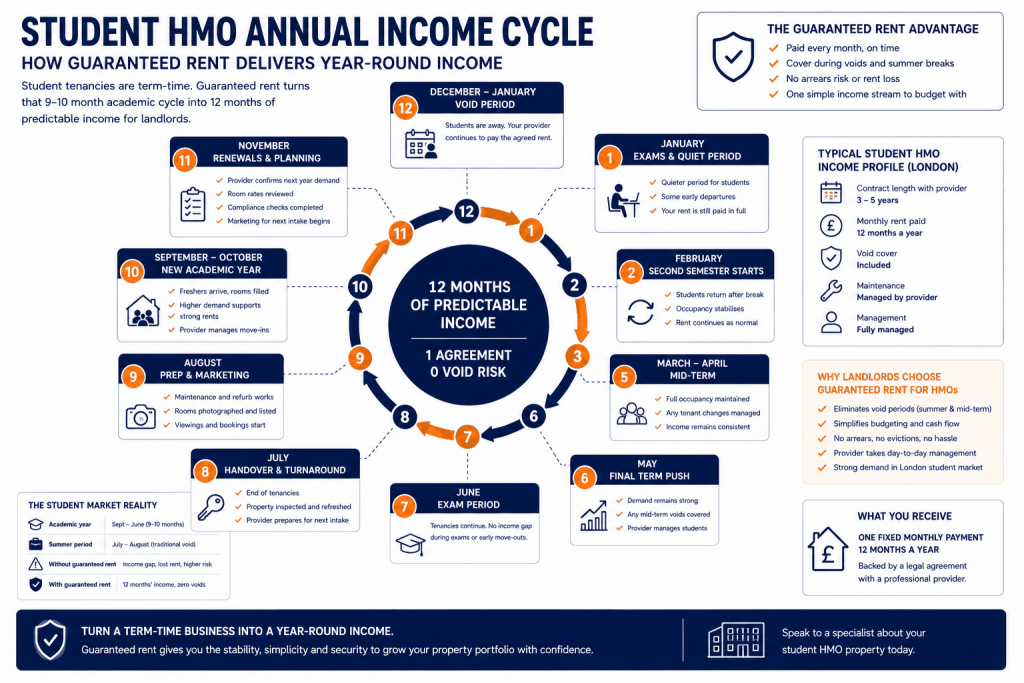
The annual cycle matters. Student demand is often concentrated around the academic year. Landlords can face summer gaps, group changes, guarantor checks, room-by-room maintenance, furniture wear, internet issues and higher expectations around communal spaces.
The annual-income-cycle image belongs here because it should show the student letting year from marketing and reservation through move-in, inspections, exam period, summer void and turnaround.
The summer void problem
Summer voids are the trap in many student HMO calculations. A room that rents well from September to June may be empty in July and August, or discounted to hold the group. Even a few empty weeks can reduce the annual result enough to change the comparison with guaranteed rent.
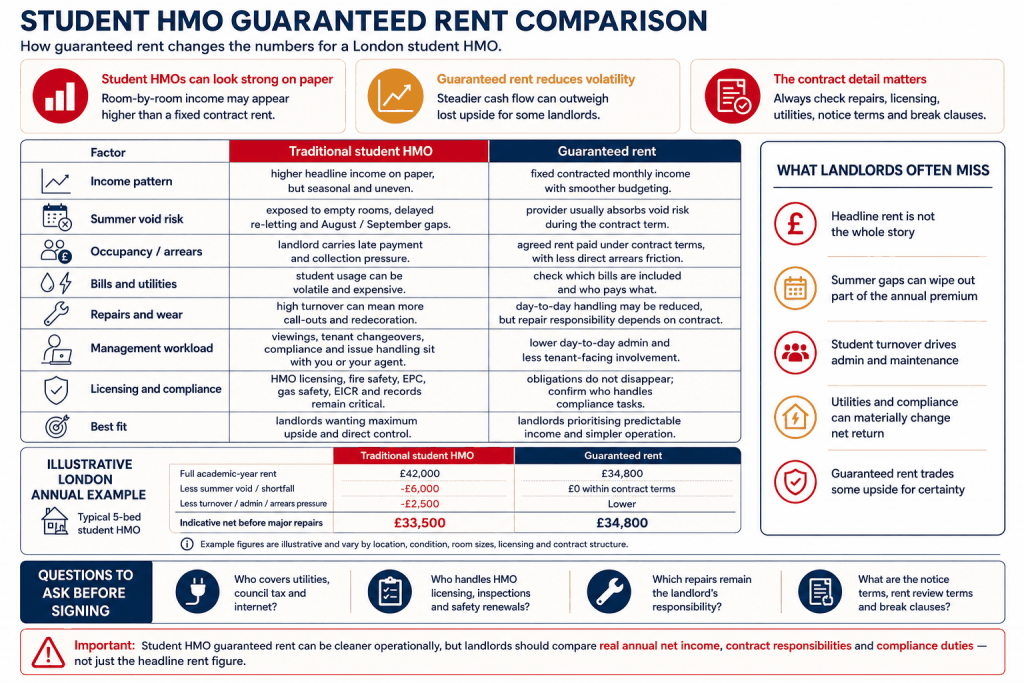
The mistake is to multiply peak monthly room rent by 12 and call it income. Landlords should calculate realistic occupancy, turnover cleaning, damage, furniture replacement, re-marketing and time spent coordinating multiple tenants. That is where the annual net result is found.
The summer-void impact chart should sit here because it shows how a higher gross rent can lose ground once seasonal gaps are included.
Licensing, fire safety and HMO management
A property with at least three tenants forming more than one household and sharing facilities may be an HMO. Mandatory licensing applies at five or more occupants, and many London boroughs also operate additional licensing for smaller HMOs. Student landlords must check the borough before relying on the rent calculation.
HMO management also means fire doors, alarms, escape routes, room sizes, waste, communal condition, inspections and tenant communication. A student property can create more repair tickets than a single let because several unrelated occupiers use the same kitchen, bathrooms and communal areas.
AMS normally checks licensing and safety before discussing guaranteed rent because a high room-rent estimate is useless if the property cannot lawfully operate as intended.
How guaranteed rent changes the student HMO numbers
Guaranteed rent can make sense when the landlord wants the income smoothed over 12 months and wants a professional operator to manage voids, turnover, inspections and compliance. The monthly figure may be lower than peak student room rent, but it can reduce summer gaps and landlord workload.
This does not mean guaranteed rent is always better. A high-quality HMO in a strong location with a landlord who can manage tenants, repairs and marketing may perform well under traditional HMO management. The choice depends on annual net income and risk tolerance.
The student-HMO guaranteed-rent comparison image belongs here. It should compare peak gross rent, realistic annual net rent, summer voids, repairs, management time and fixed rent.
Which student HMOs are suitable for fixed rent
Suitable properties are usually in reliable demand areas, have sensible room layouts, clear licensing position, good fire safety, manageable repair exposure and a location that works beyond one very narrow student group. Unsuitable properties often need major works, have weak communal space, licensing uncertainty or unrealistic rent expectations.
AMS can compare HMO management, guaranteed rent service, landlord licensing, property management in London and free rental valuation to decide whether the student model should continue, change or be simplified.
Turnaround costs between academic years
Student HMO turnaround is a project, not a clean. It can include deep cleaning, repainting, mattress replacement, furniture repairs, garden clearance, waste removal, locksmiths, inventory updates, safety checks and broadband or utilities coordination. If the property is re-let to a new group, every delay cuts into the next rental year.
Landlords should cost the turnaround before agreeing room rents. A high rent that needs heavy annual works may produce a weaker net result than a slightly lower rent with less churn. Guaranteed rent can help where the provider takes on the operational burden, but the contract must make repair and handback duties clear.
Guarantors, deposits and group risk
Student lets often involve guarantors, joint tenancies, deposits and group dynamics. One tenant leaving can affect the rest of the group. Disputes can arise over damage, cleaning, unpaid bills and room changes. A landlord needs a system for communication, deposit evidence and repair allocation.
The management load is different from a family single let. It is not necessarily worse, but it is more active. That is why student HMO guaranteed rent should be compared with specialist HMO management rather than ordinary tenant-find only.
Local demand is more important than the word student
Not every property near a college or university is a strong student HMO. Students care about transport, room size, communal space, internet, safety, bills, price and how quickly repairs are handled. Some locations work better for professional sharers or families.
AMS looks at the actual demand pattern before recommending a route. If student demand is thin, forcing the property into a student model can create voids. If demand is strong but the landlord cannot manage turnover, fixed rent may be worth comparing.
Make the annual result decide the route
The best student HMO decision is not based on the strongest September rent. It is based on the full academic year, including voids, repairs, wear, compliance and management. If the property still wins after those deductions, HMO letting may be the route. If not, guaranteed rent may be worth serious comparison.
Landlords with student HMOs should review licensing, fire safety, room demand and income before the next academic cycle. Waiting until summer often leaves too little time to change strategy.
Frequently asked questions
Can a student HMO be on guaranteed rent?
Yes, if the property, licence position, condition and provider model are suitable.
What is the main financial risk with student HMOs?
Summer voids, turnover costs, repairs and licensing can reduce the annual result.
Do smaller student HMOs need a licence?
They may. Mandatory licensing starts at five or more occupiers, but many councils operate additional licensing for smaller HMOs.
London student HMO checks before agreeing rent
A student HMO needs a demand check before a rent figure is trusted. Look at university proximity, transport, room sizes, communal space, broadband expectations, local competition and whether students or professional sharers are the stronger market.
Then check the compliance layer. Student HMOs can trigger mandatory or additional licensing, fire-safety requirements, waste issues and higher inspection needs. A high gross rent is not useful if the landlord has not budgeted for the operating standard.
Guaranteed rent can work well where the provider understands those HMO realities. It is less suitable where the property needs major works or the landlord expects student peak rent without allowing for voids and turnover.
Final student HMO income check
Before agreeing a student HMO route, landlords should compare three annual scenarios: fully occupied student letting, realistic student letting with summer voids, and guaranteed rent. The correct comparison includes licensing, fire safety, cleaning, furniture, inspections, room turnover and the landlord’s own time. If the fixed-rent figure still looks competitive after those deductions, it deserves serious consideration.
Inspection for student HMOs
Student HMOs need a stronger inspection rhythm than many single lets. Communal kitchens, bathrooms, waste areas and fire-safety features should be checked during the year, not only at check-out. Regular records help landlords control damage, support deposit decisions and prove that management duties were taken seriously.