
Key takeaways
- The Renters’ Rights Act changes do not make guaranteed rent a shortcut around landlord law. They make strong records, repairs and possession systems more valuable.
- With Section 21 removed, arrears and possession risk now depends on valid Section 8 grounds, evidence and court process rather than a simple no-fault notice route.
- A guaranteed rent agreement can still work well where the provider carries void, arrears, repair and management risk under a clear contract and has credible compliance systems.
- The landlord should compare guaranteed rent against self-management using net income, not headline rent: voids, repairs, legal costs, inspections and time all matter.
- AMS should link this article to the guaranteed rent service page as the commercial route, while the article itself answers the regulatory risk question.
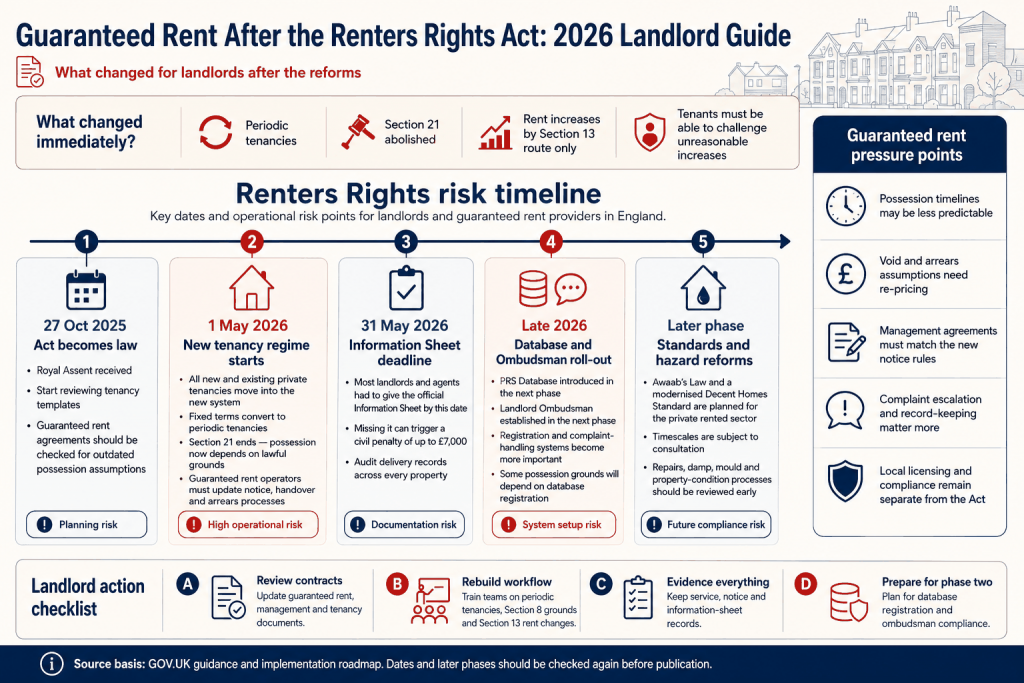
This section needs a timeline visual because landlords are trying to connect legal changes with day-to-day risk. The image should show that the change is not just Section 21; it affects records, repairs, rent increases and redress.
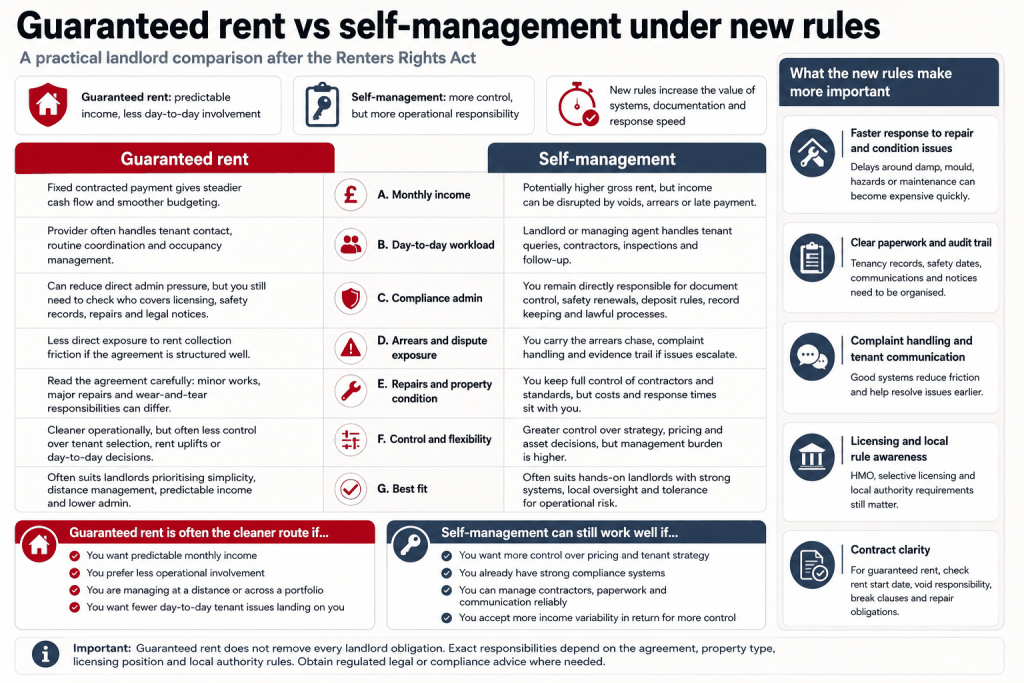
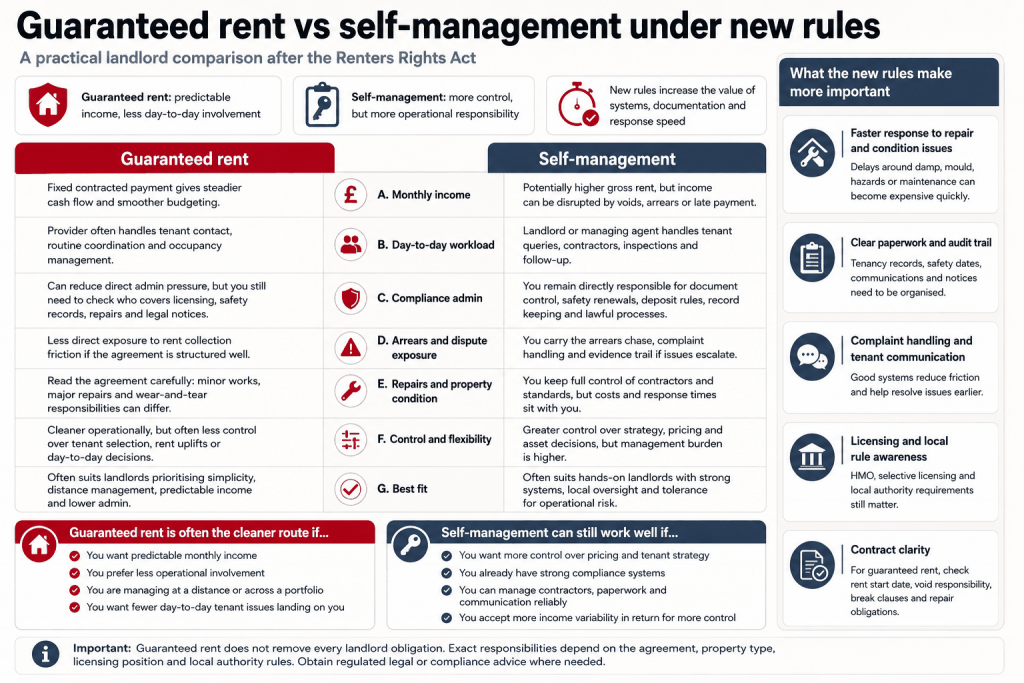
Use the image here to explain risk transfer. Landlords need to see the difference between risk disappearing, which it does not, and risk moving to a provider with systems and margin.
Use the image here to explain risk transfer. Landlords need to see the difference between risk disappearing, which it does not, and risk moving to a provider with systems and margin.
Place a net-income comparison chart here. The section asks landlords to compare the bad month, not the perfect month; the visual should make that comparison hard to ignore.
Place a net-income comparison chart here. The section asks landlords to compare the bad month, not the perfect month; the visual should make that comparison hard to ignore.
Guaranteed rent after the Renters’ Rights Act is not automatically the right answer for every landlord. The Act changed the risk calculation. It removed Section 21 no-fault evictions in England, moved most private tenancies to assured periodic tenancies, banned rental bidding, changed rent-in-advance rules and made written tenancy information more important.
For self-managing landlords, the key problem is not one single new rule. It is the combined pressure of evidence, repair response, rent control process, possession grounds and local enforcement. For a guaranteed rent provider, the same pressure exists – but the question is whether the provider has the systems, margin and contract terms to carry that risk properly.
AMS Housing Group offers guaranteed rent for London landlords with 0% commission, 1-5 year agreements and inspections every 4-6 weeks. This article explains when that risk transfer is valuable and when a landlord should ask harder questions before signing.
What changed on 1 May 2026 for private landlords in England
Official landlord guidance says several major changes took effect on 1 May 2026. Section 21 no-fault evictions have been abolished. Landlords can only evict when they have a specific legally valid possession ground. Fixed-term tenancies have been banned for most private rented sector tenancies, which have become assured periodic tenancies.
Rent increases are now limited to once per year and must follow the new legal process, including at least two months’ notice. Rental bidding is banned, so landlords and agents must publish a specific rent in written adverts and cannot ask for, encourage or accept offers above it. Large rent-in-advance requirements are also restricted.
| Change from 1 May 2026 | Why it matters for landlord risk |
| Section 21 abolished | A landlord needs a valid possession ground and evidence, not a no-fault route. |
| Assured periodic tenancies | Tenancies roll until tenant notice or valid landlord possession process. |
| Rent increases once per year | Market evidence and correct notice become important. |
| Rental bidding banned | Advertised rent must be specific; higher offers cannot be invited or accepted. |
| Written tenancy information | Tenancy paperwork is now a live compliance issue, not optional admin. |
Why guaranteed rent is now a risk-transfer decision, not a rent headline
Before the reforms, many landlords compared guaranteed rent by looking at the monthly figure only. If the provider offered 85-92% of market rent, the landlord asked whether the 8-15% gap was worth it. That question is still relevant, but it is incomplete.
The better question is: what risk moves with that gap? If the provider genuinely covers voids, tenant sourcing, rent collection, routine management, inspections, repair coordination, compliance diaries and possession handling, the gap is paying for risk transfer. If the provider only pays a lower rent and leaves many costs or caps in the small print, the landlord may be paying for less protection than they think.
For the calculation behind the rate, read AMS guidance on how guaranteed rent is calculated before comparing offers purely by monthly income.
| Landlord risk after reforms | Self-managing landlord | Robust guaranteed rent provider |
| Tenant stops paying | Landlord carries arrears and legal process. | Provider pays landlord under the agreement and handles occupant issue. |
| Tenant gives notice suddenly | Landlord carries void and remarketing. | Provider carries occupancy risk during the contract. |
| Repair complaint escalates | Landlord needs evidence and contractors. | Provider needs inspection and repair process. |
| Council asks for documents | Landlord produces compliance file. | Provider should hold and maintain compliance records. |
| Possession needed | Landlord funds and evidences Section 8 claim. | Provider manages and funds process if contract says so. |
The provider systems landlords should check before signing
A guaranteed rent agreement is only as strong as the company behind it. A provider that has no repair system, weak referencing, poor cash flow or vague contract terms can create more risk, not less. The reforms make this more important because possession and complaints depend on evidence.
Landlords should ask operational questions, not just sales questions. How often are inspections carried out? Who pays for routine repairs? What happens with major works? Who handles licensing? What is the procedure for antisocial behaviour? How are rent increases managed with occupants? What happens if the landlord wants to sell?
- Ask for a written sample agreement before committing.
- Check the provider’s trading history and Companies House record.
- Verify redress membership such as the Property Ombudsman or Property Redress Scheme.
- Ask who is responsible for gas, electrical, EPC, alarms, licensing and tenant information.
- Ask how often the property is inspected and what report the landlord receives.
- Avoid offers at or above market rent unless the provider can explain a sustainable model.
How Section 8 evidence changes arrears and possession risk
With Section 21 removed, possession depends on valid grounds and evidence. For arrears, antisocial behaviour, breach, sale or landlord occupation grounds, the file matters. A landlord or provider needs rent ledgers, correspondence, inspection notes, repair records and notices that match the current law.
For guaranteed rent landlords, the attraction is that the provider should be handling the occupant-facing possession problem. The landlord’s bank payment continues if the agreement is drafted and funded properly. But the landlord should still check the contract: does payment continue during legal proceedings, voids and tenant changes? Are any circumstances excluded? Is there an early termination clause?
If you are currently dealing with arrears or an occupant dispute, speak to AMS about eviction support for landlords before taking action.
Repairs, Decent Homes and future enforcement phases
The 1 May 2026 reforms were not the end of the implementation programme. Official guidance says other elements, including the database, ombudsman, Awaab’s Law and the Decent Homes Standard, will be implemented in later phases for the private rented sector. That means landlords need systems that can adapt, not just documents that were correct on one day.
For guaranteed rent, that puts extra weight on inspections and repairs. AMS inspections every 4-6 weeks are not cosmetic. They are the evidence layer: condition, occupancy, repair issues, tenant behaviour and compliance follow-up. A landlord who rarely visits a property may not know about a problem until it has already become a complaint.
When guaranteed rent is likely to be stronger than traditional letting
Guaranteed rent is most likely to make sense where the landlord values income certainty over maximum headline rent, lives far from the property, owns a property in a licensing-heavy borough, has limited time, has already experienced arrears or wants one accountable operator.
The model is especially relevant where one bad tenancy would damage the landlord’s finances. A self-managing landlord may keep more rent in a perfect year, but a perfect year is not the risk test. The test is a year with a void, a boiler problem, a rent dispute and a tenant who will not leave. If the guaranteed rent still arrives, the lower headline rent can be worth it.
| Landlord profile | Why guaranteed rent may fit |
| Overseas landlord | Distance makes inspection, repairs and legal response slower. |
| Portfolio landlord | Risk and admin multiply across properties and boroughs. |
| Accidental landlord | Often lacks systems for compliance and possession. |
| HMO or multi-let owner | Licensing, repairs and tenant turnover are more intensive. |
| Risk-averse landlord | Values same-date income and reduced involvement. |
When a landlord should not choose guaranteed rent
Guaranteed rent is not right for every property. A landlord with a premium property, reliable long-term tenant, strong management skills and no need for fixed income may prefer traditional letting. A landlord planning to sell in the next few months may need flexibility rather than a multi-year agreement.
The red flags are different: a provider that refuses to show the contract, offers full market rent with no clear margin, has no repair process, avoids questions about licensing, or uses vague wording around return condition. The new rules make weak providers more dangerous, because poor evidence and poor response can create legal exposure.
AMS comparison: 85-92% of market rent versus the annual risk bill
AMS guaranteed rent is typically 85-92% of market rate and 0% commission. That means the landlord gives up part of the headline rent. The comparison should be annual, not monthly.
On a £1,800 pcm East London property, an 88% guaranteed rent offer would be £1,584 pcm, or £19,008 a year. Traditional letting at full market rent looks like £21,600 gross, but the landlord still needs to account for voids, management fee, tenant-find cost, repairs, compliance and arrears risk. One two-month void or arrears event can wipe out the apparent gap.
For a property-specific figure, request an AMS guaranteed rent valuation rather than relying on a percentage from another landlord’s property.
AMS reading before signing a guaranteed rent agreement
A landlord should understand the model before comparing rates. Start with how the agreement works, then test whether the annual numbers beat traditional letting.
For the basic model, read AMS guidance on how guaranteed rent works before reviewing any provider contract.
For the value test, compare the article with AMS guidance on whether guaranteed rent is worth it for your property type.
For landlords with several properties, an AMS portfolio review can show which units fit guaranteed rent and which should stay on another route.
The safe decision is based on the contract and the system
The Renters’ Rights Act did not make every guaranteed rent offer good. It made strong systems more valuable and weak systems easier to expose. Landlords should judge the provider, contract and property together.
This article provides general guidance only and is not legal advice. Take qualified legal advice for specific tenancy or possession issues, and speak to AMS if you need a practical comparison between self-management, traditional letting and guaranteed rent.
Frequently asked questions
Does guaranteed rent avoid the Renters’ Rights Act?
No. Guaranteed rent does not avoid the law. It changes who handles the practical risk under the agreement. A provider still needs to comply with tenancy, repair, rent, possession and redress rules in the occupant relationship.
Is guaranteed rent more valuable now Section 21 has gone?
It can be, because possession risk and evidence requirements have increased for landlords. The value depends on whether the provider genuinely pays through voids, arrears and possession issues and has systems to manage the property lawfully.
Can a guaranteed rent provider still remove tenants?
They can only do so through valid legal grounds and the correct process. Section 21 is no longer available in England. Providers need to use reformed possession grounds and obtain a court possession order where required.
What should I ask before signing a guaranteed rent agreement?
Ask about inspection frequency, repair liability, compliance responsibilities, licensing, occupant referencing, payment start date, payment during voids, possession handling, break clauses, return condition and proof of trading history.