The perfect property for you

Is Guaranteed Rent Worth It? Honest Landlord Guide

We can help you​

If you’d like to talk about our services with one of our property experts, please call or email our dedicated lettings team on

Key Takeaways:

  • Guaranteed rent pays a fixed monthly income regardless of voids, arrears, or tenant problems — typically 10-15% below market rent, but often more profitable once real costs are factored in.
  • A typical London two-bed nets around £15,300 per year on guaranteed rent versus £13,040 with a traditional letting agent after voids, fees, and maintenance.
  • The Renters’ Rights Act 2025 abolished Section 21 evictions and introduced new compliance requirements, making self-managing riskier and more expensive than at any point in the last 30 years.
  • Tax treatment is identical whether you self-manage or use guaranteed rent — rental income is taxed the same way, and you can still claim allowable expenses.
  • Guaranteed rent works best for portfolio landlords, overseas owners, HMO landlords, and anyone who wants genuinely passive income without the growing burden of regulation.

A landlord in Lewisham recently told us he spent £8,400 chasing a single eviction over fourteen months. Court fees. Solicitor bills. Lost rent while the property sat occupied by someone who hadn’t paid since February. By the time bailiffs finally changed the locks, his “investment property” had cost him money for over a year.

He’s not unusual. Stories like his are why more London landlords are asking the same question: is guaranteed rent actually worth it, or is it just another scheme that sounds too good on paper?

The honest answer? It depends on your situation. For some landlords, guaranteed rent solves problems they’ve been losing sleep over for years. For others, the trade-offs don’t make sense. This guide breaks down both sides with real numbers, real downsides, and a structured decision framework — so you can work out whether it’s right for you.

Stressed landlord sitting at a desk surrounded by bills and final notice letters

What Is Guaranteed Rent? A Quick Recap

Guaranteed rent is an arrangement where a property company leases your property directly, pays you a fixed monthly rent regardless of occupancy, and handles tenant sourcing, management, and maintenance on your behalf. You receive consistent income; they take on the risk.

It’s not rent guarantee insurance (that’s a completely different product — more on the distinction later). And it’s not “rent to rent” in the negative sense, though the mechanics are similar. It’s a formal company let arrangement backed by a written contract.

For a full breakdown of the mechanics, read our guide on how guaranteed rent works.

The Pros of Guaranteed Rent

Let’s start with why landlords choose guaranteed rent in the first place. These aren’t theoretical benefits — they’re the reasons landlords stay on guaranteed rent schemes for years.

Fixed monthly income, no matter what

This is the big one. Your rent lands in your account on the same date every month. The property could be empty between tenants, the boiler could have exploded, or the tenant could have stopped paying three months ago. None of that affects you. Your payment arrives regardless.

For landlords with mortgages to cover, that predictability isn’t a luxury. It’s a lifeline.

Zero void periods

The average void period in London sits around three to four weeks between tenancies. At current London rents, that’s easily £1,300-£1,800 lost every time a tenant moves out. With guaranteed rent, voids simply don’t exist from your perspective. You’re paid through every gap, every turnover, every quiet patch.

No tenant management headaches

Late-night phone calls about a leak. Chasing rent arrears. Deposit disputes. Neighbour complaints. If you’ve been a landlord for any length of time, you know how draining day-to-day management gets. Under a guaranteed rent arrangement, the provider handles all tenant communication, issues, and disputes. That includes the entire eviction process if it ever comes to that — and given how drawn out evictions have become post-Section 21, that alone can justify the trade-off.

Maintenance and repairs handled

Most guaranteed rent providers — including AMS — cover routine maintenance and repairs as part of the agreement. No surprise plumber bills at 7am on a Saturday, no haggling with contractors, and no worrying about whether the extractor fan meets current regulations. These ongoing landlord costs add up far more quickly than most landlords expect, and they’re easy to underestimate until they’re staring at you from a bank statement.

Compliance and licensing managed for you

Between gas safety certificates, electrical installation condition reports, EPC requirements, HMO licensing, and landlord licensing obligations in selective licensing boroughs, the compliance burden on landlords grows heavier every year. A good guaranteed rent provider takes this off your plate entirely, making sure your property stays legally compliant without you having to track deadlines or book inspections.

Eviction risk eliminated

Evicting a non-paying tenant in England currently takes an average of 8-14 months through the courts. Legal costs can run from £2,000 to well over £10,000 depending on complexity. Under guaranteed rent, that financial risk sits with the provider, not you. You keep getting paid while they handle the problem.

The Cons of Guaranteed Rent (Being Honest)

No arrangement is perfect. Here’s where guaranteed rent falls short, and why it won’t suit every landlord.

You earn 10-20% below market rent

This is the trade-off at the heart of guaranteed rent. If your property would fetch £1,500 per month on the open market, a guaranteed rent provider might offer you £1,250-£1,350. That gap is how they cover their risk — voids, problem tenants, maintenance, and their own operating costs. For a detailed look at the pricing, see our guide on how much guaranteed rent costs.

Whether that reduction is “worth it” depends entirely on what you’d actually net after all your costs as a self-managing landlord. We’ll run those numbers properly in the next section.

Less control over your property

You won’t choose the tenants. You won’t decide when to redecorate or which contractor fixes the tap. For landlords who take pride in hands-on property management and want to vet every applicant personally, this loss of control can feel uncomfortable. The property is still yours, but someone else is running it day-to-day.

Locked into a contract

Most guaranteed rent agreements run for one to five years. That’s fine when things are going well, but if your circumstances change — you want to sell, move back in, or switch to short-term lets — you’re committed for the contract duration. Always read the exit clauses carefully before signing.

Not all providers are equal

The guaranteed rent market includes established companies with fifteen-plus years of track record alongside operators who appeared last Tuesday. Some bury fees in the small print. Others promise market-rate rents they can’t sustain, then go under eighteen months later — leaving landlords stranded. We’ve written about several myths about rent guarantees that stem from bad providers giving the model a poor reputation.

Your property must meet minimum standards

Guaranteed rent providers won’t take on a property that’s falling apart. Most require the property to be in reasonable, lettable condition before they’ll sign an agreement. If your property needs a new kitchen, rewiring, or damp treatment, you’ll need to invest first. That said, some providers (including AMS) carry out minor works as part of onboarding.

Guaranteed Rent Pros vs Cons infographic

The Maths: Is Guaranteed Rent Actually Worth It Financially?

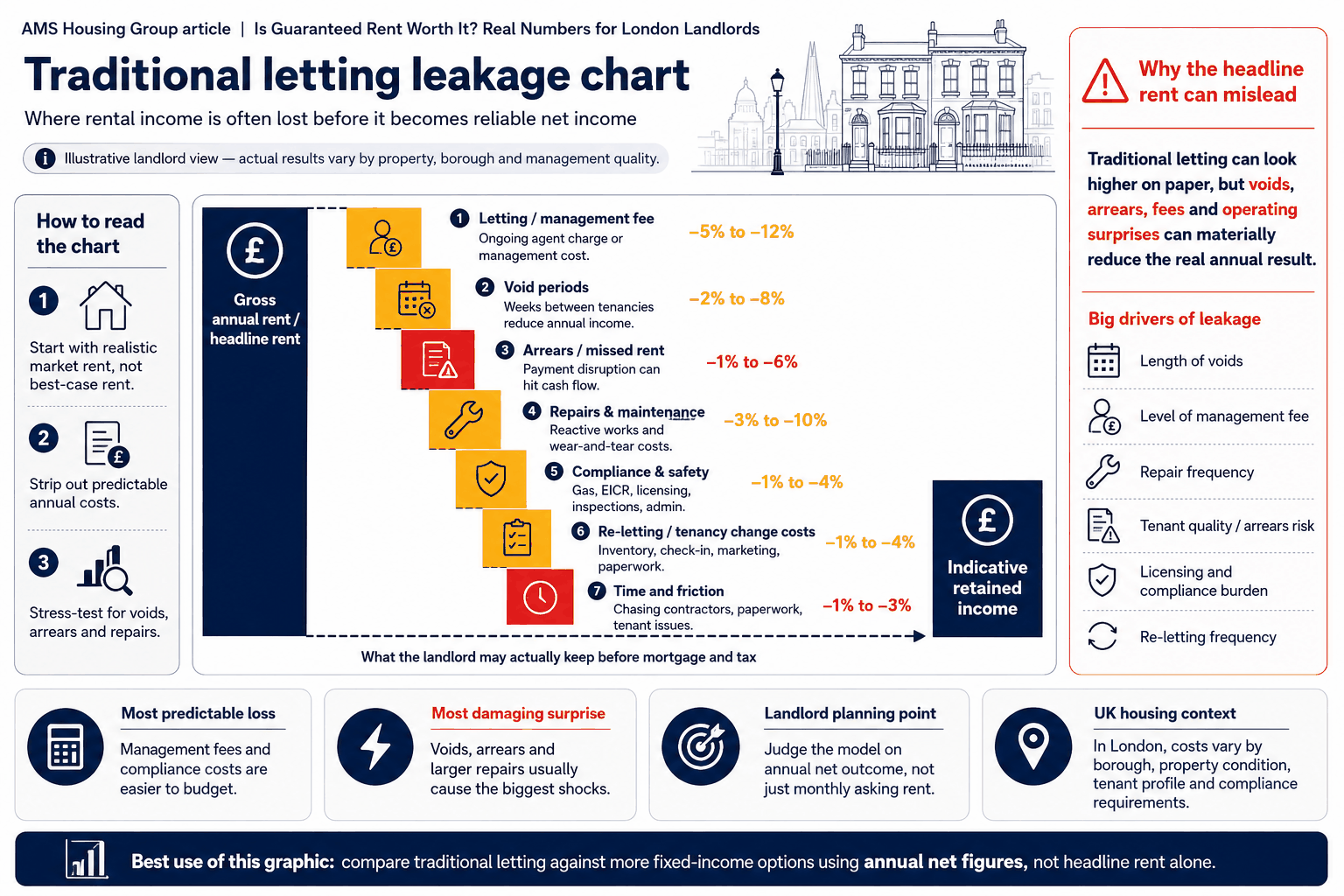
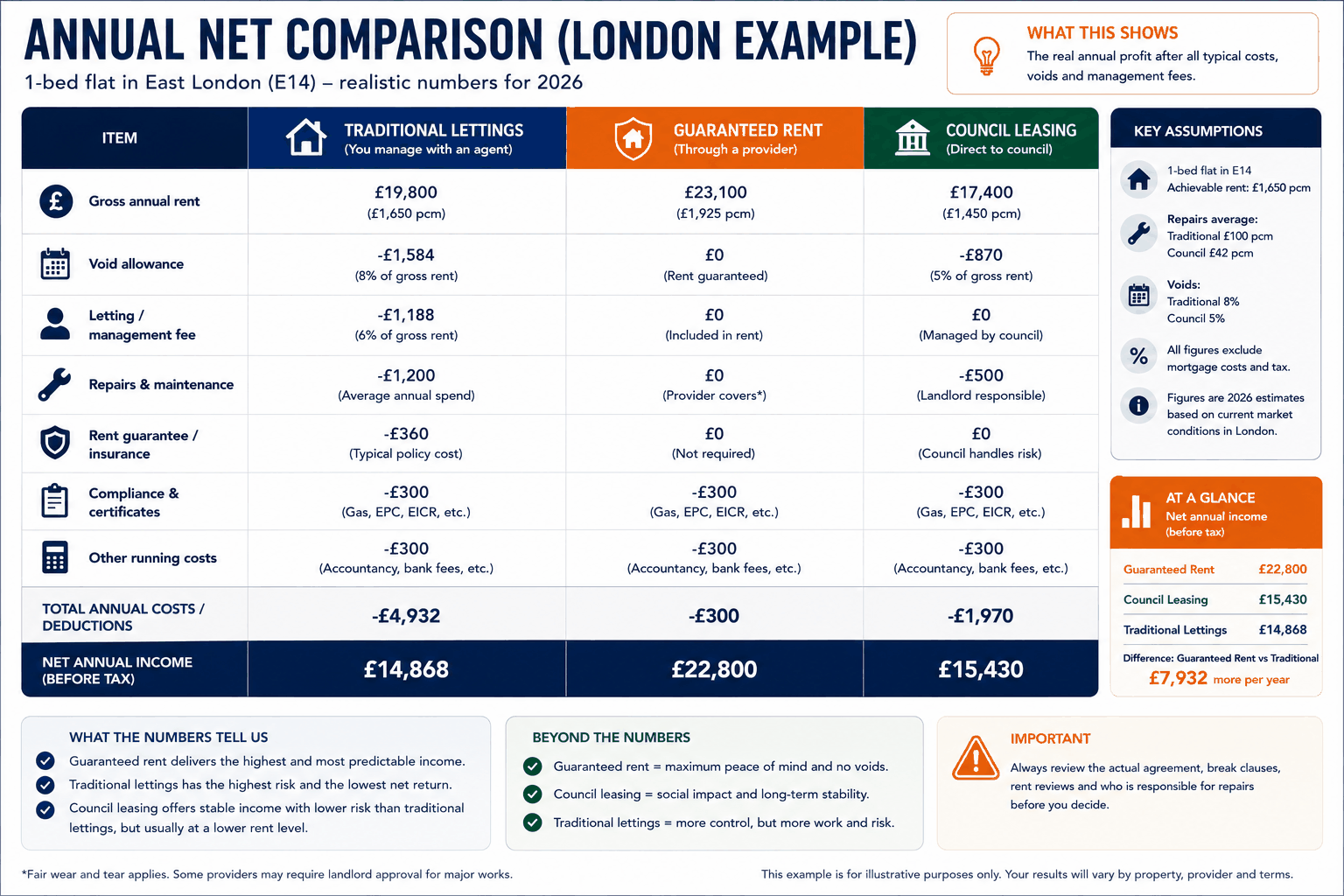
This is the section that matters most, because “is it worth it?” is fundamentally a financial question. Let’s compare a typical London two-bedroom flat over a full year.

Scenario: Traditional letting with a letting agent

ItemAnnual Cost/Income
Market rent (£1,500/month x 12)£18,000
Letting agent fees (12% of rent)-£2,160
One month void period-£1,500
Maintenance and call-outs-£800
Compliance costs (gas cert, EICR, EPC)-£500
Net annual income£13,040

And that’s a good year. No problem tenants. No eviction. No major repairs. Just one month empty and routine costs.

Scenario: Guaranteed rent

ItemAnnual Cost/Income
Guaranteed rent (£1,275/month x 12)£15,300
Agent fees£0
Void periods£0
Maintenance£0
Compliance£0
Net annual income£15,300

Read those numbers again. The guaranteed rent rate is £225 per month lower — and yet the landlord nets £2,260 more over the year.

That’s because the monthly rate tells you almost nothing on its own. What matters is what actually lands in your bank account after twelve months of real-world landlording. Voids, fees, repairs, and compliance eat into the higher headline rent far more than most landlords expect.

What a bad year looks like

Now imagine your tenant stops paying in month six. The eviction takes ten months. You’re paying the mortgage out of your own pocket the entire time while receiving nothing. You’ve still got insurance premiums, compliance costs, and a solicitor’s bill for £4,000.

In that scenario, your net income for the year could easily be negative. Suddenly that guaranteed rent contract isn’t just “worth it” — it’s the difference between staying solvent and selling the property at a loss.

For a deeper look at the factors that affect your guaranteed rent offer, see our breakdown of how guaranteed rent is calculated.

Guaranteed Rent vs Traditional Letting: Full Comparison

Since the comparison between guaranteed rent and traditional letting is central to deciding whether it’s worth it, here’s a side-by-side breakdown covering every factor that matters.

FactorGuaranteed RentTraditional Letting (with Agent)Self-Managing
Monthly incomeFixed, 10-15% below marketMarket rate minus agent feesFull market rate
Void periodsCovered — you’re paid regardlessYou absorb the cost (avg 3-4 weeks/year)You absorb the cost
Arrears riskNone — provider bears all riskYou chase, or agent chases at extra costYou chase (and pay legal fees)
MaintenanceIncluded in most schemesYou pay, agent may coordinateYou pay and coordinate
ComplianceProvider handles everythingAgent may advise, you’re still liableEntirely your responsibility
Tenant sourcingProvider handlesAgent handles (tenant-find fee applies)You handle (advertising, referencing)
Eviction costsProvider’s problemYour problem (£2,000-£10,000+)Your problem
Control over tenantsNone — provider selectsSome input, agent recommendsFull control
Contract flexibility1-5 year termsRolling or annualNo contract
Hands-on time requiredNear zeroLow-moderateHigh

The pattern is straightforward. Traditional letting gives you higher headline income and more control. Guaranteed rent gives you lower headline income but removes virtually all risk and time commitment. Self-managing gives you maximum income potential but demands the most from you personally.

Which approach wins depends on your priorities, your risk tolerance, and how you value your time. A landlord earning £80,000 in their day job who spends eight hours a month managing a rental isn’t really saving money by self-managing — they’re working a second job at below minimum wage.

Guaranteed Rent vs Rent Guarantee Insurance

These two products sound similar but work very differently, and confusing them is a costly mistake.

Guaranteed rent is a full-service arrangement. A company leases your property, pays you every month, and manages everything. You have one relationship: with the provider.

Rent guarantee insurance is an insurance policy. You find tenants, manage the property, and handle everything yourself. If a tenant stops paying, you make a claim. After a waiting period (typically 2-3 months of arrears), the insurer reimburses lost rent — up to a cap, for a limited period.

Insurance doesn’t cover void periods between tenancies. It doesn’t cover maintenance. It doesn’t manage your property. And making a claim doesn’t happen overnight — you’ll still be out of pocket for months before any money arrives.

For most landlords, guaranteed rent is the more comprehensive solution. If you’re weighing the two options, our rent guarantee insurance guide walks through exactly how insurance policies work and where they fall short.

Tax Implications of Guaranteed Rent

Landlords regularly ask whether guaranteed rent changes how their income is taxed. The short answer: it doesn’t.

HMRC treats guaranteed rent the same as any other rental income. You declare it on your self-assessment under property income and pay tax at your marginal rate. You can still claim allowable expenses — mortgage interest relief (basic rate credit), buildings insurance, ground rent, service charges, and accountancy fees. The main difference is that expenses like maintenance, agent fees, and compliance costs are already absorbed by your provider, so your return is simpler.

Capital gains tax is unaffected when you sell. And if you own through a limited company (increasingly common since the Section 24 changes), the guaranteed rent is treated as trading income with corporation tax at the standard rate. The company let structure pairs well with guaranteed rent — the provider becomes your company’s tenant on a commercial lease.

Speak to a qualified accountant about your specific position, but the headline point stands: guaranteed rent doesn’t create tax complications.

Mortgage Lender Attitudes to Guaranteed Rent

Will your mortgage lender accept a guaranteed rent arrangement? In most cases, yes.

The legal structure behind guaranteed rent is a company let — the provider becomes your tenant under a company lease. Most buy-to-let lenders are comfortable with this. Some older mortgage products specifically require an AST (Assured Shorthold Tenancy) with an individual tenant, but you can usually request consent for a company let with a quick call to your lender. Many standard terms already permit it.

Some lenders actually prefer guaranteed rent because a company tenant on a multi-year lease looks lower risk than an individual on a periodic tenancy. Consistent rent means consistent mortgage payments, which is what lenders care about most. At AMS, we regularly provide lender-ready documentation and have dealt with most major buy-to-let lenders.

What Happens at the End of a Guaranteed Rent Lease?

This is a question that doesn’t get enough attention. Most articles about guaranteed rent focus on signing up and forget about what happens when the agreement ends.

Option 1: Renew the agreement. If you’re happy with the arrangement, most providers will offer a renewal. Your guaranteed rent figure may be renegotiated to reflect current market conditions — sometimes up, sometimes down. Longer renewal terms often attract better rates.

Option 2: Take the property back. At the end of the lease, the provider returns the property to you. This is where contract terms matter. Your agreement should specify the condition the property must be returned in. Look for clauses covering:

  • A condition report (with photos) taken at the start and end of the lease
  • Responsibility for wear and tear versus damage
  • Cleaning and decoration standards on handover
  • Timeframe for the provider to vacate and remove any remaining tenants

Option 3: Switch to traditional letting. Some landlords use guaranteed rent for three to five years while they’re busy with other commitments, then switch to self-managing or using a letting agent when their circumstances change.

The critical point: read the end-of-lease terms before you sign, not when the agreement is about to expire. A good provider will return the property in fair condition, accounting for normal wear and tear. A bad one might hand back a property that needs thousands in repairs. This is another reason why choosing the right provider matters so much.

When Guaranteed Rent Is Worth It

Guaranteed rent isn’t for every landlord, but certain situations make it a clear winner.

You own multiple properties. Managing one rental is manageable. Managing four or five across different boroughs while holding down a day job is a different story. Guaranteed rent lets you scale a portfolio without scaling your workload.

You live far from your rental property. Whether you’re based overseas or on the other side of London, distance turns every small problem into an expensive one. A midnight call about a burst pipe is stressful enough when you live ten minutes away. From Dubai or Manchester, it’s a nightmare. Guaranteed rent removes the need to be local.

You value predictability over maximum returns. Some landlords would rather know they’re receiving £1,275 every month than gamble on £1,500 some months and nothing in others. If your financial planning depends on consistent income, guaranteed rent delivers that certainty.

You’re tired of tenant problems. Late payments, property damage, noise complaints, relationship breakdowns that turn a clean tenancy into a messy eviction. If you’ve had enough, guaranteed rent hands all of that to someone else.

You own an HMO. Multi-tenant properties involve more complexity: mandatory licensing, fire safety requirements, room size regulations, and multiple tenancy agreements running on different cycles. Guaranteed rent on an HMO property simplifies all of that and removes the management burden that makes HMOs so time-intensive.

You want protection from new regulations. The Renters’ Rights Act introduced significant new landlord responsibilities. If navigating the PRS Database, updated eviction grounds, and rolling periodic tenancies sounds like a headache you’d rather avoid, guaranteed rent puts a professional team between you and the regulatory burden.

Happy landlord relaxing on a sofa while checking rent payment on his phone

When Guaranteed Rent Might NOT Be Worth It

Being honest means acknowledging that guaranteed rent isn’t the right fit for everyone.

You genuinely enjoy managing your property. Some landlords find satisfaction in choosing tenants, maintaining their property to a high standard, and building direct relationships with tenants. If property management is something you enjoy rather than endure, guaranteed rent removes the parts you like.

Your property is in a premium area with very high demand. If you own a flat in Kensington that lets within 48 hours every time it’s listed, and your tenants are professionals who never miss a payment, the 10-15% discount might genuinely cost you more than self-managing. The maths shifts when void risk and tenant risk are both very low.

You only plan to rent for six to twelve months. Guaranteed rent contracts typically start at one year minimum. If you’re planning to sell, renovate, or move back in within months, a short-term let or traditional agency arrangement gives you more flexibility.

You want maximum control over tenant selection. Under guaranteed rent, the provider selects and vets tenants. If having final say over who lives in your property is non-negotiable for you, this arrangement won’t satisfy that need.

You have a premium, high-yielding single property. If you own one property in a location where demand never drops and tenants queue up, the guaranteed rent discount may not be offset by risk reduction. Run the numbers for your specific situation before deciding.

Your Decision Framework: A Structured Way to Decide

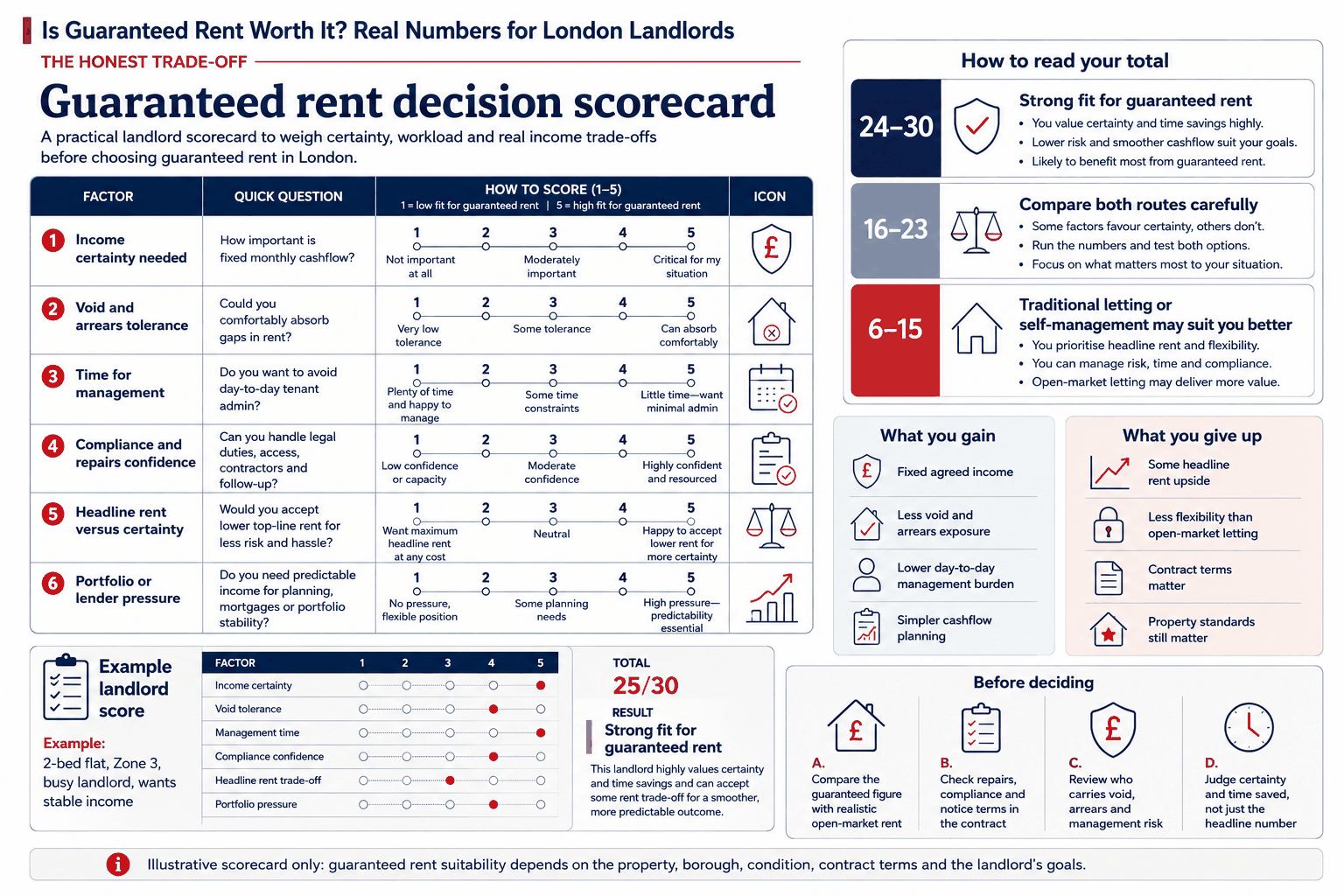
Rather than leaving you with “it depends,” here’s a practical framework. Score yourself on each factor, then see where you land.

Factor 1: How many properties do you own?
One property with a reliable tenant history = lower need. Two or more properties, or one property with a patchy tenant history = stronger case for guaranteed rent.

Factor 2: How close do you live to your rental?
Within 30 minutes = manageable. Different city or country = strong case for guaranteed rent.

Factor 3: How much time can you commit?
Happy spending 5-10 hours a month on property management = self-managing works. Want zero involvement = guaranteed rent.

Factor 4: What’s your risk tolerance?
Comfortable absorbing a £5,000-£15,000 hit from a bad tenancy = traditional letting is viable. That kind of loss would cause serious financial stress = guaranteed rent provides the safety net you need.

Factor 5: How do you feel about the new regulations?
Confident navigating the new landlord rules, PRS Database registration, and updated compliance standards = self-managing remains an option. Overwhelmed or unsure = guaranteed rent handles it for you.

If you answered in favour of guaranteed rent on three or more factors, it’s almost certainly worth exploring. Request a free valuation to see what your property would earn, and make the decision with real numbers in front of you.

Why 2026 Changes the Equation

If you’ve been sitting on the fence about guaranteed rent for years, 2026 is the year the landscape shifted underneath you.

The Renters’ Rights Act 2025 brought the most significant changes to England’s private renting sector in a generation. The headline change — abolishing Section 21 “no-fault” evictions — means landlords can no longer serve two months’ notice and wait for a tenant to leave. Every eviction now requires grounds, evidence, and a court order.

In practice? If your tenant stops paying, you need to demonstrate at least three months of arrears before you can begin possession proceedings. Factor in four months’ notice, court backlogs stretching beyond twelve months, and the cost of legal representation — and a single problem tenant can cost you £10,000-£20,000 and over a year of lost income.

The Act also introduced new compliance requirements. Landlords must register with a Private Rented Sector Database and meet updated property standards. Fines reach £7,000 for a first offence and £40,000 for repeat breaches.

For landlords who were previously content self-managing, this regulatory shift tips the balance firmly towards guaranteed rent. When a single bad tenancy can cost this much, paying 10-15% below market rent for complete protection starts looking less like a compromise and more like common sense.

For a deeper look at what the Act means for guaranteed rent specifically, read our full analysis of guaranteed rent and the Renters’ Rights Act.

How to Choose the Right Guaranteed Rent Provider

Not all guaranteed rent companies are built the same. Choosing the wrong provider can be worse than not using one at all. Here’s what separates the reliable from the risky.

Track record and longevity. How long have they been operating? A company that’s been paying landlords reliably for ten-plus years is a very different proposition from one that launched last year. Ask for references. Check Companies House.

Transparent contracts. Read every clause. What happens if you want to exit early? Are there hidden fees for inspections, tenant changeovers, or “administration”? A reputable provider has nothing to hide.

What’s genuinely included. Does the guaranteed rent cover maintenance, compliance, and tenant management — or just the rent itself? Some providers charge separately for repairs or pass on compliance costs. Compare like for like.

Financial stability. The model only works if the provider can afford to keep paying you when properties are empty. Ask about their financial reserves and portfolio size. A company managing 500+ properties has the diversification to absorb losses that would sink a smaller operator.

Local market knowledge. A provider who knows London inside out will price your property accurately and find tenants quickly. Generic national providers often lack the local expertise that makes guaranteed rent work.

For a full checklist, read our guide on choosing a guaranteed rent provider. And if you’re weighing up whether council leasing might be a better fit, we’ve covered that too.

Frequently Asked Questions

Is guaranteed rent a scam?

No. Guaranteed rent is a legitimate, well-established business model used across London and the UK. However, like any industry, disreputable operators exist. The key is choosing a provider with a proven track record, transparent contracts, and financial stability. AMS Housing Group has been operating since 2009, manages over 500 properties, and holds membership of the Property Ombudsman.

How much less than market rent will I get?

Typically 10-15% below current market rent. The exact figure depends on your property’s location, condition, size, and the length of contract you agree to. Longer contracts (3-5 years) often attract higher guaranteed rents because they give the provider more certainty. You can get a specific figure for your property through a free valuation.

Can I end a guaranteed rent agreement early?

This depends on your contract. Most agreements include break clauses or early termination provisions, though there may be notice periods or fees involved. Always negotiate these terms before signing. At AMS, we start with a minimum twelve-month commitment and build flexibility into renewals.

Is guaranteed rent better than rent guarantee insurance?

They solve different problems. Rent guarantee insurance reimburses you after a tenant stops paying — but only after a waiting period (typically 2-3 months of arrears), and it doesn’t cover void periods, maintenance, or management. Guaranteed rent prevents the problem entirely: you’re paid every month regardless. For most landlords, it’s far more comprehensive. We’ve written a detailed comparison in our rent guarantee insurance guide.

What happens if the guaranteed rent company goes bust?

This is a legitimate concern and exactly why provider selection matters. If a guaranteed rent company fails, you’d need to reclaim your property and find new tenants or a new provider. Protect yourself by choosing an established company with strong financials, a large portfolio, and a long operating history.

Do I still need landlord insurance with guaranteed rent?

Yes. Guaranteed rent covers your rental income and day-to-day property management, but you still need buildings insurance as a minimum. Landlord insurance covers structural damage, liability claims, and other risks that sit outside the scope of a guaranteed rent agreement. Your mortgage lender will almost certainly require it regardless.

Is guaranteed rent worth it for HMOs?

Often, yes — and arguably more so than for standard lets. HMOs involve more tenants, more compliance requirements (mandatory licensing, fire safety, room size regulations), and more management complexity. Guaranteed rent on an HMO hands all of that to the provider while giving you fixed income from a property type that would otherwise demand significant time and expertise.

Is guaranteed rent taxable?

Yes. Guaranteed rent is treated as rental income by HMRC, exactly the same as rent received directly from a tenant. You declare it on your self-assessment tax return and pay income tax at your marginal rate. You can still claim allowable expenses like mortgage interest relief (at the basic rate), buildings insurance, and accountancy fees.

Still Not Sure? Get a Straight Answer

The only way to know whether guaranteed rent makes financial sense for your property is to see an actual figure. Not a range. Not a “typical” estimate. A real number based on your specific property, location, and condition.

AMS Housing Group has been providing guaranteed rent across London since 2009. We manage over 500 properties, we pay on time every month, and we don’t charge commission or hidden fees. If guaranteed rent isn’t the right fit for your situation, we’ll tell you that too.

Request a free, no-obligation property valuation and we’ll show you exactly what your property could earn on a guaranteed rent agreement. No pressure, no hard sell — just the numbers.

Or call our team directly on 020 3793 2247 to talk it through.

We'll rent your property

Related Posts

AMS Housing Group is a confident team of property management professionals, delivering a 360 degree approach to lettings, to make a positive difference to an asset and landlord experience.