
Key takeaways
- Property management can include tenant sourcing, referencing, tenancy setup, rent collection, inspections, repairs, compliance and reporting.
- Landlords should ask what is included, what costs extra, who approves repairs and how quickly arrears are escalated.
- The 2026 reforms make evidence, written tenancy information and fair rent-advertising processes more important.
- Full management still usually leaves void and arrears risk with the landlord; guaranteed rent changes that risk transfer.
- A good service should protect annual net income, not just quote the lowest monthly management fee.
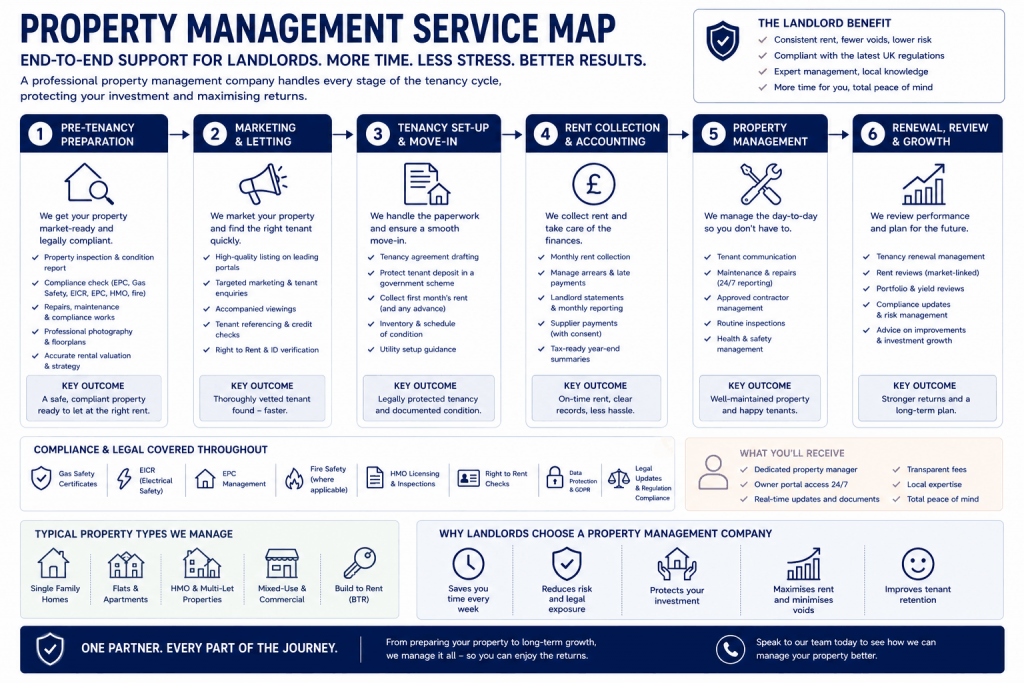
A property management company can do far more than collect rent. The best firms manage the full tenancy cycle: pricing, marketing, tenant checks, tenancy setup, deposits, repairs, inspections, compliance, arrears, reporting and advice.
For London landlords, the useful question is not whether a company offers “management”. It is what that word includes. Some agents collect rent and forward emails. Others run inspections, contractors, compliance diaries and arrears escalation. AMS property management is built around routine records, landlord communication and practical control of the property.
This guide explains the work a landlord should expect, how to compare service levels and where guaranteed rent changes the risk entirely.
The work before a tenant moves in
Good management starts before the advert goes live. The manager should check the property can legally be let, prepare the compliance file, advise on rental value, arrange photography, write the advert, handle enquiries and filter applicants fairly.
From 1 May 2026, written adverts must include an asking rent and landlords cannot encourage or accept bids above it. That makes the valuation process more important. A rushed rent figure can weaken the whole tenancy.
Tenant selection should include identity, affordability, references, Right to Rent and property suitability. If the property is in a licensing-heavy borough, the manager should check occupancy limits before viewings begin.
Rent collection, arrears and communication
Rent collection should not be passive. The manager should know when rent is due, when it has landed, when it is late and what the escalation process is. Day-one arrears communication is not aggressive; it is disciplined record keeping.
Landlords should receive clear statements and quick updates on problems. If a tenant stops paying, the file should already contain the tenancy terms, rent schedule, deposit evidence, repair records and communication history. That is the evidence a landlord needs if the issue later moves into a Section 8 route.
Ask how arrears are handled, who sends formal letters, when legal advice is sought and whether the agent has authority to agree payment plans.
Repairs, inspections and contractor control
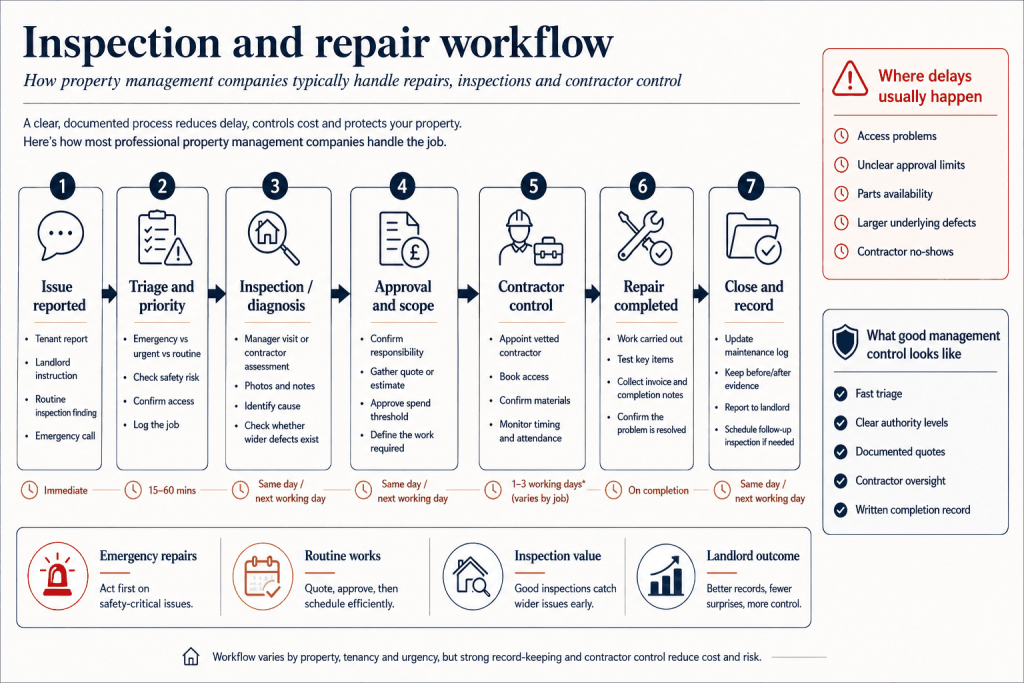
Repairs are where many management services succeed or fail. A good manager triages repair reports, uses qualified contractors, checks urgent risks quickly and keeps the landlord updated before costs spiral. A poor manager simply forwards tenant messages and leaves the landlord to decide under pressure.
Routine inspections protect condition and evidence. They should check damp, ventilation, alarms, leaks, unauthorised occupants, garden condition, waste storage, pets and general care of the property. The inspection report should be useful, not a tick-box exercise.
AMS routine inspections are typically every 4-6 weeks under managed arrangements, which helps identify repair and compliance issues before they become disputes.
Compliance and legal record keeping
Compliance is not a one-day task at move-in. Gas safety, electrical safety, EPC, deposit protection, Right to Rent, alarm tests, licensing, written tenancy information and repair records all need dates, copies and reminders.
GOV.UK landlord guidance makes clear that landlords must keep properties safe, provide an EPC, protect deposits and check Right to Rent in England. A property manager can help administer that system, but the landlord should know exactly what the agreement covers.
In London, licensing varies by borough. The manager should not assume a property is exempt because it is a normal family home.
Choosing the right service level
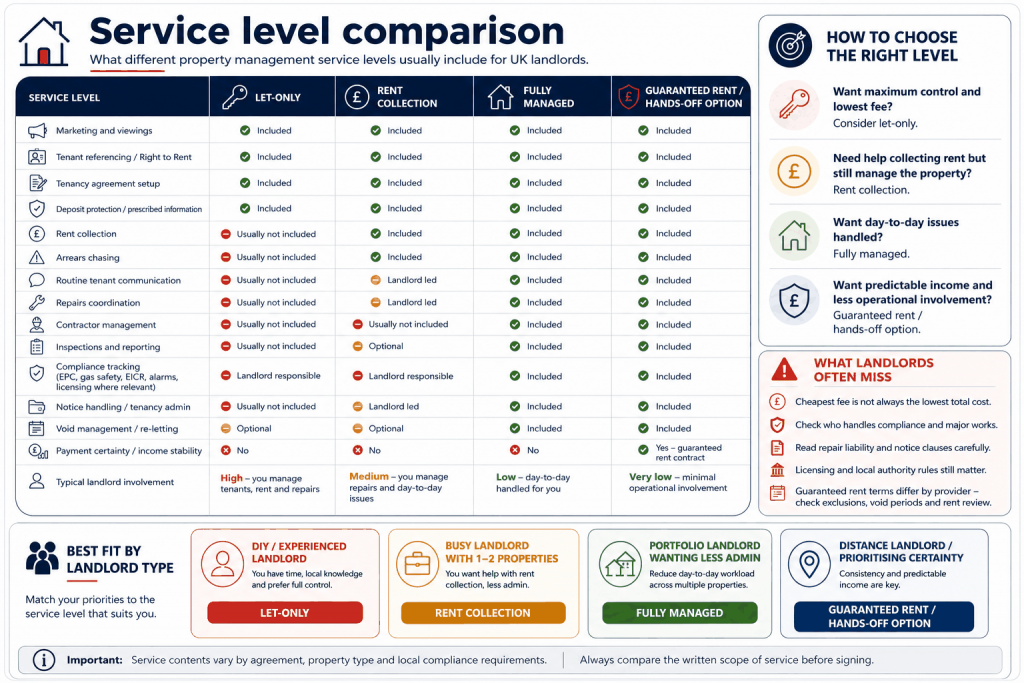
Let-only can work for experienced landlords who only need a tenant found and paperwork prepared. Rent collection can suit landlords who want payment admin but still handle repairs themselves. Full management is better where the landlord wants tenant communication, repairs, inspections and compliance admin handled by a professional.
Guaranteed rent is a different choice. The landlord accepts a fixed rent below market level in exchange for predictable income and lower operational involvement. It is especially useful for landlords who care more about certainty than squeezing every pound of gross rent.
Compare lettings support for landlords, full property management in London and AMS guaranteed rent service on annual net income, not just monthly fees.
The questions landlords should ask before appointing a manager
Ask who deals with emergency calls, who approves repairs, whether contractor markups apply, how often inspections happen, who monitors licence dates, how arrears are escalated, how often statements are issued and what happens if the tenant refuses access.
The right answer is written into the management agreement. The wrong answer is “we usually handle that”. If it is not in writing, assume it may cost extra or remain with the landlord.
Fees, add-ons and the true cost of management
A management fee is only the visible part of the cost. Landlords should check tenant-find charges, renewal charges, inspection charges, contractor markups, check-out fees, account statement fees and whether compliance reminders are included. A low monthly percentage can still produce a high annual bill.
The comparison should be made over a full year. If the rent is £1,800 per month, a 12% plus VAT management fee is not small. Add a tenant change, a void, a repair markup and a renewal charge, and the true cost may be much higher than the advert suggests.
AMS content should push landlords to compare annual net income and service quality, not one headline percentage.
London borough knowledge as part of the service
A property manager working in London needs licensing knowledge. Selective and additional licensing schemes vary by borough and can change. A manager who misses a licence check can expose the landlord to enforcement, repayment claims and problems serving notices.
Ask whether the manager checks licensing by postcode, not by general borough reputation. A street-level check is safer than a broad answer. This is especially important for properties in Newham, Barking and Dagenham, Waltham Forest, Redbridge, Brent, Ealing and Haringey.
Borough knowledge also affects contractor response, rent valuation, tenant demand and repair expectations. London management is not a national call-centre task.
How to audit an existing managing agent
Landlords already using an agent should not wait for a crisis before checking the service. Ask for the current compliance file, last inspection report, repair history, rent ledger, arrears notes, deposit evidence, licence check and contractor invoices. A good agent can provide them quickly. A weak agent may send fragments.
Then compare the agreement with the service actually delivered. Are inspections happening at the promised frequency? Are repairs followed up? Are statements clear? Are renewal or admin charges still being applied where the work no longer reflects the 2026 tenancy structure?
This audit often reveals whether the problem is the property or the management model. A landlord considering sale after a bad tenancy may discover the property is still strong but the management process is failing.
The service line that decides value
The most useful line in a management agreement is often not the fee. It is the responsibility line. If the manager is responsible for keeping the compliance diary, arranging inspections and escalating arrears, the landlord is buying protection as well as admin. If the agreement only says the agent will collect rent and pass messages on, the landlord still carries most of the work.
Before appointing any manager, ask for a sample monthly statement, sample inspection report and sample repair update. Those documents show how the service works when nobody is selling it.
Service comparison
| Route | Best fit | Main risk retained |
| Let-only | Landlord wants help finding and setting up a tenant | Repairs, inspections, arrears and compliance diary |
| Full management | Landlord wants day-to-day tenant and repair support | Void, major works and some legal risk |
| AMS guaranteed rent | Landlord wants fixed income and fewer calls | Lower headline rent than open market, but stronger certainty |
FAQs
Do property managers handle repairs?
A full management service usually coordinates repairs, but landlords should check approval limits, contractor markups and emergency process.
Does property management include compliance?
It should include compliance reminders and record handling where agreed, but exact responsibility must be written into the agreement.
Do property managers collect rent?
Most full management and rent collection services collect rent and issue statements; let-only services usually do not.
Is guaranteed rent a property management service?
It is a fixed-income property arrangement that includes management responsibilities, but it is not the same as a percentage-fee management service.
How should landlords choose?
Compare annual net income, time saved, risk transferred, repair process, inspection frequency and local licensing knowledge.
Speak to AMS before you commit
If this decision affects rent, compliance, sale timing or tenant risk, speak to AMS Housing Group before committing. AMS is based at 29 Longbridge Road, Barking IG11 8TN and works across all 33 London boroughs and Essex. Call 020 3793 2247 or use the valuation enquiry route to compare the numbers for your own property.