
Key takeaways
- Guaranteed rent is not an insurance claim; it is a property agreement that pays the landlord a fixed monthly amount.
- A credible offer is normally below market rent because the provider is funding void, arrears, management and operational risk.
- The valuation should check condition, certificates, licensing, local demand and likely repairs before a figure is agreed.
- The contract should explain rent review dates, repair responsibilities, inspections, handback condition and break clauses.
- After the 2026 reforms, the value of strong records and evidence-led management has increased because landlords can no longer rely on Section 21.
Guaranteed rent works by replacing uncertain tenant income with a fixed contractual payment to the landlord. The provider pays an agreed monthly rent, manages the property and takes on the operational risk of occupancy, arrears and many day-to-day tenant issues.
For London landlords, the point is not simply that the monthly figure is lower than open-market rent. The point is whether the annual outcome is stronger once voids, arrears, management fees, inspections, compliance time and legal risk are included. AMS guaranteed rent is usually offered at 85-92% of market rent with 0% commission, depending on property condition, location and contract terms.
This guide explains the model in practical terms, using the questions landlords should ask before signing. It gives general information only and is not legal or financial advice.
The basic guaranteed rent model
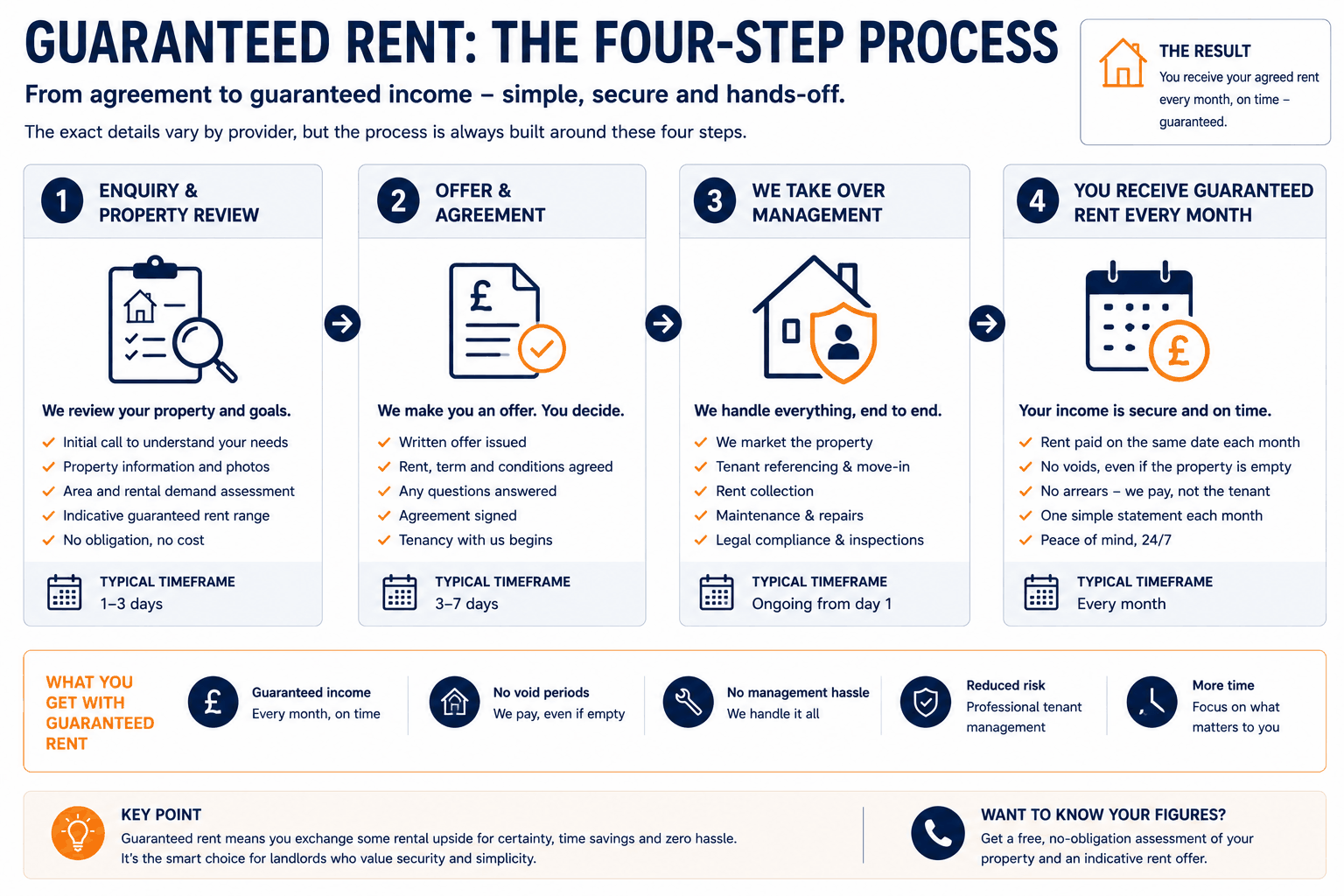
The structure is simple. The landlord enters into an agreement with a provider. The provider pays the landlord the agreed rent every month and then manages the property, occupants and day-to-day operations. In a professional model, the landlord is paid according to the agreement, not according to whether an occupier has paid on time.
This is different from traditional letting. With a letting agent, the landlord usually keeps the full market-rent upside but still carries voids, arrears, repairs, certificate renewals and legal escalation. With guaranteed rent, the landlord accepts a lower fixed figure to remove much of that operational uncertainty.
The model only works when the risk is priced honestly. A provider promising above-market rent with no explanation of repairs, voids, inspections or compliance should make a landlord cautious. A genuine offer should be able to show how the rent was calculated and what is included.
What happens before an offer is made
A good guaranteed rent offer starts with the property, not a generic percentage. The provider should review likely market rent, location, demand, EPC position, gas and electrical records, licence status, repair condition, layout, access and whether the property is suitable for the intended occupancy route.
In Barking, Ilford, Dagenham and Waltham Forest, two properties with the same bedroom count can produce different guaranteed rent offers because one may need licensing, one may have stronger transport demand and one may need repair work before occupation. That is why a valuation should be carried out before a landlord relies on an online range.
Landlords should expect questions. A provider that does not ask about certificates, mortgage or lease restrictions, condition, previous arrears or local authority issues is not really assessing risk. Those details decide whether the arrangement will run smoothly.

What AMS manages during the contract
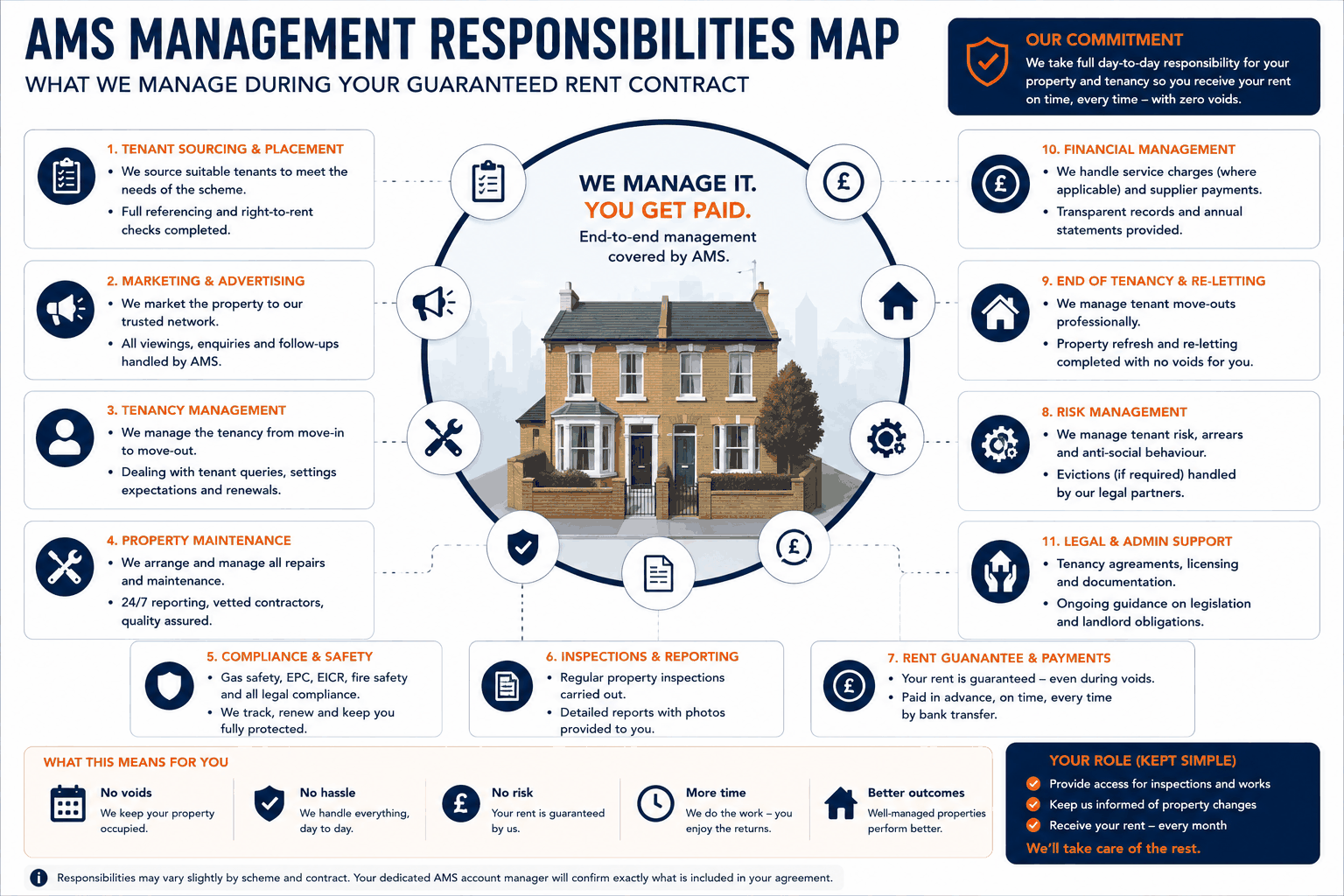
A guaranteed rent agreement should make management responsibilities clear. Under AMS managed arrangements, the practical work can include tenant sourcing, occupancy management, rent handling, inspections, repair coordination, contractor control, compliance diary support and communication with occupants.
The landlord still needs to understand the agreement. Major structural works, mortgage restrictions, leasehold consent and ownership decisions cannot be ignored. But the day-to-day burden shifts away from the landlord, which is why the model appeals to overseas landlords, portfolio owners and landlords who have had difficult tenancies.
The strongest protection is routine management. AMS inspections are typically every 4-6 weeks, which helps catch repairs, occupancy changes and document issues before they become expensive.
IMAGE SLOT – AMS management responsibilities map infographic
| Suggested filename | understanding-how-guaranteed-rent-works-image-3.webp |
| Alt text | AMS management responsibilities map for how does guaranteed rent work – AMS Housing Group |
| Placement note | Insert the already-created image here. This section has been written to lead directly into the visual. |
| Image prompt used | Design a high-context AMS management responsibilities map infographic placed after the section “What AMS manages during the contract” for an AMS Housing Group article titled “How Does Guaranteed Rent Work? Complete UK Landlord Guide 2026”. Use the section context “AMS management responsibilities map” and show practical landlord information rather than decoration. Include clear British English labels, no generic stock-photo feel, informational infographic style, clean professional property management aesthetic, UK housing market context, dark navy and white colour palette with restrained amber highlights, high contrast for readability, no people unless essential, and an East London or London setting where relevant. |
Where the provider earns its margin
The provider earns its margin from the gap between the guaranteed rent paid to the landlord and the income it can generate while managing the property. That margin is not a hidden trick; it is what funds void risk, arrears exposure, staff time, contractor control, inspections, compliance admin and possession risk.
This is why comparing market rent with guaranteed rent month by month is not enough. A £1,800 pcm market rent can look stronger than a £1,575 fixed offer until one void month, agency fees, arrears chasing, a repair bill and compliance time are included. The comparison needs to be annual and net, not monthly and gross.
Landlords should ask what is included, what sits outside the agreement and what happens at handback. If the provider cannot explain the economics, the landlord should not rely on the offer.
How to compare it with insurance and traditional management
Rent guarantee insurance protects against a defined insured event. Full management handles the tenancy for a fee while the landlord usually keeps void and arrears risk. Guaranteed rent changes the risk transfer from the start because the landlord receives a fixed payment under the agreement.
For a property-specific comparison, landlords should request a free rental valuation, then compare traditional letting, full property management in London and AMS guaranteed rent service using the same property facts.
The best route depends on risk appetite. If the landlord wants maximum upside and is happy to manage risk, traditional letting may fit. If the landlord wants steady income with fewer calls, guaranteed rent deserves a proper net-income comparison.
A Barking landlord example
A landlord with a two-bedroom flat in Barking may see an open-market rent that looks stronger than the guaranteed rent offer. The mistake is comparing only the first line. Add one month of void, a tenant-find fee, management charges, a repair call-out and the time spent chasing a late payer, and the fixed figure can look more competitive.
This does not mean guaranteed rent always wins. It means the property should be tested against a bad year, not a perfect one. If the landlord has no mortgage pressure, strong local knowledge and time to self-manage, open-market letting may still suit. If the landlord wants predictable income, the fixed route may be worth the margin.
AMS usually asks landlords to compare three outcomes: full market rent with self-management, open-market rent through a managing agent and fixed income through guaranteed rent. Seeing all three makes the trade-off honest.
Contract terms landlords should not skip
The agreement should explain start date, rent amount, payment date, rent review mechanism, repair approvals, inspection rights, permitted use, handback standard, notice, break clauses and what happens if major works are needed. A landlord should not rely on verbal assurances.
Handback terms matter because a property can look profitable during the contract and become disputed at exit if condition, furnishings, utility accounts or keys are not recorded at the start. A proper inventory is still useful even where the provider is the contracting party.
Ask whether the provider is part of a redress scheme, how complaints are handled, whether contractors are qualified, and how often inspections are completed.
How AMS tests whether the fixed figure is fair
The fair test is not whether the landlord could theoretically achieve more on the open market. They usually can, in a perfect month. The fair test is whether the fixed rent still looks sensible after a realistic allowance for voids, arrears, management charges, inspections, repairs and the landlord’s time.
AMS normally starts from market rent, then tests the property against likely occupancy, condition and operating cost. A strong property near transport with a clean compliance file and predictable repairs can support a stronger offer than a property with uncertain licensing, poor access, old electrics or a weak EPC.
The landlord should leave the discussion understanding the trade-off in pounds, not just percentages. If open-market letting is likely to produce £2,000 pcm but a conservative year includes one void month, £2,000 in agent and setup costs, and a repair buffer, the guaranteed rent offer needs to be compared against that annual net figure.
Guaranteed rent comparison points
| Question | Why it matters |
| Is the offer based on an inspection or only a phone estimate? | Condition, certificates and licensing can change the right figure. |
| Who handles voids and arrears? | This is the core difference between fixed income and normal letting. |
| How often will inspections take place? | Regular inspections protect condition and evidence. |
| What is included in repairs and compliance management? | The landlord needs to know which costs remain with them. |
| What happens at contract end? | Handback condition, notice and renewal terms decide exit risk. |
FAQs
Is guaranteed rent the same as rent guarantee insurance?
No. Insurance is a claim-based product. Guaranteed rent is a property agreement where the provider pays a fixed monthly rent and manages the property under contract.
Why is guaranteed rent lower than market rent?
The provider needs a margin to fund voids, arrears, management, inspections, compliance work and operational risk.
Does the landlord still own the property?
Yes. The landlord remains the property owner. The agreement sets out how the provider occupies or manages the property during the contract period.
Is guaranteed rent suitable for every property?
No. Suitability depends on location, condition, licensing, layout, demand and whether the contract works for both parties.
How should a landlord compare offers?
Compare annual net income, responsibilities, repair exposure, compliance support, handback terms and provider credibility rather than monthly rent alone.
Speak to AMS before you commit
If this decision affects rent, compliance, sale timing or tenant risk, speak to AMS Housing Group before committing. AMS is based at 29 Longbridge Road, Barking IG11 8TN and works across all 33 London boroughs and Essex. Call 020 3793 2247 or use the valuation enquiry route to compare the numbers for your own property.