Key takeaways
- A UK landlord compliance checklist is only useful if every item has a date, document, tenant-service record and next renewal owner.
- The core England checks include gas safety, electrical safety, EPC, smoke and carbon monoxide alarms, deposit protection, Right to Rent and safe repair handling.
- London landlords must add a borough licensing check because selective licensing and additional HMO licensing vary street by street and scheme by scheme.
- After the Renters’ Rights reforms, poor records are riskier because possession, rent increases, repairs, redress and written tenancy information depend on evidence.
- AMS should use this page as the broad compliance hub and link to specialist pages for landlord licensing, compliance inspections and property management.
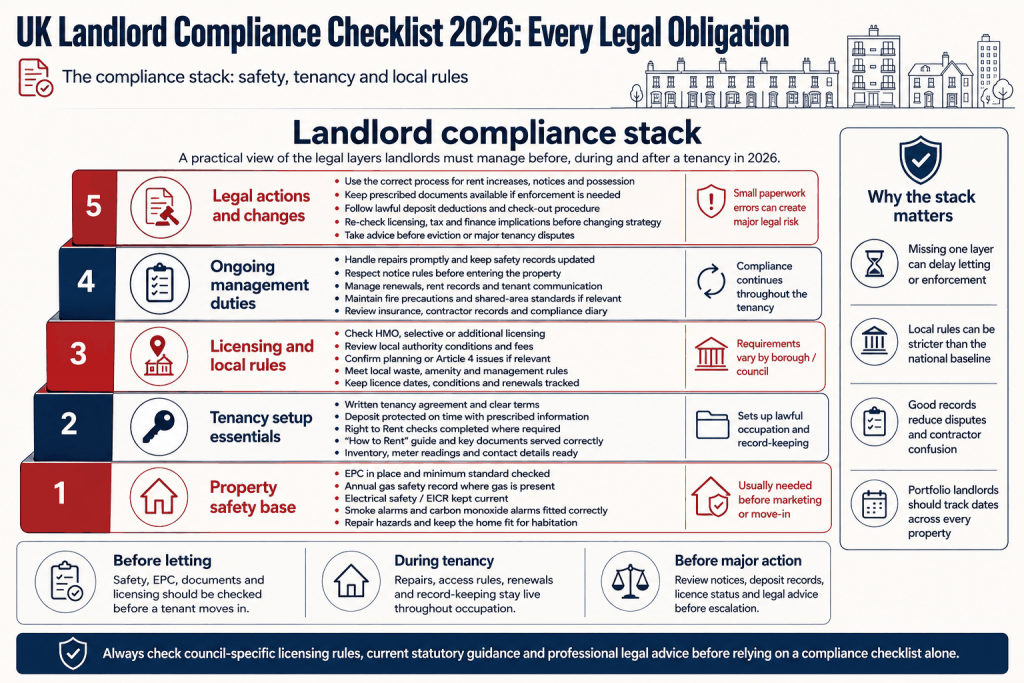
A visual checklist belongs here because compliance is not one certificate. The reader should see the whole evidence file before the article moves into individual rules.
A visual checklist belongs here because compliance is not one certificate. The reader should see the whole evidence file before the article moves into individual rules.
A UK landlord compliance checklist in 2026 needs to do more than list certificates. It needs to show what must be checked before advertising, before move-in, during the tenancy and before any rent increase or possession step. The risk is not only missing a document; it is being unable to prove what happened when a tenant, council, insurer or court asks.
The Renters’ Rights Act 2025 changed the operating environment from 1 May 2026. Section 21 no-fault evictions have been abolished in England, most private tenancies are now assured periodic tenancies, rental bidding is banned and landlords must provide written information about the tenancy. These changes make record keeping and lawful process more important, not less.
AMS manages 500+ properties across London and Essex and inspects managed properties every 4-6 weeks. If you want a property-specific compliance review, start with our rental property compliance inspection service before marketing or renewing a tenancy.
Before advertising: the compliance file must exist first
The safest point to fix compliance is before the advert goes live. Once a tenant has viewed, applied or paid money, pressure builds and mistakes become harder to unwind. A compliant advert is not just a nice description and a rent figure. It is backed by the certificates, licensing check and property conditions needed to let the home lawfully.
A landlord should be able to answer four questions before advertising: Is the property lawful to let? Is it safe? Is the asking rent published clearly? Can I prove the documents are current? If any answer is weak, pause the advert.
| Pre-advertising check | Evidence to hold before marketing |
| Energy Performance Certificate | Valid EPC, normally ordered before marketing; rental property must meet minimum energy performance rules unless exempt. |
| Gas safety | Current gas safety record if there is gas at the property. |
| Electrical safety | Electrical Installation Condition Report or valid proof of inspection within the required cycle. |
| Licensing check | Screenshot or written note of selective, additional HMO or mandatory HMO licensing position for that borough. |
| Asking rent | Written advert with a specific rent. Rental bidding above the advertised rent is banned from 1 May 2026. |
Gas safety, electrical safety and EPC: the core certificate trio
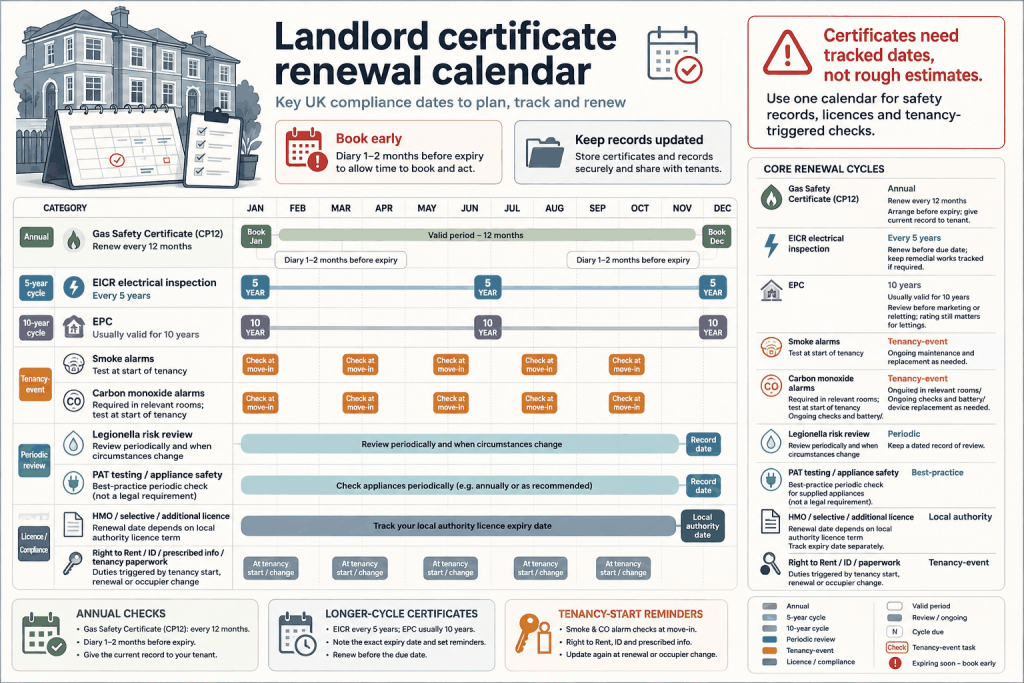
The certificate trio is the first compliance layer most landlords understand, but it is still where many avoidable problems start. Gas safety is annual where gas appliances or fittings are present. HSE guidance says landlords must arrange checks by a Gas Safe registered engineer and provide the gas safety record to tenants within the required time. Electrical safety rules require checks at least every five years by a properly qualified person. EPCs are required before marketing a property to sell or rent and are valid for 10 years.
The practical issue is not just whether the certificate exists. It is whether the landlord can show the certificate was valid at the right time and was given to the tenant when required. A file dated after the tenant moved in is not the same as a file ready before move-in.
| Document | Typical timing | Practical AMS check |
| Gas safety record | Annual where gas applies | Certificate date, engineer details, tenant service record and next due date. |
| EICR/electrical safety | At least every five years | Report result, remedial works, contractor invoice and tenant copy. |
| EPC | Valid for 10 years | Rating, expiry date and whether the property can legally be let. |
| Smoke alarms | Every storey | Move-in test photo and inspection record. |
| Carbon monoxide alarms | Rooms with relevant combustion appliance requirements | Installation record, move-in test and repair response log. |
London landlord licensing checks cannot be left until after viewings
Licensing is where London landlords are most likely to be caught by local variation. Mandatory HMO licensing applies nationally where a property is occupied by five or more people forming more than one household and sharing facilities. Additional HMO licensing and selective licensing depend on the borough and sometimes on the street or ward.
A normal family let in one borough may need no licence. A similar property in another borough may need a selective licence before it is let. An HMO in one area may need mandatory licensing only; in another, a smaller shared house may need additional licensing. This is why a generic national checklist is not enough for London.
For London and Essex landlords, AMS landlord licensing support can check the scheme position before the property goes live.
- Check the council website for the property address, not just the borough name.
- Save the licensing page or screenshot with the date checked.
- Check mandatory HMO rules separately from selective licensing.
- If a managing agent is involved, agree who is named on the licence and who handles renewal.
- Do not assume last year’s licensing position still applies.
| Image placement | Insert after “London landlord licensing checks cannot be left until after viewings” |
| Suggested filename | london-landlord-licensing-decision-tree-2026.webp |
| Alt text | London landlord licensing decision tree for selective and HMO licensing checks |
| Caption | Source: GOV.UK HMO guidance and borough licensing checks. |
| AI image prompt | Create a London landlord licensing decision tree: property address, number of occupiers, households, borough scheme, mandatory HMO, additional HMO, selective licensing, licence application before letting. professional property management aesthetic, UK housing market context, clean and clear design, dark navy and white colour palette, high contrast for readability, no generic stock photo feel, informational infographic style, no people unless essential, London/East London context where relevant, British English labels |
Right to Rent, tenant selection and discrimination risk
Right to Rent checks apply before the start of a new tenancy in England. GOV.UK says landlords must check all tenants aged 18 or over, even if they are not named on the agreement, there is no written agreement, or the tenancy is not in writing. This is an immigration-linked duty and should be handled carefully.
The check must not become a way to discriminate. Tenant selection must be consistent, documented and lawful. The Renters’ Rights changes also ban discrimination against tenants because they have children or receive benefits. A landlord can still assess affordability, but the assessment should be fair, evidence-based and applied consistently.
| Tenant check | What to record |
| Identity and Right to Rent | How the check was completed, date, share code or document copies as allowed. |
| Affordability | Income evidence or guarantor evidence, assessed consistently. |
| Referencing | Employment, landlord reference and credit/risk notes where obtained. |
| Protected characteristics | No decision based on unlawful discrimination. |
| Benefits or children | No blanket “No DSS” or child-based refusal. |
Deposits, rent in advance and written tenancy information after 1 May 2026
Deposit rules remain a major penalty risk. Landlords who take a tenancy deposit must protect it in a government-approved scheme and provide prescribed information within the required period. The cap is generally five weeks’ rent where annual rent is below £50,000, and six weeks’ rent where annual rent is £50,000 or more.
The 2026 tenancy changes also changed how landlords should think about rent in advance and written information. From 1 May 2026, landlords can only require up to one month’s rent between signing the tenancy and the tenancy starting, cannot accept rent before that period, and cannot require payment before rent is due once the tenancy has begun. Landlords must also provide required written tenancy information.
This is a practical shift for landlords who used large advance-rent payments as a risk filter. It makes proper referencing, guarantor checks, rent guarantee comparison and management systems more important.
Repairs, access and evidence during the tenancy
A compliance checklist is not finished when the tenant moves in. The landlord must manage repairs, access, safety follow-ups and inspection records throughout the tenancy. The strongest landlords have dated evidence: tenant report, landlord response, contractor instruction, visit result, photo, invoice and closure note.
At AMS, the practical test is simple: if a council officer or solicitor asked for the file tomorrow, could we show what happened without relying on memory? For older London stock, especially in Barking, Newham, Waltham Forest, Hackney and Tower Hamlets, damp, ventilation, heating and electrical issues need clear response logs.
If you do not want to run this process yourself, compare it with AMS full property management in London, where inspections, repairs and compliance dates are managed as part of the service.
Before a rent increase or possession claim
Since 1 May 2026, rent increases are limited to once per year and landlords must follow the new legal process, including giving the tenant at least two months’ notice of the proposed increase. A rent increase should be supported by market evidence, not just the landlord’s mortgage pressure.
Possession is now a Section 8 evidence exercise. Section 21 no-fault evictions are no longer available in England. That means a landlord needs a valid possession ground and supporting evidence. Weak compliance can undermine the landlord’s position, delay possession or create counterclaims.
If a tenancy has already broken down, speak to AMS about eviction support for landlords before serving notices or making assumptions about court timing.
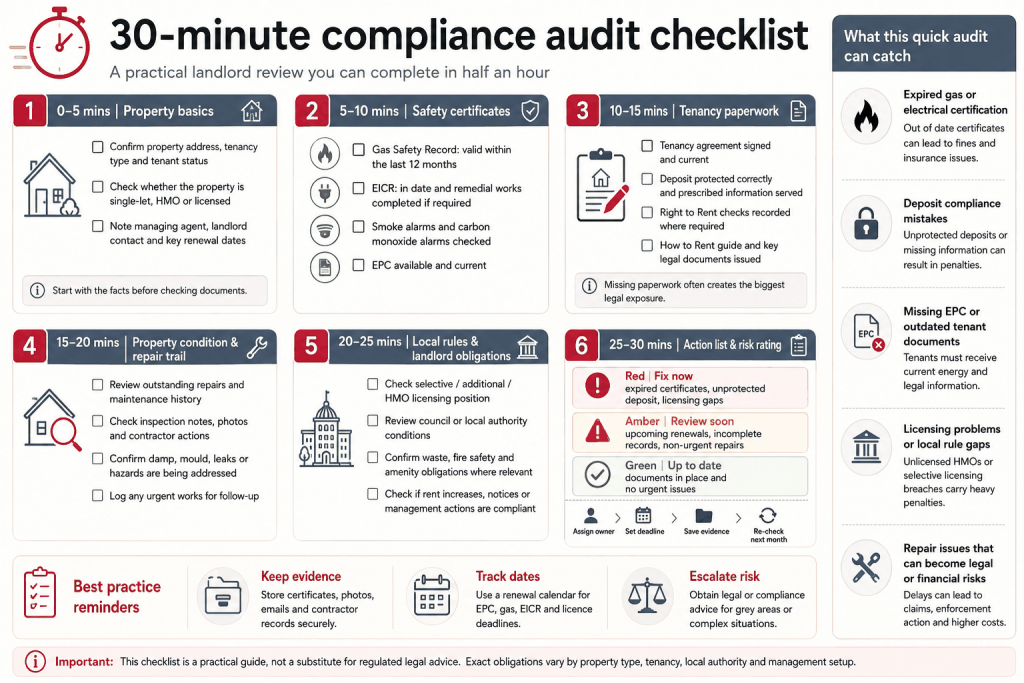
The 30-minute compliance audit landlords should run every quarter
Build a file that can defend the tenancy
Compliance is not about looking organised. It is about being able to prove that the property was safe, the tenancy was set up correctly and repair decisions were made properly. The landlord with the best paper trail usually has the strongest position when something goes wrong.
This article provides general guidance for landlords in England and is not legal advice. Local licensing and enforcement vary. For complex cases, take qualified legal advice and speak to AMS if the risk depends on management, inspection, licensing or compliance records.
AMS routes for landlords who find a gap in the compliance file
The right next step depends on the gap. Missing certificates need one route; licensing uncertainty needs another; repeated repairs need management control.
For complex legal, tax or ownership questions, AMS legal and financial property advice can sit alongside your solicitor or accountant.
For landlords who want the compliance burden removed from day-to-day work, compare with AMS guaranteed rent as a managed fixed-income route.
For multiple properties, an AMS portfolio review can identify which properties carry the highest licensing, repair or cash-flow risk.
Frequently asked questions about UK landlord compliance
What certificates does a landlord need in England?
Most landlords need to consider an EPC, annual gas safety where gas applies, electrical safety checks at least every five years, smoke alarms, carbon monoxide alarms where required, deposit protection records, Right to Rent records and licensing documents where a borough or HMO scheme applies.
Do landlords still need to provide the How to Rent guide?
GOV.UK landlord guidance says that in most cases landlords do not now need to provide the old How to Rent guide following the Renters’ Rights Act changes. Landlords should use the new official landlord and tenant guidance and check the current position before move-in.
Can a landlord still use Section 21 if the paperwork is correct?
No. Section 21 no-fault evictions have been abolished in England. Landlords now need a valid possession ground and must follow the updated notice and court process.
Does landlord licensing apply to every London rental?
No. Mandatory HMO licensing applies by national rules, but selective and additional licensing vary by borough and sometimes by area. Landlords should check the exact address before marketing.