
Key takeaways
- A serious guaranteed rent offer starts with realistic market rent, not the highest online asking rent.
- AMS guaranteed rent is normally 85-92% of market rent, because the provider carries void, arrears, management and maintenance risk.
- Condition, compliance, licensing, layout and contract length can move the offer up or down.
- An above-market guaranteed rent promise should be challenged hard: the provider still needs a credible margin.
A fair guaranteed rent calculation starts with one question: what would the property realistically achieve on the open market if it were let properly today? Only after that figure is evidenced should a provider adjust for risk, compliance, maintenance and contract length.
For London landlords, the calculation cannot be done from one postcode average. A compliant two-bed flat near Barking station, a tired leasehold flat in Waltham Forest and a larger HMO-style house in Newham all carry different demands and risks.
Start with achieved market rent, not the highest advert
The first anchor is comparable achieved rent. Asking rents on portals are useful, but they can be inflated, reduced later, or left online after a property has sat vacant. A guaranteed rent provider should look at similar properties that actually let, not just the boldest listing.
In practice, AMS weighs postcode, bedroom count, property type, transport, condition, likely tenant profile and speed of letting. A property at £1,800 pcm on a portal may not produce £1,800 every month if it takes six weeks to let or needs regular repairs.
The first existing image should sit here because it explains the movement from market rent to guaranteed rent. The section around it should show the calculation path, not simply label the graphic.
Related AMS route: AMS guaranteed rent service.
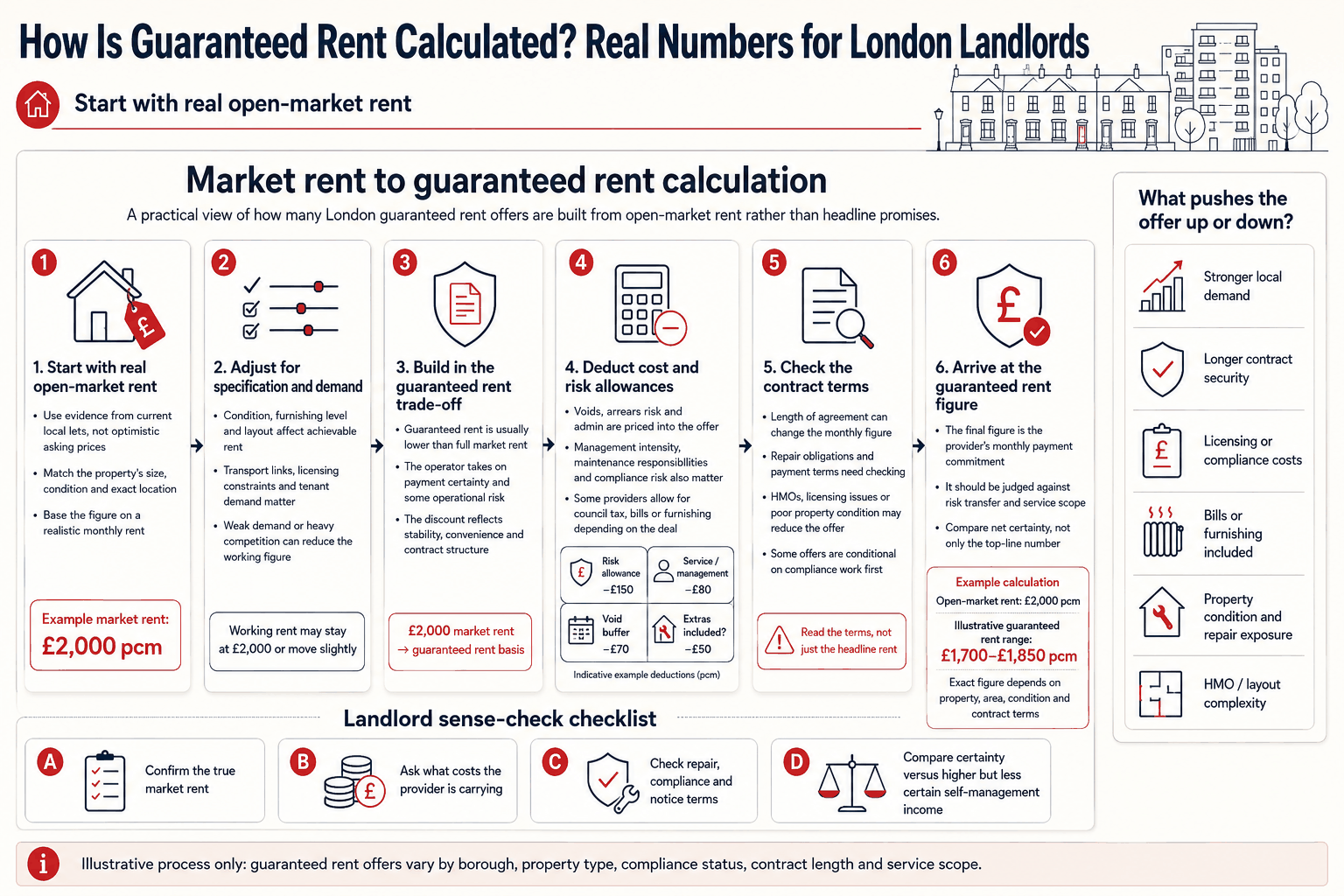
The adjustments that move a guaranteed rent offer
After market rent, the provider prices risk. Strong demand, good condition, clear compliance records and a sensible layout can push the offer towards the top of the range. Poor condition, unclear licensing, heavy maintenance exposure or awkward layout can pull it down.
The biggest hidden factor is repairs. A provider paying rent every month cannot ignore the cost of boilers, leaks, locks, call-outs and handback conditions. That is why a property that looks similar online can produce a different guaranteed rent figure after inspection.
Licensing also matters. A property that needs selective licensing or HMO licensing can still work, but only if the costs, standards and timing are priced into the agreement from the beginning.
Related AMS route: landlord licensing support.
Why AMS normally works from 85-92% of market rent
AMS uses the 85-92% range because guaranteed rent is a risk-transfer product. The landlord gives up part of the theoretical market rent in return for fixed monthly income, 0% commission, fewer void concerns and a provider that manages the occupancy risk.
This does not mean every property gets the same percentage. A well-presented two-bed flat in a high-demand East London location may sit higher than an older house needing work before occupation. The honest answer is that the property sets the number.
If a provider promises more than open-market rent, ask where the margin comes from. Either the property is being used differently, the costs are being ignored, or the promise may not survive a difficult tenancy.
Related AMS route: how guaranteed rent compares with traditional letting.
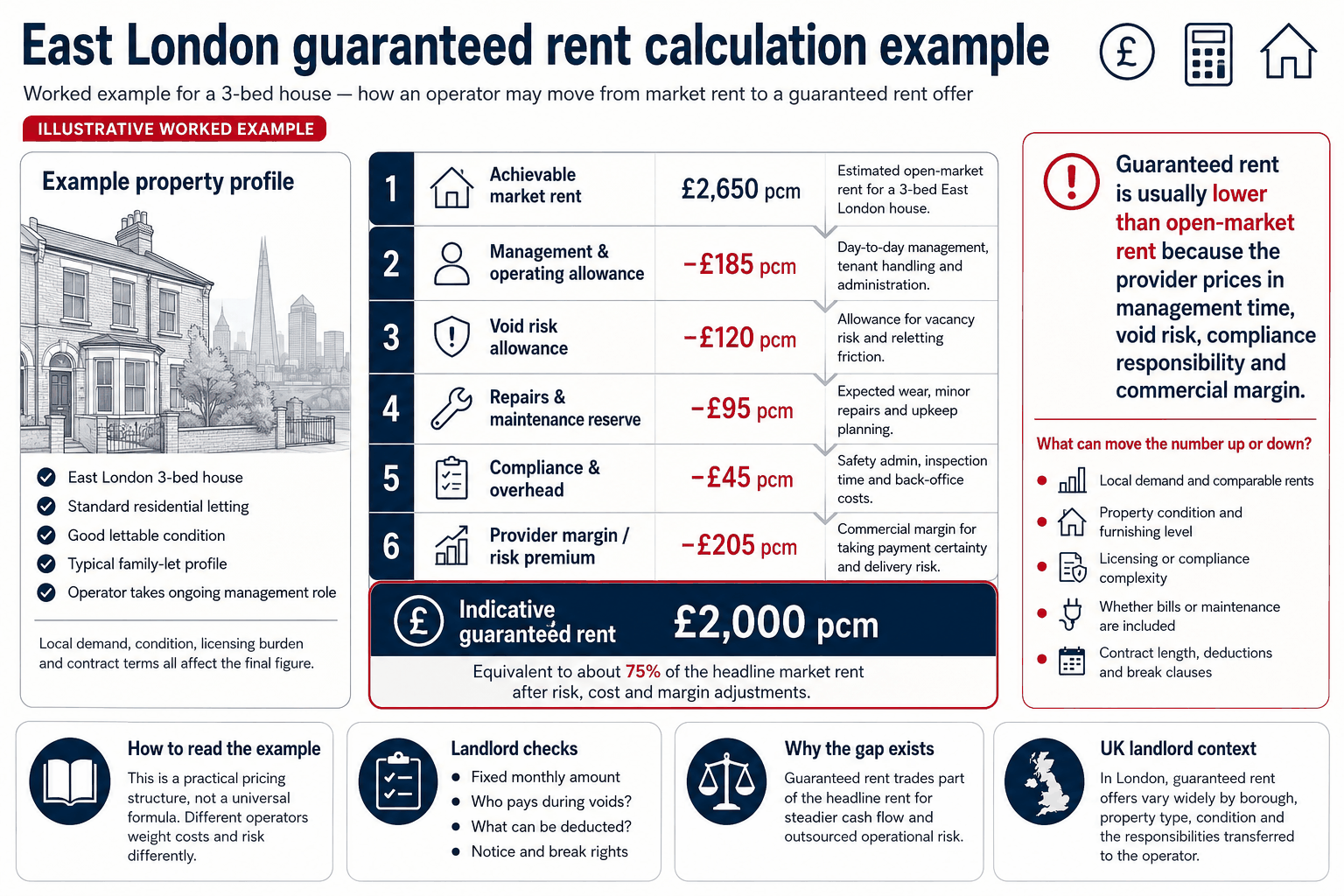
Worked example for a 3-bed East London house
Take a three-bedroom house that could realistically let for £2,000 pcm. A traditional letting route might collect £24,000 in perfect conditions, but the landlord may still pay management fees, maintenance, certificate costs and lose income during voids.
A guaranteed rent offer at 88% would be £1,760 pcm, or £21,120 a year. On paper the gap is £2,880. In reality, one void month, one management fee, a tenant change and an emergency repair can remove much of that gap.
The second existing image belongs after this worked example. It should show the numbers in a way a landlord can compare annually: gross rent, likely deductions and fixed rent.
Related AMS route: free property valuation.
How to spot a dangerous guaranteed rent offer
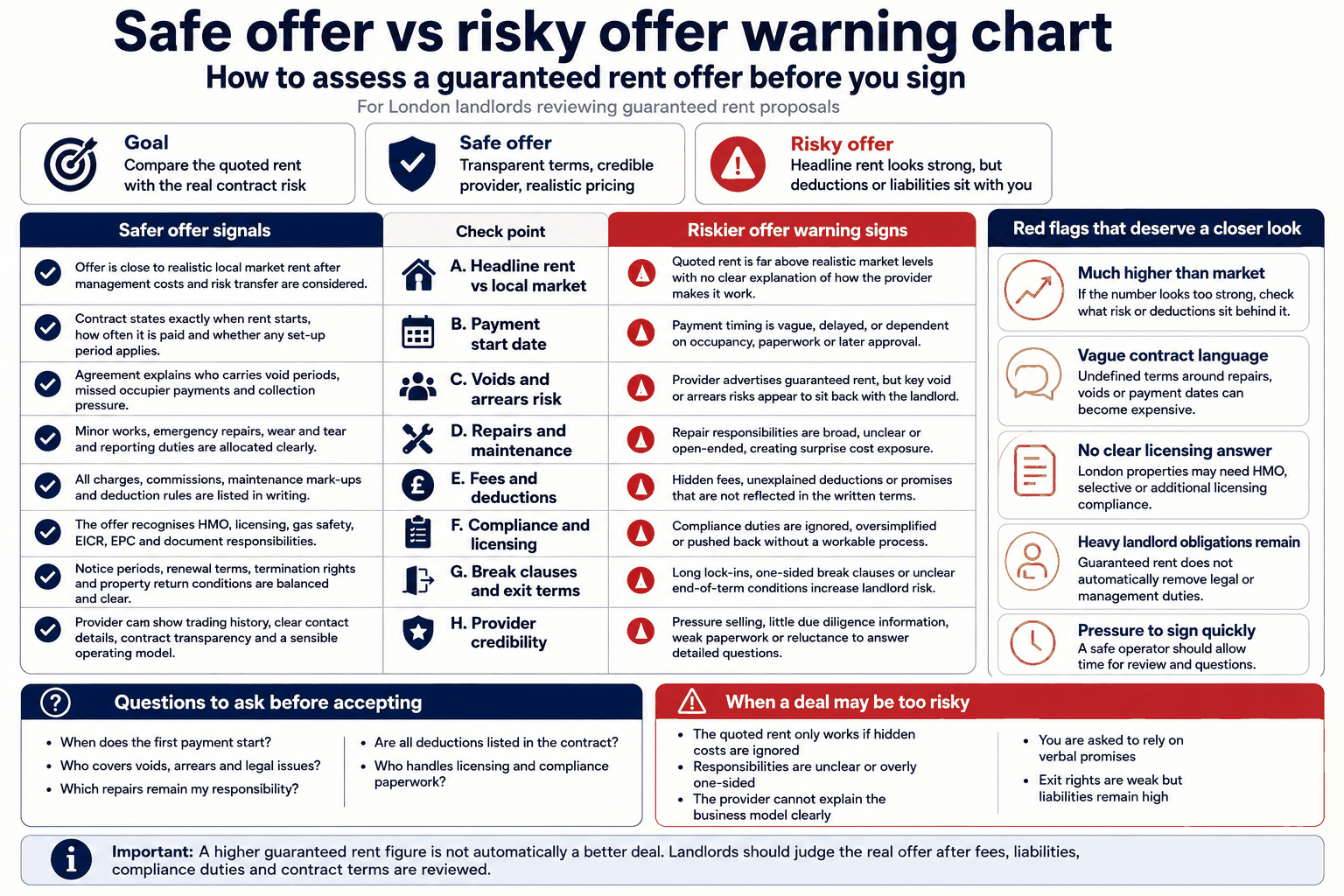
A dangerous offer usually has one of three signs: it is above credible market rent, the provider cannot explain repair responsibilities, or the contract avoids clear handback standards. The risk is not just a missed payment. It is being locked into a weak agreement with unclear accountability.
Landlords should ask who pays for repairs, how often inspections happen, what happens if the provider falls behind, who holds licences, how handback is assessed and whether the agreement allows the landlord to sell or refinance.
Use the third existing image here as a warning chart: safe offer versus risky offer. The graphic should reinforce specific due-diligence questions, not act as decoration.
Related AMS route: portfolio review for landlords.
What to prepare before asking for a valuation
Prepare photos, floor plans, current certificates, recent repair records, licence status, mortgage or lease restrictions and any known issues. A provider can give a rough view quickly, but an accurate guaranteed rent figure depends on evidence.
If the property is already tenanted, include rent payment history, tenancy details and any arrears or repair disputes. If it is empty, include the target availability date and any works that must be finished before occupation.
The better the information, the more useful the offer. A vague quote may feel quick, but it is not the same as a properly priced agreement.
Related AMS route: full property management in London.
How condition and compliance change the calculation
A compliant property can usually be priced with more confidence. Current gas safety, electrical safety, EPC, licensing checks, smoke alarms, carbon monoxide alarms and a clean repair file reduce uncertainty. A provider can see what it is taking on.
Poor conditions do not always make guaranteed rent impossible. It may mean works are needed before occupation, or the first offer is lower until the risk is removed. This is why landlords should not compare a pre-works offer with a polished market-rent advert.
In London, licensing can have a direct financial effect. Selective licensing, additional HMO schemes and mandatory HMO licensing vary by borough. A property that looks profitable online may need time and money before it can be used in the intended way.
How contract length and handback affect the rent figure
A one-year arrangement and a five-year arrangement do not price the same risk. A longer contract gives the provider more certainty, but it also increases responsibility for wear, maintenance and market movement over the term.
Handback condition matters. Landlords should know what standard the property must be returned in, what counts as fair wear and tear, who pays for damage, and how disputes are resolved. A strong fixed-rent figure can become weak if the exit terms are vague.
A fair calculation should therefore link rent to the whole agreement: starting condition, expected use, inspection rhythm, repair obligations, contract length and handback standard.
Before accepting a guaranteed rent figure
Ask whether the figure is subject to inspection, works, licence checks or contract length. A headline offer is less useful than a final written offer with assumptions removed.
Compare the final offer against your likely annual net under open-market letting. If you use the highest possible asking rent as the comparison, guaranteed rent will always look weaker than it really is.
Questions that make a guaranteed rent quote transparent
Ask the provider to show the open-market rent they used, the percentage applied, the condition assumptions and the main risks that affected the figure. If the answer is only “this is what we pay in the area”, the valuation is not transparent enough.
A fair quote should also explain what would improve the figure. Sometimes a small pre-let repair, better photos, a licence check or a clearer floor plan can change the risk profile. Sometimes the property is already close to its best figure and the landlord simply needs to choose between maximum rent and certainty.
The final question is about review. Landlords should know whether the rent is fixed for the whole term, reviewed annually or adjusted at renewal. The offer is not just a number; it is a contract over time.
Final valuation check before publication
The article should make one message clear: guaranteed rent is calculated from evidenced market rent and risk, not from wishful thinking. That prevents landlords being pulled towards offers that cannot be explained.
Frequently asked questions
What percentage of market rent is guaranteed rent?
For AMS, guaranteed rent is usually 85-92% of realistic market rent. The exact figure depends on condition, location, compliance, contract length and risk.
Can guaranteed rent be higher than market rent?
A genuine guaranteed rent offer should not rely on an unexplained above-market promise. If the offer is higher than credible open-market rent, ask how the provider funds the risk.
Does property condition affect the calculation?
Yes. Condition affects maintenance exposure, speed of occupation and tenant suitability, so it can move the offer significantly.
Should I compare monthly or annual income?
Annual comparison is safer. It includes voids, repairs, fees, arrears and compliance costs that monthly figures can hide.
What landlords should do next
A good guaranteed rent calculation should be explainable. If a provider cannot show how it moved from market rent to fixed rent, the landlord should not sign. Ask AMS for a property-specific valuation before comparing offers.
For a property-specific view, request a free valuation from AMS Housing Group, or call 020 3793 2247. AMS is based at 29 Longbridge Road, Barking IG11 8TN and works across all 33 London boroughs and Essex.