Key takeaways
- Guaranteed rent is not automatically a scam, but above-market promises need careful checking.
- The landlord usually accepts below-market rent in exchange for fixed income and risk reduction.
- Lower monthly rent can still produce higher annual net income when voids, arrears and fees are included.
- Provider quality is the real risk: contracts, inspections, repairs, compliance and handback terms must be clear.
- AMS uses 85-92% of market rent, 0% commission and regular inspections as part of a transparent model.
This article gives general guidance only. For legal, tax, mortgage, insurance or possession decisions, landlords should take qualified advice based on the property and tenancy facts.
Guaranteed rent attracts myths because some landlords have seen bad operators, unrealistic promises and unclear contracts. Some concerns are fair. Others confuse a legitimate fixed-rent model with insurance, subletting scams or above-market promises.
This article separates myth from fact for UK landlords. It explains how a proper guaranteed rent model works, what a landlord gives up, what risk is transferred and what checks should be completed before signing.
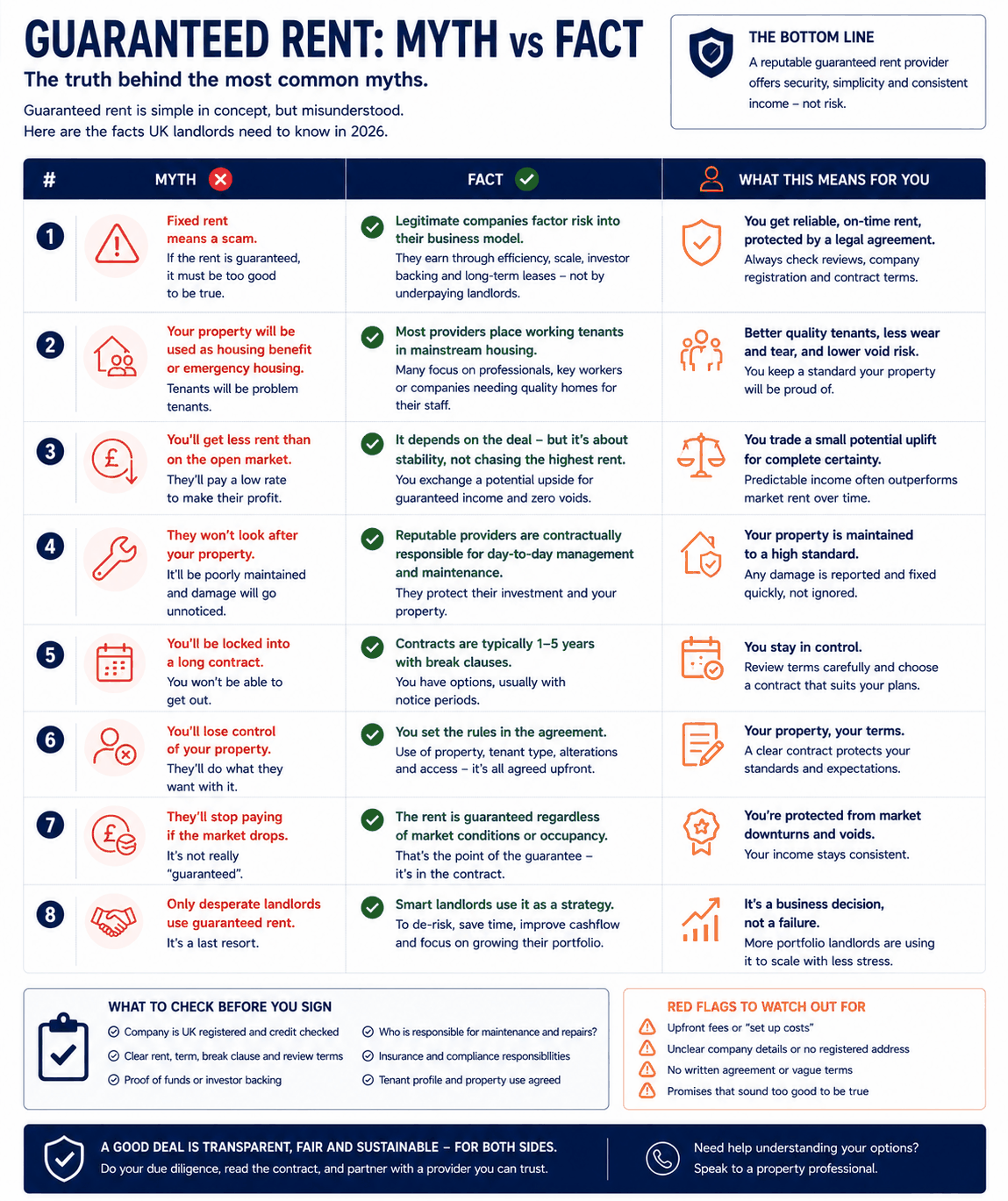
Myth 1: fixed rent means a scam
Fixed rent is not the scam. The red flag is a promise that cannot be explained. A credible provider pays below market rent because it needs a margin to manage tenants, voids, repairs, inspections and risk. If a provider offers above-market rent and vague terms, the landlord should ask how the promise is funded.
A proper guaranteed rent agreement should identify rent, term, repair responsibilities, inspection routine, handback condition, compliance duties, insurance requirements, break clauses and dispute process. The landlord is not buying magic. They are agreeing a risk-transfer contract.
The myth-vs-fact image belongs here because the first job is to separate legitimate scepticism from lazy assumptions.
Myth 2: lower rent always means lower profit
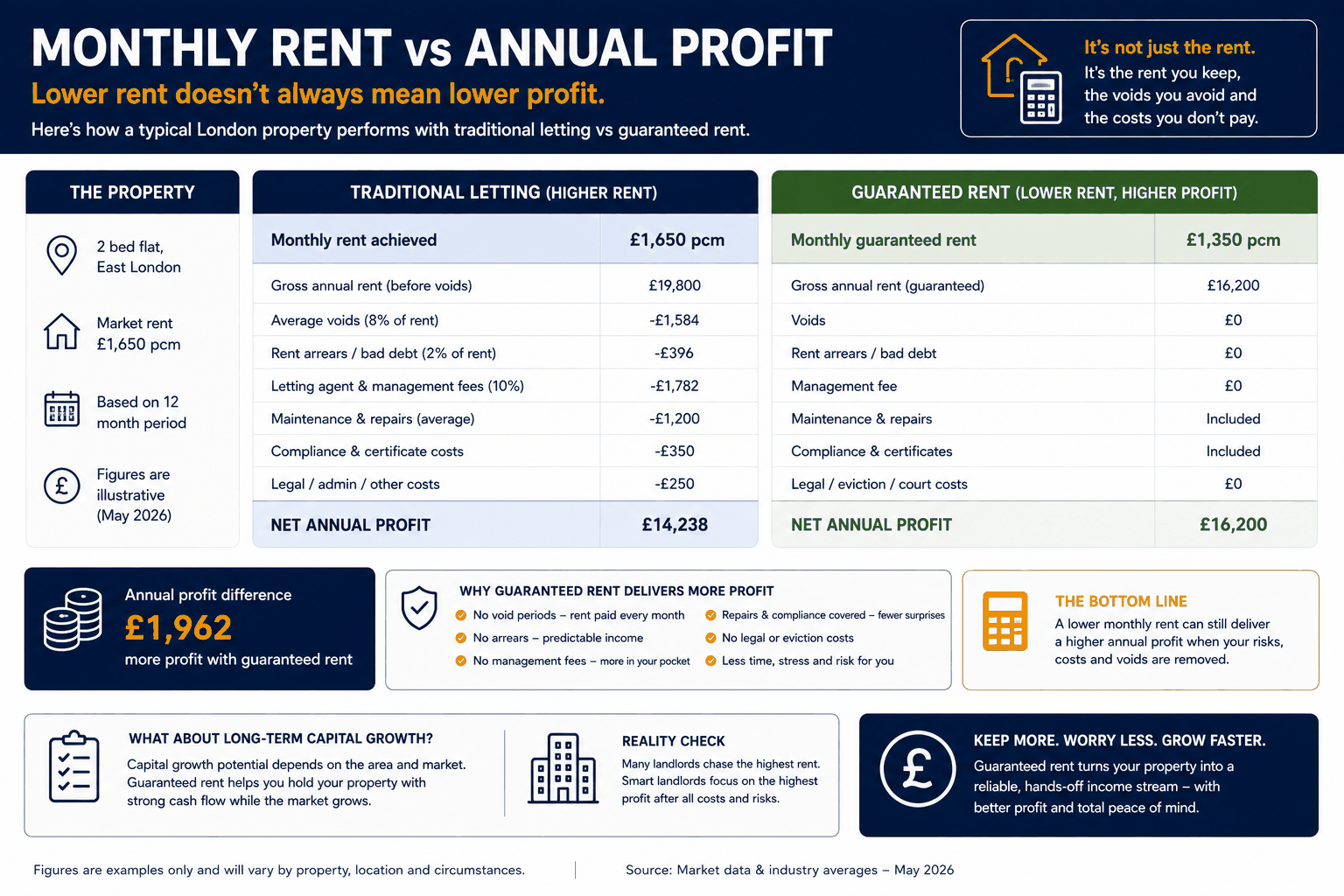
Monthly rent and annual profit are not the same. Traditional letting can produce a higher headline rent but lose money through voids, agent fees, arrears, repairs and tenant turnover. Guaranteed rent may look lower each month while producing a cleaner annual cash flow.
A landlord with a £1,700 pcm market rent might focus on the missing £170-£255 per month. But one void month costs £1,700, and a problem tenancy can cost far more. The right comparison is market net income versus guaranteed fixed income over 12, 24 or 36 months.
This is where the monthly-rent-vs-annual-profit image should sit. The section now explains why the chart matters.
Myth 3: landlords lose all control
A good guaranteed rent contract should reduce day-to-day involvement, not remove every owner right. The landlord still owns the asset and should know how inspections, repairs, access, reporting and handback work. Control should be replaced with accountability, not silence.
The practical check is simple: what reports will the landlord receive, how often will the property be inspected, what repair authorisation limits apply and what standard must be met at handback? If those terms are unclear, the issue is not guaranteed rent as a model. It is poor contract design.
Myth 4: maintenance will be ignored
Some landlords worry that a provider will ignore maintenance to protect margin. That can happen with weak operators, which is why due diligence matters. A professional provider has an incentive to keep the property lettable, compliant and safe because unresolved repairs create complaints, voids and legal risk.
AMS carries out regular inspections and treats maintenance records as part of the property file. A landlord should ask for the inspection schedule, repair process, emergency response method and how contractor invoices or reports are shared.
This myth is also why compliance should be linked to the decision. Gas, electrical, licensing, deposit records and repair proof are not optional because rent is fixed.
Provider due diligence before signing
The one concern that is not a myth is provider quality. Landlords should check the company’s trading history, local presence, redress membership, repair process, contract length, exit terms, insurance expectations, inspection routine and how rent is calculated. The offer should be explainable without pressure.
The due-diligence checklist image belongs here because it gives landlords a practical way to test a provider before signing: company, rent calculation, contract, compliance, repairs, reporting, handback and references.
AMS can help landlords compare guaranteed rent service with lettings support, property management in London and free rental valuation.
Myths 5 to 8: the checks landlords should not skip
Myth 5 is that every property qualifies. It does not. A provider needs a property that can be let safely, legally and profitably. Poor condition, weak demand, unresolved licensing or unrealistic rent expectations can make a property unsuitable.
Myth 6 is that the landlord never has to think about the property again. The landlord should still understand the agreement, insurance, repairs, handback standard and who is responsible for compliance. Less involvement should not mean no oversight.
Myth 7 is that guaranteed rent and rent guarantee insurance are the same thing. They are different. Insurance is a claims product triggered by arrears. Guaranteed rent is a management and risk-transfer model where the landlord receives a fixed rent under contract.
The fair concern: provider quality
Myth 8 is that all guaranteed rent providers are the same. They are not. Provider quality is the real due diligence point. The landlord should check trading history, local office, redress membership, inspection routine, repair process, contract wording, exit terms and how the property will be occupied.
A strong provider should not avoid difficult questions. If the landlord asks what happens during a void, a repair dispute or a handback disagreement, the answer should be written and specific. If the answer is just reassurance, the landlord has not finished due diligence.
How AMS explains the model without overselling it
AMS explains guaranteed rent as a trade-off. The landlord receives a fixed rent below market level. AMS manages the property, tenant risk and operational work. The margin pays for management, voids, inspections, repairs coordination and risk. That is a commercial model, not a trick.
The landlord should compare it with the best realistic alternative, not an imaginary perfect tenancy. When landlords compare against real voids, real agent fees and real repair calls, the decision becomes clearer.
A better question than whether guaranteed rent is good or bad
The better question is whether the provider, property and contract fit together. Guaranteed rent is useful where the landlord values certainty and the provider can manage the property properly. It is weaker where the property is unsuitable, the landlord wants full control or the offer is not supported by the market rent.
Use the article as a due-diligence tool. Ask what happens in a bad month, not a perfect month. If the answers are specific and written down, the landlord can compare the route fairly. If the answers are vague, walk away or take advice.
Frequently asked questions
Is guaranteed rent a scam?
No, not automatically. A legitimate model pays the landlord fixed rent below market while the provider manages risk. Unrealistic above-market promises should be checked carefully.
Can guaranteed rent produce more profit than market letting?
It can, when voids, fees, arrears and management costs reduce the traditional letting result.
What is the biggest real risk?
Provider quality. The contract, inspection process, repairs, compliance and handback terms must be clear.
Due diligence turns myths into usable questions
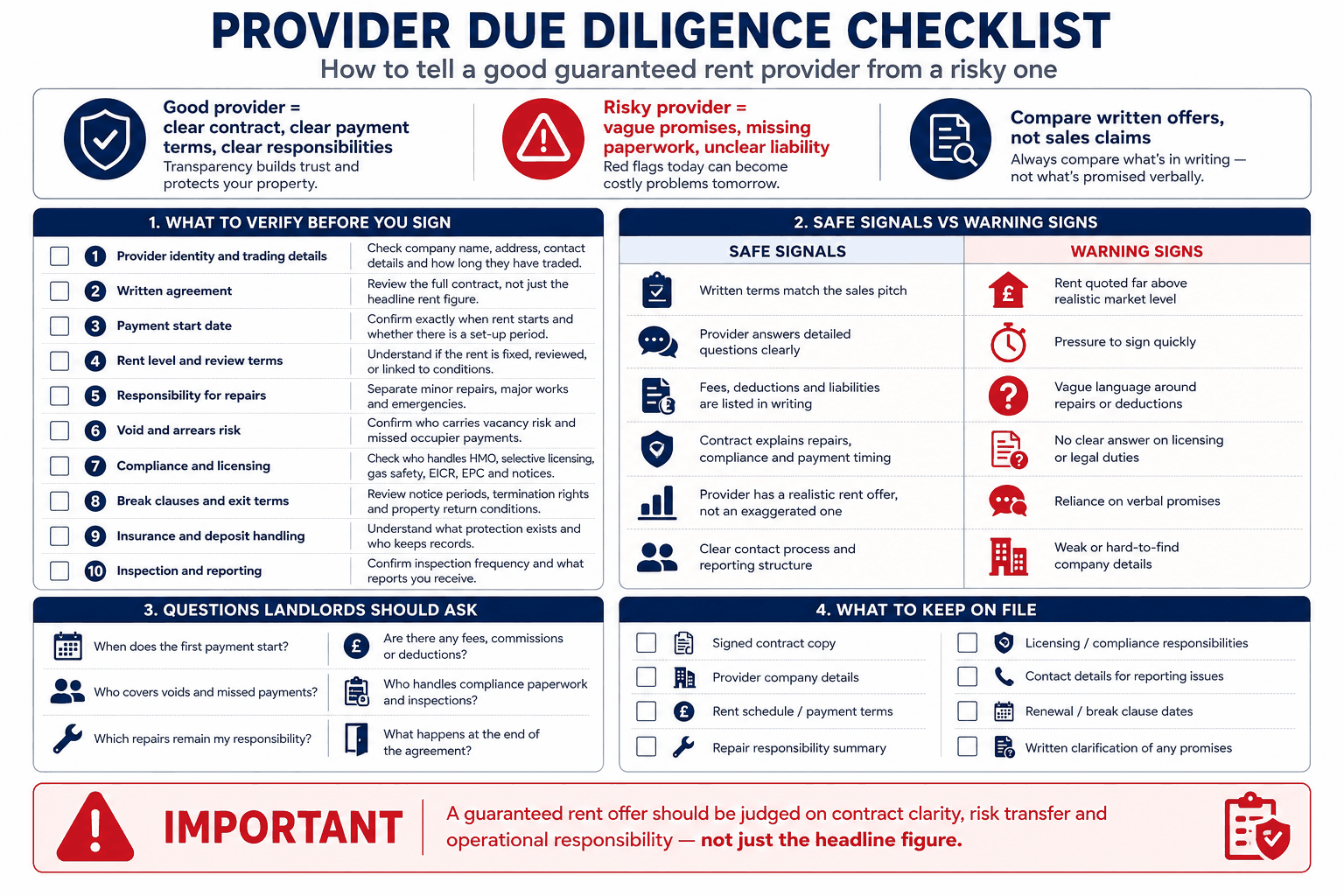
The best way to deal with myths is to turn each one into a question. Is the rent below market for a clear reason? Who pays for repairs? How often are inspections done? What happens if the tenant stops paying? What evidence will the landlord receive?
A landlord who asks these questions does not need to rely on trust alone. The contract, offer calculation and management process should show whether the provider is professional. If the answers are vague, the landlord should not sign.
This is the line between healthy scepticism and missed opportunity. Some landlords reject fixed rent because of myths; others accept weak offers because they ask too few questions. The safer route is evidence-led comparison.
Provider checks that protect the landlord
Landlords should also ask who physically attends the property, how emergencies are handled, whether the provider uses its own staff or contractors and how quickly inspection reports are shared. These details show whether the guaranteed rent promise is backed by a real operating system or only a sales agreement.