
Key takeaways
- The best rent is not always the highest advert; achieved rent and speed of letting matter.
- Condition, layout, transport, licence requirements and tenant demand all move the valuation.
- London borough differences can outweigh national rent averages.
- A guaranteed rent quote should be tested against annual net income, not just gross monthly rent.
The rent your house can achieve is the figure a suitable tenant will actually pay, pass referencing for and continue paying. A high asking rent that creates a long void can produce less annual income than a slightly lower, evidence-backed rent.
For AMS landlords, valuation starts with local comparables, then checks condition, compliance, licensing, likely demand and the owner’s need for certainty.
Why asking rents and achieved rents are not the same
Asking rents show landlord ambition. Achieved rents show the market. A property listed at £2,100 pcm but reduced after four weeks is not the same as a similar property let quickly at £1,950 pcm.
Use portals carefully. Look for similar properties that have actually let, recent reductions, days on market and local tenant demand. ONS data is useful for direction of travel, but a single street or station catchment can still behave differently.
A sensible property valuation also accounts for void time. Losing one month at £2,000 is the same as accepting around £167 pcm less over a year.
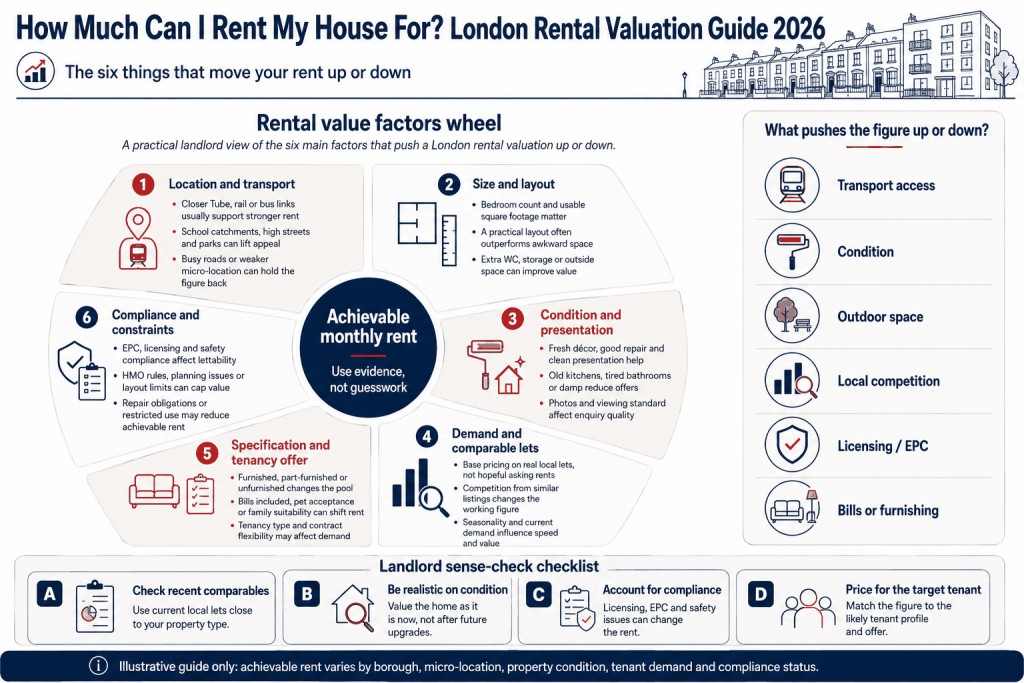
The six factors that move your rent up or down
The first existing image belongs here as a rental value factors wheel. The sections around it should explain the real variables: comparable achieved rents, condition, bedroom count, transport, EPC, outdoor space, licensing and speed of demand.
Condition is not just decoration. A clean, compliant property with working heating, modern photos and a clear move-in date usually attracts better applicants and shorter voids. A tired property may still let, but usually at a discount or with higher maintenance friction.
Transport matters differently across London. A Barking flat near the Elizabeth line or District line can appeal to a different tenant base from a larger house in Havering or a flat in Waltham Forest.
London borough differences landlords should not ignore
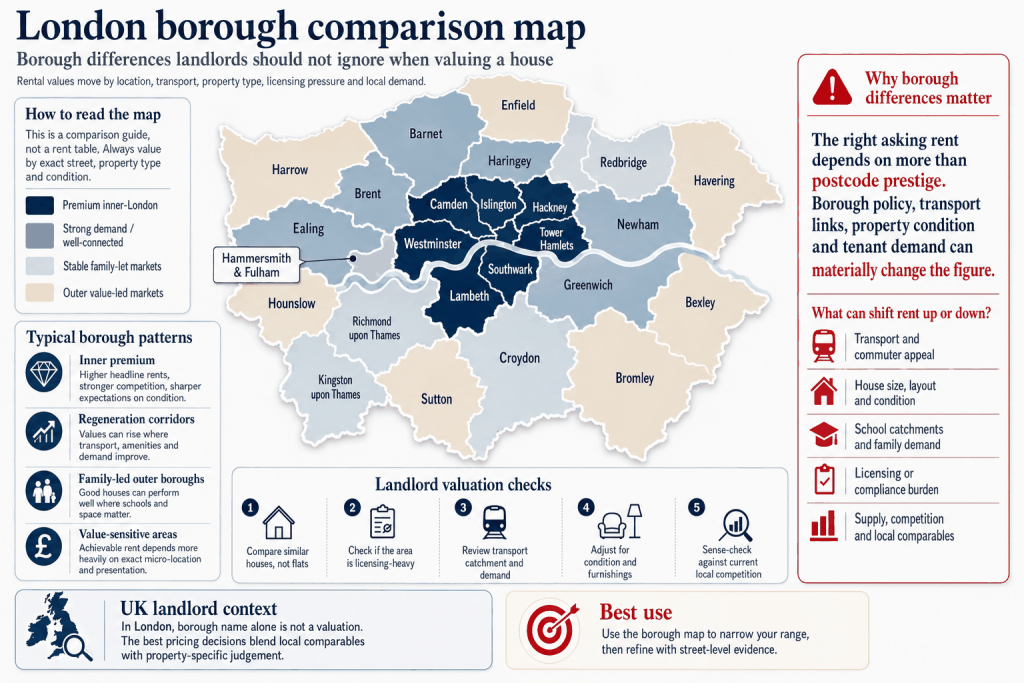
London is not one rental market. Licensing rules, household demand, transport links and local affordability ceilings can change quickly between boroughs. Newham, Barking and Dagenham, Waltham Forest and Redbridge often produce different valuation logic for similar-looking homes.
The second image should work as a borough comparison map. It should not just colour London; it should show why rent changes: transport, licensing, family demand, HMO potential and local affordability.
Borough licensing is a valuation issue because it changes cost, timing and suitability. A higher rent is not useful if the property cannot be lawfully let in the intended way.
A valuation method landlords can use this week
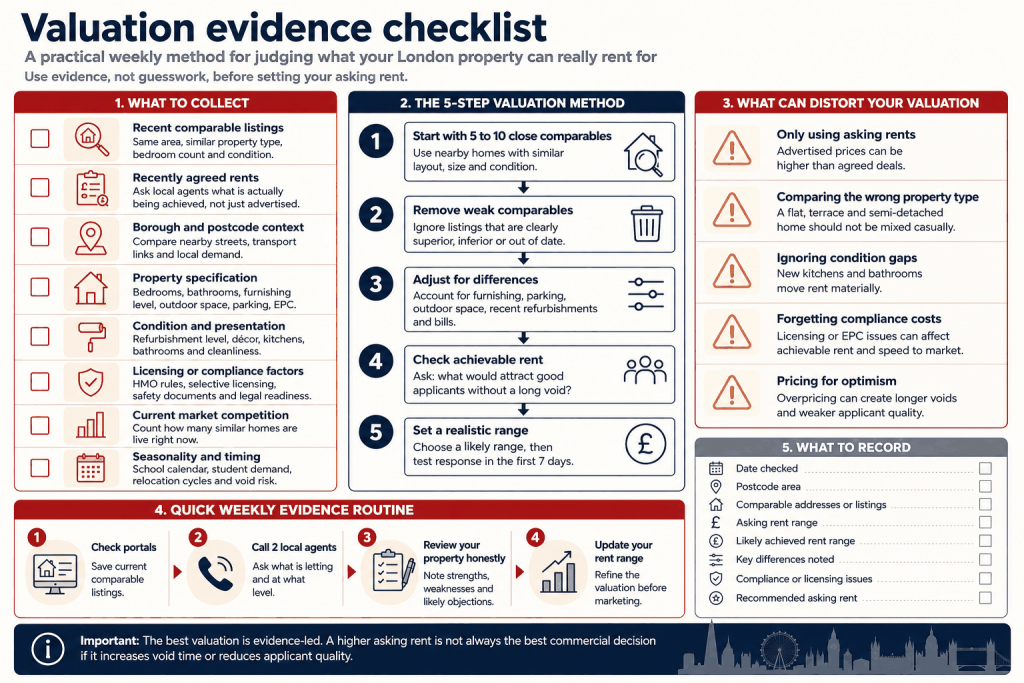
Start by collecting five comparable properties within a realistic radius. Remove any that are clearly superior or inferior. Note bedroom count, condition, outdoor space, transport distance, EPC, furnished status and whether the listing is still live after several weeks.
Then build three figures: conservative rent, likely rent and stretch rent. The likely rent is usually the one to use for annual planning. The stretch rent may work in a hot market, but only if the landlord can afford the void risk.
The third existing image belongs after this method as a valuation evidence checklist. It should help the landlord prepare for an AMS valuation or an agent appraisal.
When a lower rent gives a stronger annual result
A landlord chasing an extra £100 pcm can lose more than that if the property sits empty for one month. The right rent balances speed, tenant quality and net annual income.
Guaranteed rent changes the comparison again. AMS may offer 85-92% of realistic market rent, but the landlord should compare that fixed figure with agent fees, voids, maintenance exposure and arrears risk.
For a landlord with a mortgage payment due every month, certainty may be worth more than a theoretical maximum rent. For a landlord with stronger reserves and time to manage, open-market letting may be the better route.
How licensing and tenant demand affect rent strategy
A rent figure is only useful if the property can be let legally and quickly. In boroughs with selective or additional licensing, the landlord should check the scheme before advertising and build any licence cost or delay into the rent strategy.
Tenant demand also depends on property type. A family house near schools, a two-bed commuter flat and a shared house near transport do not compete for the same applicants. They should not be valued from the same average.
The best valuation conversation is specific: likely applicant, move-in date, compliance position, works needed, photographs, marketing route and fallback rent if demand is slower than expected.
What to do if the valuation range is wide
A wide valuation range usually means uncertainty. The property may be unusual, local stock may be limited, or the current market may be moving. In that case, landlords should plan from three figures: fast-let rent, likely rent and stretch rent.
Fast-let rent is useful when cash flow matters more than maximising the headline. Stretch rent may work where supply is tight and the property is strong. Likely rent is usually the best planning figure for annual income.
If the landlord is comparing guaranteed rent, the guaranteed offer should be measured against the likely rent, not the most optimistic stretch rent.
Before setting the advertised rent
Decide the rent before photographs and marketing go live. Under the 2026 rules, landlords must advertise a specific price and must not invite or accept bids above it, so the published figure needs to be defensible.
Keep the evidence behind the rent. Save comparable listings, valuation notes, condition photos and any licence checks. If a tenant later challenges a rent increase, good valuation records will help explain the landlord’s position.
For portfolio landlords, keep the valuation assumptions consistent across properties. Otherwise one property may be priced from optimistic portal adverts while another is priced from achieved rent, making the portfolio look stronger than it really is.
Mini example: the £100 rent decision
A landlord with a property that could probably let at £2,000 pcm may be tempted to advertise at £2,100. If that higher figure creates a six-week void, the landlord loses roughly £3,000 before the tenancy even starts. The extra £100 pcm would take 30 months to recover that delay.
If the same property lets quickly at £2,000 to a stronger tenant, the annual result may be better. The right rent is therefore not the highest rent someone might pay. It is the figure that balances speed, evidence and tenant quality.
For guaranteed rent comparisons, use the same discipline. Compare the fixed rent with the likely achieved rent over the year, not with a stretch figure that may never be achieved.
How to test a valuation before advertising
Before the property goes live, test the figure against two questions. First, would a strong tenant choose this property over three similar alternatives? Second, can the landlord afford a four-week void if the market rejects the price?
A soft launch through agent feedback or an AMS valuation can prevent a stale listing. If early enquiries are weak, the landlord should adjust quickly rather than wait until the property has been online too long and looks unwanted.
This is especially important after the 2026 rent bidding ban. Landlords must advertise a clear asking rent and cannot invite or accept bids above it. That makes the first advertised figure more important than before.
Frequently asked questions
How do I estimate the rent for my house?
Use comparable achieved rents, current listings, condition, bedroom count, location, compliance and likely tenant demand. Do not rely on one online estimate.
Should I price high and negotiate down?
Sometimes, but overpricing can create a void. In rental valuation, the annual result matters more than the highest initial advert.
Does licensing affect rental value?
Yes. Licensing can change cost, timing and whether the property can be let to the intended household type.
Can AMS value my property for guaranteed rent?
Yes. AMS can assess open-market rent and compare it with a guaranteed rent option for London and Essex landlords.
What landlords should do next
A good rental valuation is evidence, not guesswork. Gather the comparables, check the compliance file and compare annual net income before setting the advertised rent.
For a property-specific view, request a free valuation from AMS Housing Group, or call 020 3793 2247. AMS is based at 29 Longbridge Road, Barking IG11 8TN and works across all 33 London boroughs and Essex.