Table of Contents
Landlord emergency cover is designed for the problems that cannot wait until Monday morning: serious leaks, heating failure in cold weather, unsafe electrics, blocked drains, broken locks and loss of access. The value is not only the call-out. It is the speed of response, the quality of the contractor and the record showing what happened.
The safest way to approach landlord emergency cover is to look at the rule, the money and the evidence together. A landlord may start with one practical question, but the answer often depends on several connected points: leaks, boilers and electrics. Treating those points separately is how mistakes creep in. The better approach is to decide what needs to be checked before the tenancy or transaction starts, what should be recorded during the arrangement, and what evidence will be needed if the decision is challenged later. That gives the landlord a clearer route from general information to a property-specific decision.
That is why timing matters. Checking the point before a tenancy starts is usually cheaper and simpler than trying to correct it after a dispute, claim, licence query or tax deadline has appeared. A landlord should also think about who will need the evidence later: a tenant, buyer, lender, insurer, council officer, tribunal, accountant or managing agent. The same document can serve several purposes if it is kept properly. A clear rent record can support a tax return and an arrears claim. A dated photograph can support a deposit deduction and a repair history. A certificate can help with compliance and reassure a buyer. Treating records as part of the management system rather than a last-minute admin task makes the property easier to own.
A simple example shows why this matters. A landlord may think the issue is only about one decision, such as a deduction, licence, insurance clause, rent increase or repair. In reality, that decision can affect several later steps. The same facts may decide whether the tenant accepts the position, whether a council sees the property as properly managed, whether an insurer accepts a claim, whether a buyer proceeds, or whether an accountant can defend the treatment in the accounts. When the record is complete, those later conversations are shorter and less risky.
What counts as a rental property emergency?
An emergency is usually an issue that creates immediate risk to the occupier, the property or neighbouring homes. A ceiling leak into the flat below, a total electrical failure, a broken external lock or a boiler failure during winter can require urgent action. A dripping tap or loose cupboard door usually does not.
Tenants should know how to report emergencies and when to call the managing agent, insurer or emergency services. Clear instructions reduce panic and prevent tenants from instructing expensive contractors without approval.
This part of the decision should be written down rather than left as a verbal understanding. For a landlord, the risk usually appears later: when a tenant challenges a charge, a council asks for evidence, an insurer reviews a claim, or HMRC queries a figure. Keep policy wording, exclusions, excesses, emergency call-out records and evidence of occupancy in the same property file so the decision can be reconstructed months or years later.
Insurance depends on disclosure. If the property is empty, let as an HMO, used by students, undergoing works or occupied under a company let, the insurer needs to know before there is a claim.
For landlord emergency cover, the first step is usually to define the position precisely. Vague words create later disagreements: ‘managed’, ‘reasonable’, ‘included’, ‘market rent’ and ‘good condition’ can mean different things to different people. The practical answer is to translate those broad words into evidence, dates, responsibility and cost. The same discipline applies in the property file. If the landlord can point to a clause, certificate, valuation, photograph or dated message, the decision becomes much easier to defend.
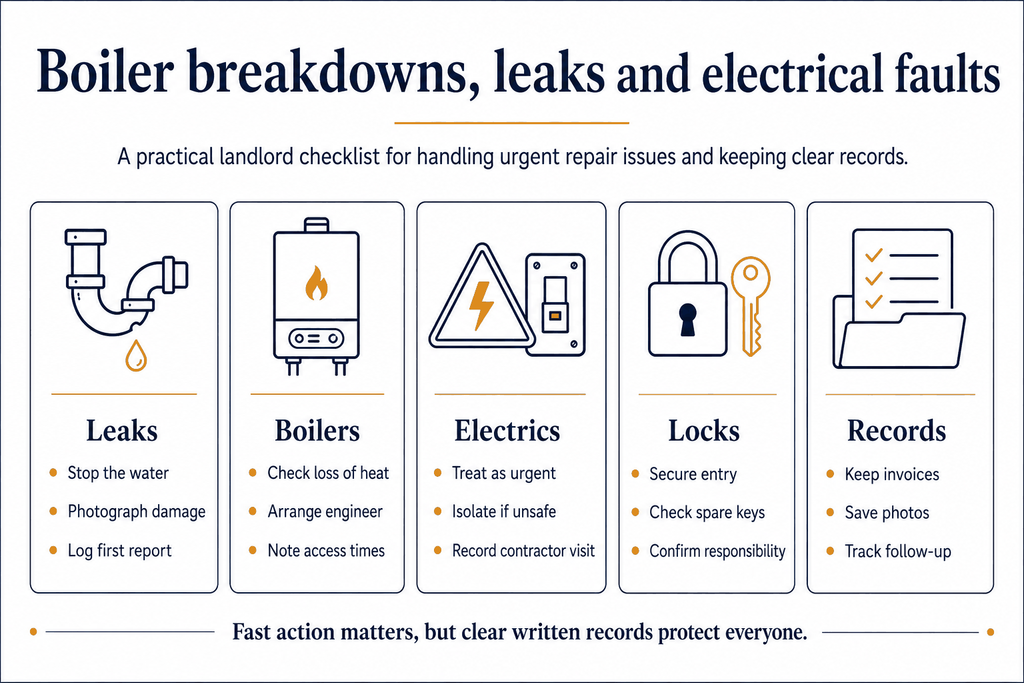
Boiler breakdowns, leaks and electrical faults
Heating and hot water problems can quickly become urgent, especially where vulnerable occupants are involved. Water leaks are often more expensive because the visible damage may be far from the source. Electrical faults need qualified attention because temporary fixes can create safety risk.
GOV.UK states that landlords must keep gas and electrical equipment safely installed and maintained. The wider legal position is not replaced by an emergency policy; cover helps with response, but landlords still need proper maintenance records.
The practical test is whether another person could pick up the file and understand what happened without phoning the landlord for the story. A clear record should show the date, the reason for the decision, who agreed it, what evidence supported it and what happened afterwards. That level of detail is not bureaucracy for its own sake; it is what turns boilers from a loose intention into something defensible if the tenancy, tax return, insurance claim or sale later comes under scrutiny.
A cheap policy can become expensive if the excess is high or the relevant risk is excluded. Landlords should read the wording for vacancy limits, gradual damage, malicious damage, escape of water and legal expenses.
This is also where landlords should avoid copying a process from a different property. A leasehold flat above a shop, a family house in Barking, a converted HMO in Newham and a newly bought auction property can all sit under different practical constraints. Mortgage conditions, block rules, council licensing, insurance wording and tenant profile can change what is sensible. A decision that works cleanly for one property can be risky for another, even when the search query looks the same.
Emergency cover versus landlord insurance
Emergency cover and landlord insurance are not the same product. Insurance may deal with insured damage, liability or loss of rent under the policy wording. Emergency cover usually provides access to contractors for defined incidents, often with limits on labour, parts or call-out value.
Read exclusions carefully. Some policies exclude pre-existing faults, sludge in heating systems, shared drains, roof leaks over a certain height or systems without service records.
Landlords also need to separate the legal rule from the commercial decision. Something can be legally possible but still poor management if it increases void risk, creates a repair dispute, breaches a mortgage condition or makes the property harder to let. Before acting, check the numbers, the paperwork and the likely tenant reaction together. That is especially important in London, where licensing, affordability and property condition can change the outcome of the same decision from one borough to the next.
Emergency call-outs should still be recorded carefully. The landlord may later need to show what failed, who attended, what work was done and whether the tenant or insurer was updated.
The money should be looked at alongside the admin burden. A landlord might save a small amount by handling a task alone, but lose far more if the process creates a void, an invalid notice, a failed claim or a deduction dispute. That does not mean every landlord needs full management. It means the decision should be based on the cost of mistakes as well as the cost of the service.
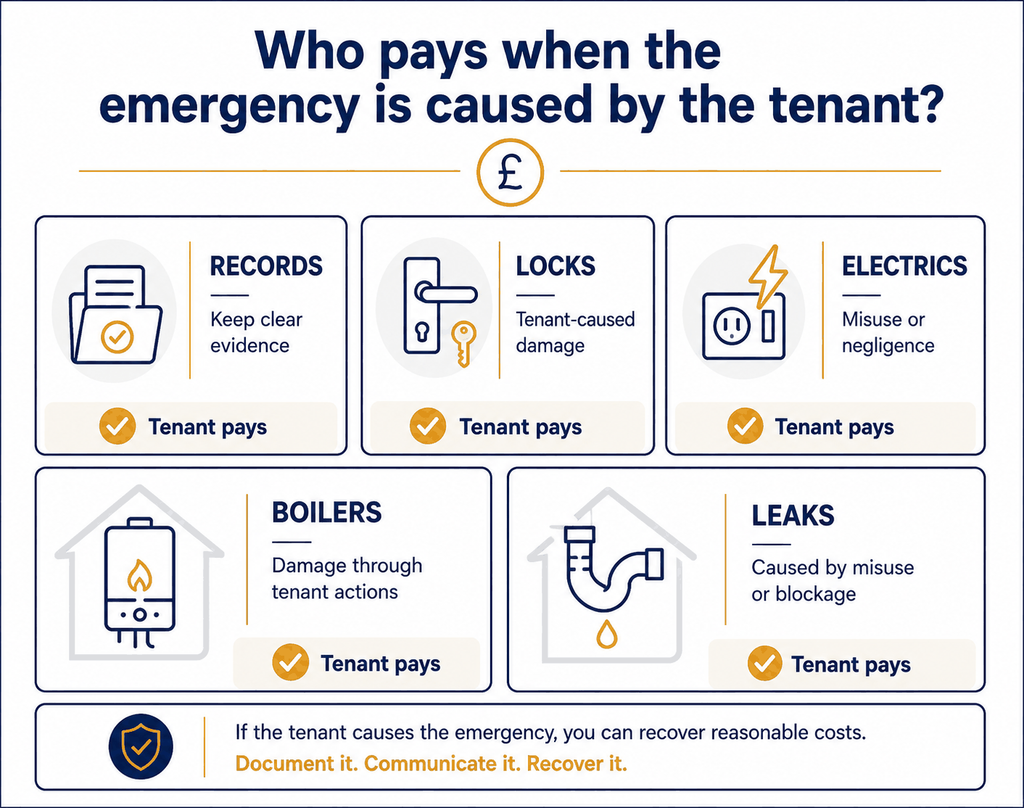
Who pays when the emergency is caused by the tenant?
Responsibility depends on the facts and the tenancy agreement. A landlord normally deals with the immediate emergency first, then decides whether the cost can fairly be recovered from the tenant. Evidence matters: photos, contractor notes, dates and messages should be kept with the property file.
Where a property is under full management or guaranteed rent, the management agreement should say who authorises emergency work and what spending limit applies before owner approval is needed.
A useful way to approach this section is to think about the end of the tenancy before the beginning. If the tenant leaves, the property is inspected, or a buyer’s solicitor asks questions, the landlord will need proof of what was agreed and why. Photographs, dated emails, contractor invoices, rent records and certificates are often more persuasive than a later explanation. Good record keeping also makes it easier for a managing agent or solicitor to step in without starting from scratch.
Cover also needs to match the property’s use. A furnished flat, an HMO, a leasehold property and a vacant refurbishment do not carry the same risk even if the buildings value is similar.
Tenants also respond better when the position is explained early. Clear move-in documents, prompt repair updates and plain reasons for decisions reduce suspicion and make later discussions easier. Many disputes start because the tenant only sees the landlord’s decision after money is being withheld, rent is being increased or access is being requested. A short written explanation at the right time often prevents the matter becoming formal.
Why response records matter after the repair
A good emergency process ends with a written record: what was reported, when, who attended, what was found, what was fixed and what follow-up is needed. That record may protect the landlord if the tenant later alleges disrepair or if an insurer asks for evidence.
AMS landlords can combine repair reporting with regular property inspections, especially where a leak or repeated boiler issue suggests a deeper maintenance problem.
The figures should be tested on a net basis. A headline saving, higher rent, cheaper quote or faster route can disappear once finance costs, compliance work, void periods, tax treatment and repairs are included. Landlords should compare the likely annual position rather than the first monthly figure, and they should update that calculation when the market changes. That gives a more honest view of whether the choice supports reliable income or simply moves risk into a different column.
If a deduction is likely, the landlord needs invoices, photographs and a calculation. A rounded figure for ‘cleaning’ or ‘repainting’ is much weaker than evidence showing the actual loss and how it was caused.
The final check is whether the decision still works if circumstances change. A tenant may leave earlier than expected, market rent may move, a repair may reveal a bigger defect, or a council may ask for more information. Good landlord planning leaves room for those changes. It does not assume that the smoothest version of events is the only version that needs to be costed or documented.
Frequently asked questions
Is landlord emergency cover compulsory?
No, but landlords still need a way to respond to urgent repair and safety problems.
Does emergency cover replace boiler servicing?
No. Most policies require normal servicing and exclude poor maintenance or pre-existing faults.
Can a tenant arrange emergency repairs and charge the landlord?
They should usually follow the reporting process unless there is immediate danger and the landlord or agent cannot be reached.
What is the most common landlord emergency?
Leaks, boiler failures, lock problems and electrical issues are among the most common urgent rental property problems.
Should landlords have a 24-hour contact number?
Yes. Tenants need a clear route for urgent issues, even if the landlord uses an agent.
Build an emergency plan before the first call-out
For landlords who want fewer admin gaps, compare AMS property management, guaranteed rent and a free rental valuation before choosing the next route.