Key takeaways
- Many residential buyers can start with 5-10%, but the sensible cash requirement is higher once fees, Stamp Duty, surveys and repairs are included.
- Buy-to-let borrowers commonly need a larger deposit than owner-occupiers, often because lender risk is different.
- London buyers need a bigger cash buffer because purchase prices, service charges and repair costs can be higher.
- A low-deposit purchase can work, but it leaves less protection if prices fall or repairs arrive early.
The deposit is only the first line in a house-buying budget. A buyer also needs legal fees, survey money, mortgage costs, moving costs, possible Stamp Duty Land Tax and a repair buffer.
For landlords and future landlords, the deposit question is also a risk question. A low deposit can get a purchase moving, but it can leave the owner exposed if rent, rates or repairs move against them.
The minimum deposit and the sensible deposit are different
A 5% deposit may be possible on some residential mortgages, and some specialist products go higher loan-to-value with strict rules. But a minimum deposit is not the same as a safe purchase budget.
A £400,000 purchase with a 5% deposit needs £20,000 before other costs. If the buyer then faces legal fees, surveys, mortgage fees and immediate repairs, the cash requirement can rise quickly.
The first existing image should sit here as the deposit and buying cost stack. It should make the point visually that the deposit is only one part of the cash needed.
You can Request for a free property valuation from AMS Housing to get estimates.
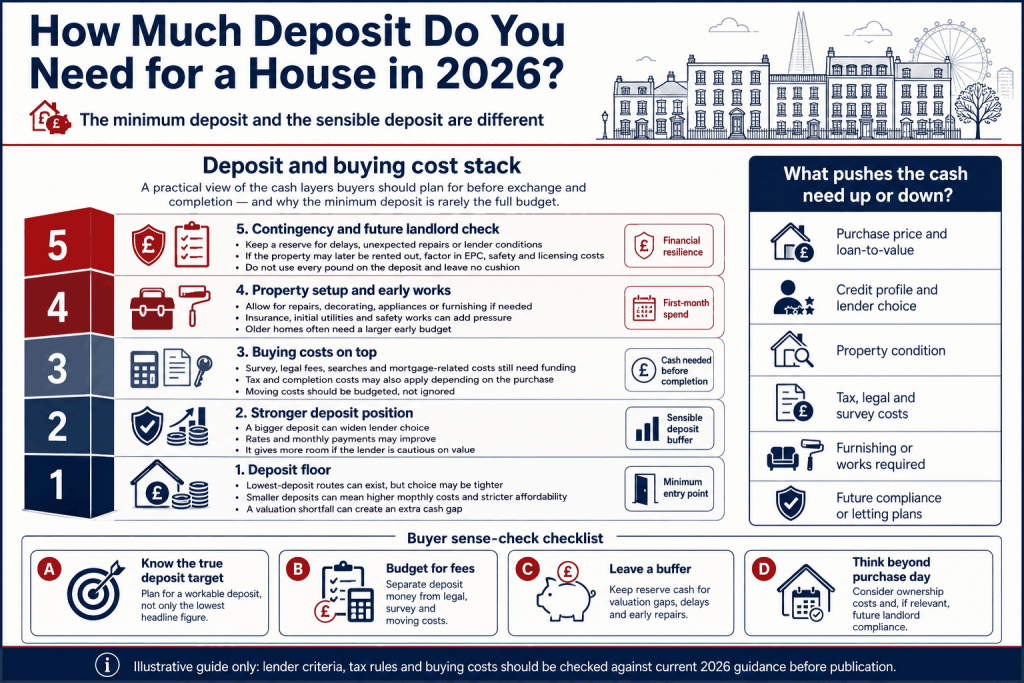
The cash stack most buyers forget
Buyers should budget for conveyancing, search fees, surveys, valuation fees, mortgage arrangement fees, removals, insurance and initial repairs. First-time buyer Stamp Duty relief can help, but it is price-sensitive and should be checked on GOV.UK before exchange.
Landlords have extra reasons to keep a buffer. A rental property may need certificates, licensing checks, smoke and carbon monoxide alarms, EICR remedial work or basic refurbishment before letting.
A buyer who uses every pound on the deposit may own the property but be unable to make it safe, lettable or sale-ready.
London and Essex deposit examples
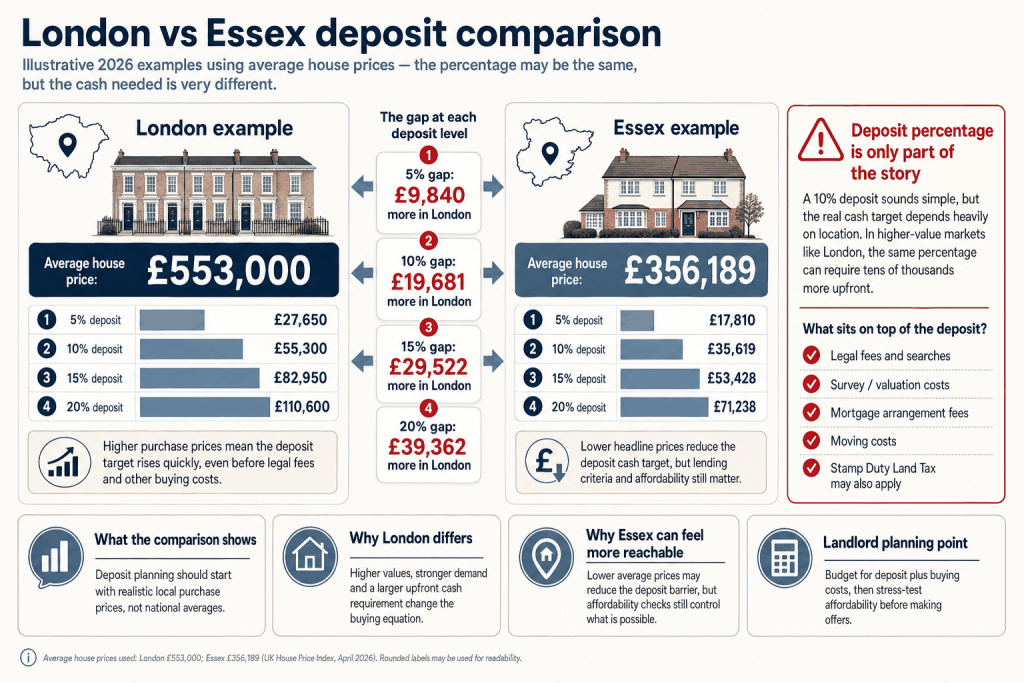
The second existing image should compare London and Essex deposit examples, because a percentage hides the actual cash gap. A 10% deposit on a £300,000 Essex house is £30,000. On a £550,000 London flat, it is £55,000 before service charges or SDLT.
Location also affects mortgage stress testing. A buyer may technically have the deposit but still fail affordability because the monthly payment is too high against income.
For landlords, the location test should include expected rent, licensing, service charges and whether the property could support a guaranteed rent or open-market letting route.
Why landlords should think differently from owner-occupiers
Owner-occupiers mostly ask whether they can afford the mortgage. Landlords also need to ask whether the property can support its costs when empty, during repairs or during a difficult tenancy.
Buy-to-let deposit requirements are usually higher because the lender is assessing rental coverage and investor risk. The deposit becomes part of a wider investment decision rather than only a route to ownership.
A landlord should not buy with a deposit plan that leaves no room for compliance, insurance or repair costs.
Low-deposit risk in a flat or falling market
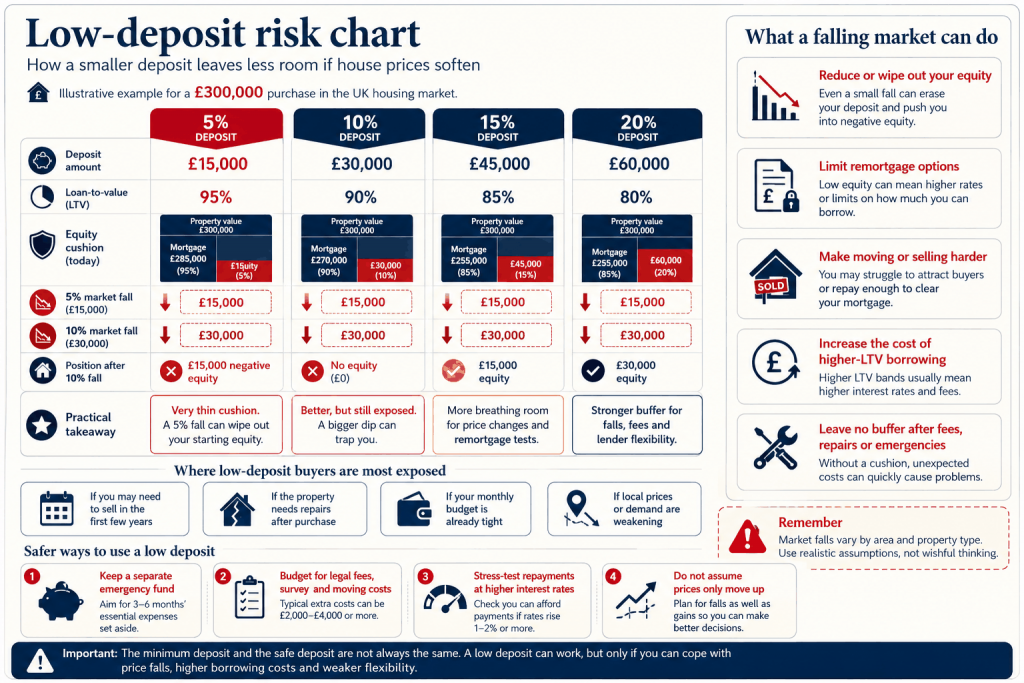
The third existing image belongs here as a low-deposit risk chart. It should show equity buffer, price fall risk, remortgage risk and repair exposure.
Low deposits magnify risk because a small price fall can wipe out equity. In leasehold flats, unexpected service charges or major works can create pressure even if the mortgage is affordable.
The buyer should test the purchase against a bad first year: higher interest, one repair, slower rental demand or a delayed remortgage. If the numbers still work, the deposit may be realistic.
Why buy-to-let deposits are usually larger
A buy-to-let lender looks at investor risk, rental coverage and the property’s ability to support the mortgage. That is why buy-to-let deposits are usually higher than residential deposits, and why a buyer should not assume first-time buyer rules apply to an investment property.
The lender may stress-test rent against mortgage payments at a higher assumed rate. A property with strong tenant demand can still fail a lender’s rental coverage test if the rent does not support the borrowing.
For landlords, the deposit should sit alongside a works budget, certificate budget and void reserve. Owning the property without enough capital to let it properly can turn a purchase into a cash drain.
How to use deposit size as a risk-control tool
A larger deposit can reduce monthly payments and improve remortgage resilience. It may also give the owner more room if values dip or rates rise. The downside is that more cash is locked into the property.
A smaller deposit leaves more cash outside the property, but it increases borrowing and can make monthly payments less forgiving. If the property will be rented, that can create pressure during voids or repairs.
The right deposit is therefore not just what the lender accepts. It is the amount that leaves enough money to own the property safely after completion.
London landlord angle: the deposit is only one constraint
London buyers often focus on the deposit because it is the largest visible barrier. Landlords need to add another test: whether the property can carry itself once owned. That means expected rent, licensing, repairs and mortgage costs have to be tested together.
A lower-priced property in outer East London may be easier to buy but may need more work. A more expensive flat closer to transport may be easier to let but carry service charges and leasehold restrictions. The deposit cannot be assessed away from those facts.
Before making an offer with a small deposit
Ask your broker or lender how the deposit affects the rate, affordability and product options. The smallest deposit can be the most expensive if it forces a higher rate or stricter terms.
Then test the purchase after completion. If you cannot keep a repair reserve after legal fees, surveys, SDLT and moving costs, the deposit plan is probably too tight.
For a landlord, the deposit plan also needs to leave room for the first tenancy setup. Marketing, cleaning, inventory, safety documents, landlord insurance and any licensing work can arrive before the first rent payment is received.
Mini example: deposit versus cash left after completion
A buyer with £40,000 savings looking at a £350,000 home might technically have more than a 10% deposit. But if legal fees, survey, removals and immediate repairs cost £6,000, the buyer does not truly have £40,000 available for the deposit.
Using the full sum as deposit may reduce borrowing slightly, but it can leave the owner exposed. A boiler repair, roof issue or urgent electrical work can then become debt rather than planned maintenance.
For landlords, that problem is sharper. A property cannot be let safely if the deposit has consumed the money needed for compliance, repairs and licensing.
The repair reserve after completion
A buyer should not use every available pound on the deposit. Homes often reveal costs after completion: boiler issues, roof repairs, damp, electrical remedial work, appliances, locks, decorating and basic safety upgrades.
For a future landlord, the reserve is even more important. The property may need an EICR, smoke alarms, carbon monoxide alarms, EPC work, landlord insurance, a licence check and photographs before it can be marketed properly.
A sensible reserve depends on age, condition and property type. Older leasehold flats and ex-rental houses usually deserve a larger buffer than a recently refurbished home with clean certificates.
Final deposit planning check before publication
The safe deposit is the amount that leaves the buyer able to complete, repair, insure and hold the property. That is especially important for landlords, because the first tenancy often creates costs before it creates income.
Frequently asked questions
Is 5% enough deposit for a house?
It can be enough for some residential purchases, subject to lender criteria and affordability. It is not usually enough for a typical buy-to-let mortgage.
How much deposit do first-time buyers need in London?
The percentage may be similar to elsewhere, but the cash sum is higher because property prices are higher. Budget for extra costs too.
Do I need Stamp Duty money as well as a deposit?
Potentially yes. First-time buyer relief depends on price and eligibility. Check GOV.UK or take advice before exchange.
Should landlords keep money back after completion?
Yes. Repairs, certificates, licensing and voids can arrive quickly after completion.
What landlords should do next
Do not judge affordability by deposit alone. Work out the full cash stack and leave enough money to own, repair and let the property safely.
For a property-specific view, request a free valuation from AMS Housing Group, or call 020 3793 2247. AMS is based at 29 Longbridge Road, Barking IG11 8TN and works across all 33 London boroughs and Essex.