
Key takeaways
- Gas safety records are normally annual where gas appliances are present.
- Electrical installation checks are required at least every five years by a qualified person.
- An EPC must be ordered before marketing and is normally valid for 10 years, subject to minimum rating rules and exemptions.
- Deposit protection and prescribed information are evidence duties, not just payment duties.
- London landlords must check selective, additional and HMO licensing borough by borough.
Landlord certificates are not just paperwork. They are proof that a rented property was safe, lawful and ready to let at the right time. If the evidence is missing, the landlord may struggle with insurance, council enforcement, tenant disputes or possession.
This 2026 guide explains the landlord certificates required in England, with extra emphasis on London borough licensing and record keeping. It is general guidance only; landlords should check official sources and local schemes before marketing a property.
Build a certificate register before marketing
The safest way to manage certificates is to create a register for each property. It should list the document, date issued, expiry date, contractor, tenant-copy date, proof of service and the next action. A landlord with one flat can do this in a spreadsheet. A portfolio landlord needs a system that flags renewals before they become breaches.
The key documents include gas safety where applicable, EICR, EPC, alarm checks, deposit protection certificate, prescribed information, Right to Rent evidence, licensing records, tenancy information, inventory and repair records. Not every item is technically a certificate, but each can matter when proving compliance.
The landlord-certificate-register image should sit here because it turns a loose checklist into a working compliance register with renewal dates and proof-of-service columns.
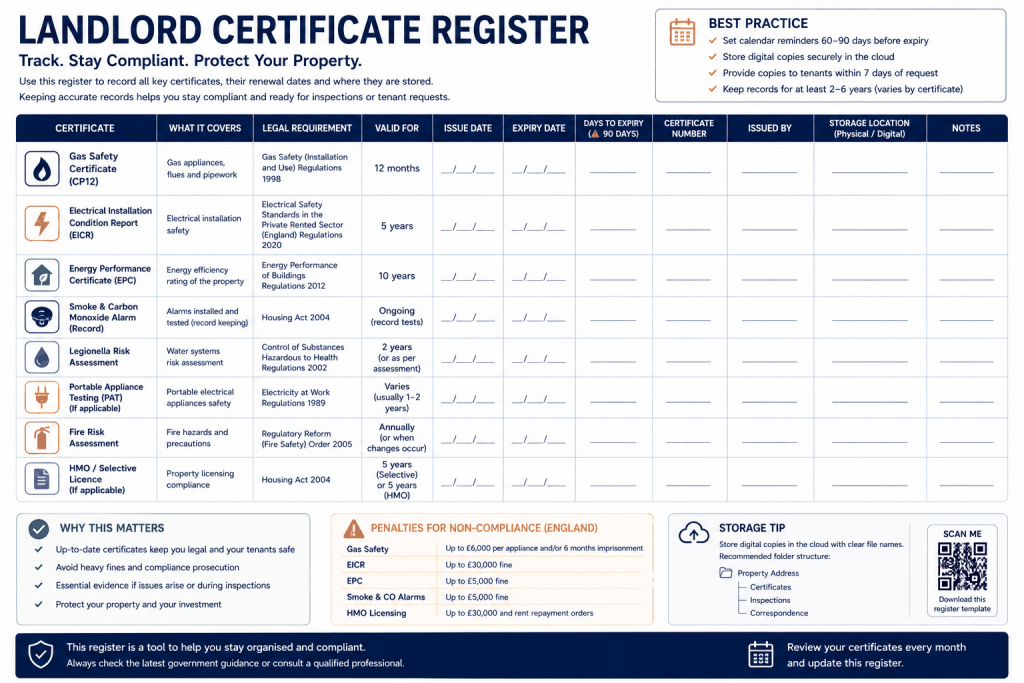
Gas, electrical and EPC records landlords must keep
Gas records matter where a property has gas appliances or pipework. The check must be done by a Gas Safe registered engineer, and landlords should keep the record and provide it to tenants within the required timeframe. Electrical safety checks must be carried out at least every five years by a properly qualified person, and tenants must be given proof of inspection and testing.
The EPC is also a marketing document. A landlord should order it before advertising and check whether the rating meets the minimum standard or whether a valid exemption applies. In practice, AMS often sees landlords focus on the certificate date but miss the issue underneath: a low EPC, old electrics or unresolved gas warning can delay letting and reduce tenant confidence.
The renewal-timeline image belongs here. It should show annual gas checks, five-year EICRs, ten-year EPCs, new-tenancy alarm checks and local licence review points.
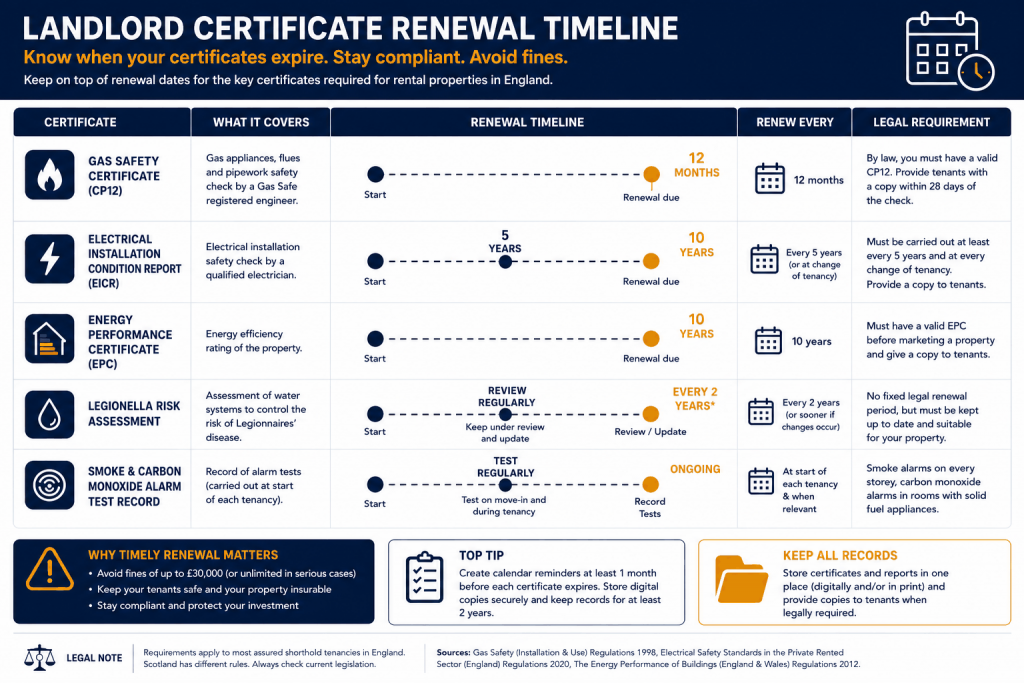
Deposit, Right to Rent and tenancy information evidence
Deposit protection is not complete just because the money has been placed in a scheme. Landlords must also serve prescribed information and keep evidence that it was given. Right to Rent checks are another evidence duty: the landlord must complete the right check before occupation and keep a clear record of what was checked.
The 2026 tenancy changes also mean landlords need written tenancy information that reflects the current law. Old templates can create confusion around fixed terms, rent increases, pets, benefits discrimination and possession. The certificate file should therefore include tenancy documents, information sheets where required and a record of how these were supplied.
A useful test: could someone who has never seen the property open the folder and understand that the tenancy was set up correctly? If not, the landlord has not finished the compliance job.
Licensing evidence for London boroughs
London licensing is the part that national checklists often miss. Mandatory HMO licensing applies to properties with five or more people forming more than one household, but boroughs can also run additional HMO licensing and selective licensing. A property in Newham, Barking and Dagenham, Waltham Forest, Brent or Ealing can have different obligations from a similar property nearby.
The landlord should keep the licence application, licence document, conditions, floor plans, inspection correspondence and any renewal dates. If a licence is pending, keep proof of application and council communication. Do not assume a previous owner’s licence or an old managing agent’s email is enough.
Pre-marketing document checklist for 2026 lettings
Before a property goes live, check that certificates are not just present but usable. The EPC should be current; gas and electrical records should not expire during marketing; alarms should be tested; licence duties should be confirmed; repair issues should be logged; and the tenancy document should match the 2026 rules.
This is where the pre-marketing checklist image belongs. It should show the practical sequence: EPC before advert, gas and electrical before occupation, licence check before viewings, deposit and prescribed information at tenancy setup, Right to Rent before move-in and inventory before keys.
A landlord who checks this after a tenant has been found is already late. The best time to fix missing documents is before the advert goes live.
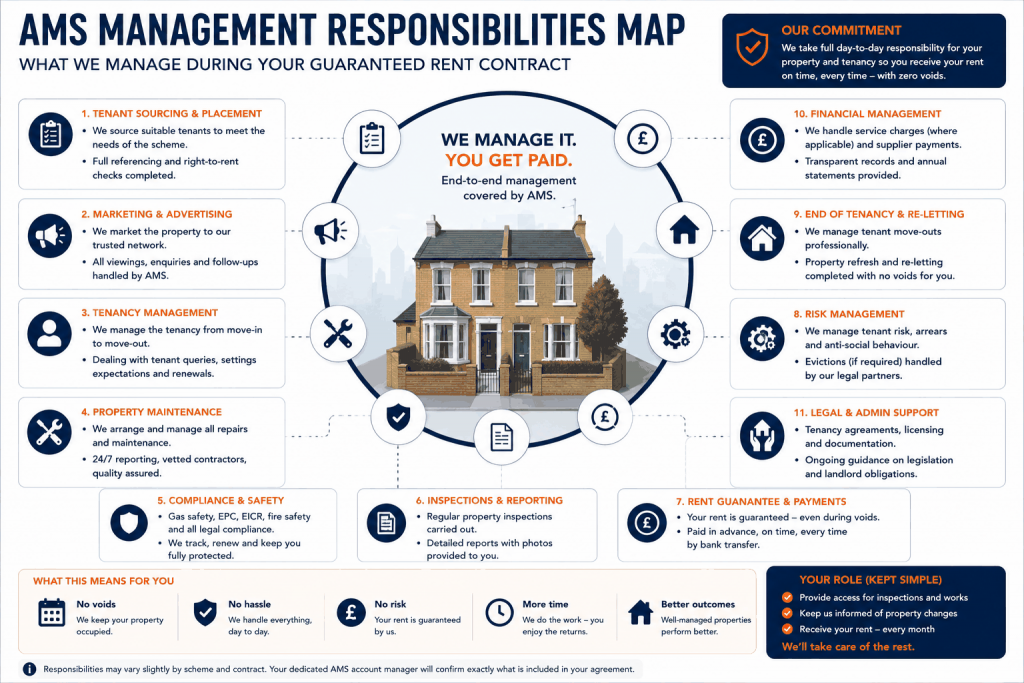
Certificate mistakes that create larger legal problems
A missing certificate rarely stays a small admin issue. It can affect insurance, local authority enforcement, possession claims, tenant complaints and sale due diligence. A landlord may have carried out the right check, but if the proof cannot be produced, the landlord may still struggle to defend the position.
Common failures include an expired gas record, EICR remedial works not completed, EPC not checked before advertising, deposit prescribed information served late, alarm checks not recorded and licence conditions filed away without action. These failures often appear only when a tenant complaint or legal notice forces someone to inspect the file.
The safest practice is to use a renewal buffer. Do not wait until the expiry week. Book gas and electrical work early enough to allow for engineer availability, tenant access issues and remedial works.
Certificates are linked to repairs and inspections
Certificates should not sit in a separate folder from repairs. If an EICR flags remedial works, that action belongs in the repair log. If an inspection notes a broken alarm, the certificate file should show replacement or testing. If a licence condition requires a fire door, the licence file should connect to the contractor invoice.
AMS treats this as one compliance system because a landlord rarely faces one isolated question. Councils, tenants and insurers often ask for the full story: what was checked, what was found, what was fixed and when the tenant was told.
How portfolio landlords should organise certificates
A portfolio landlord needs a dashboard, not ten separate memory systems. Each property should have a next-expiry date, risk rating and named person responsible. Properties with older stock, HMOs, licensing conditions or repeat repairs should be reviewed more often than low-risk single lets.
This is where a compliance inspection can be valuable. It checks the property condition and the document position together, so the landlord knows whether the home is ready to let, renew, sell or move into a guaranteed rent agreement.
Certificate support for AMS landlords
AMS keeps certificate management close to inspections and repairs because the records are connected. An expired EICR, a failed alarm check or an unresolved damp report can affect rent, tenant trust, insurance and possession. Certificate admin is therefore part of risk management, not a separate filing job.
Frequently asked questions
Which landlord certificate is needed every year?
A gas safety record is normally annual where the property has gas appliances. Other records have different renewal cycles.
How often is an EICR needed?
Electrical installations must be inspected and tested at least every five years by a qualified person.
Do all London landlords need a licence?
No, but many London properties fall within mandatory, additional or selective licensing schemes. Check the borough before marketing.