Key takeaways
- Good management starts before marketing, with compliance, pricing and repair condition checked first.
- The 2026 reforms make written tenancy information, asking rent and evidence-led possession central to management.
- Routine inspections, fast repairs and a proper rent ledger protect the annual return.
- London landlords must check HMO, selective and additional licensing by exact borough and address.
- Guaranteed rent is worth comparing where the landlord wants fixed income and less day-to-day management.
Property management of rental properties in the UK now means more than finding a tenant and collecting rent. The landlord or manager needs to price correctly, advertise lawfully, check tenants, protect deposits, handle repairs, inspect, keep records and manage arrears with evidence.
For London landlords, the practical choice is between self-management, let-only support, full property management and guaranteed rent. The right route depends on time, risk, mortgage pressure, licensing duties and whether fixed income matters more than maximum headline rent.
Rental property compliance before marketing
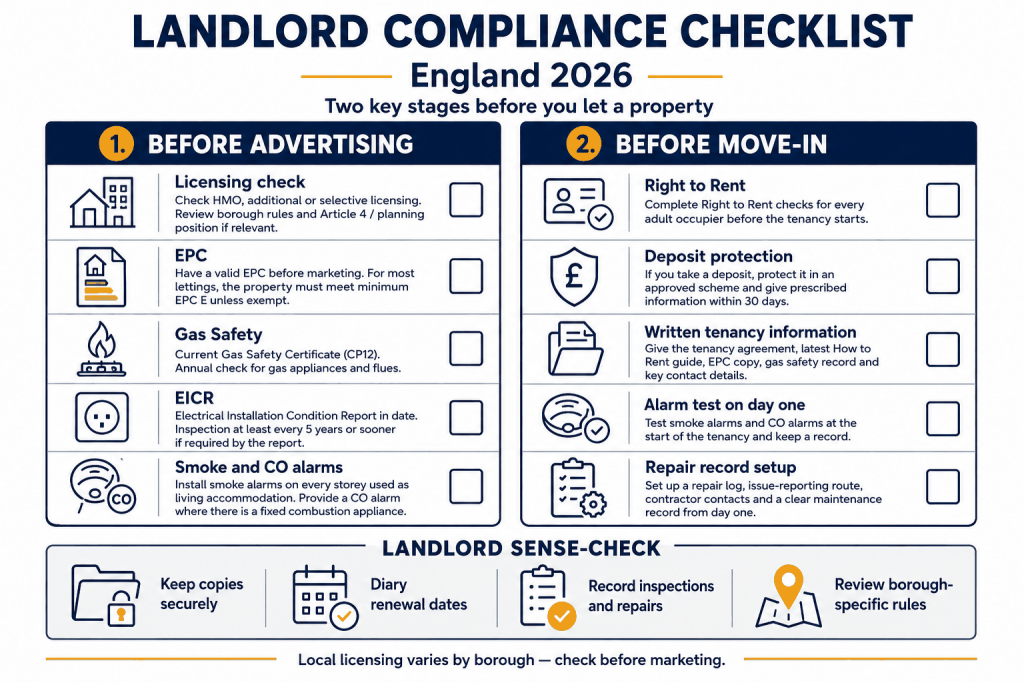
A rental property should not go live until the compliance file is ready. EPC, gas, electrical, alarms, deposit process, Right to Rent, licensing, repair condition and written tenancy information should be checked before viewings start.
GOV.UK lists core landlord duties including safe homes, gas and electrical safety, EPC, deposit protection and Right to Rent checks in England. Those duties now sit within a more evidence-led tenancy system.
London landlords need a borough check. A property in Newham, Barking and Dagenham, Redbridge, Waltham Forest, Brent or Haringey may have licensing requirements that change the letting route.
Rental valuation, advert and tenant application process
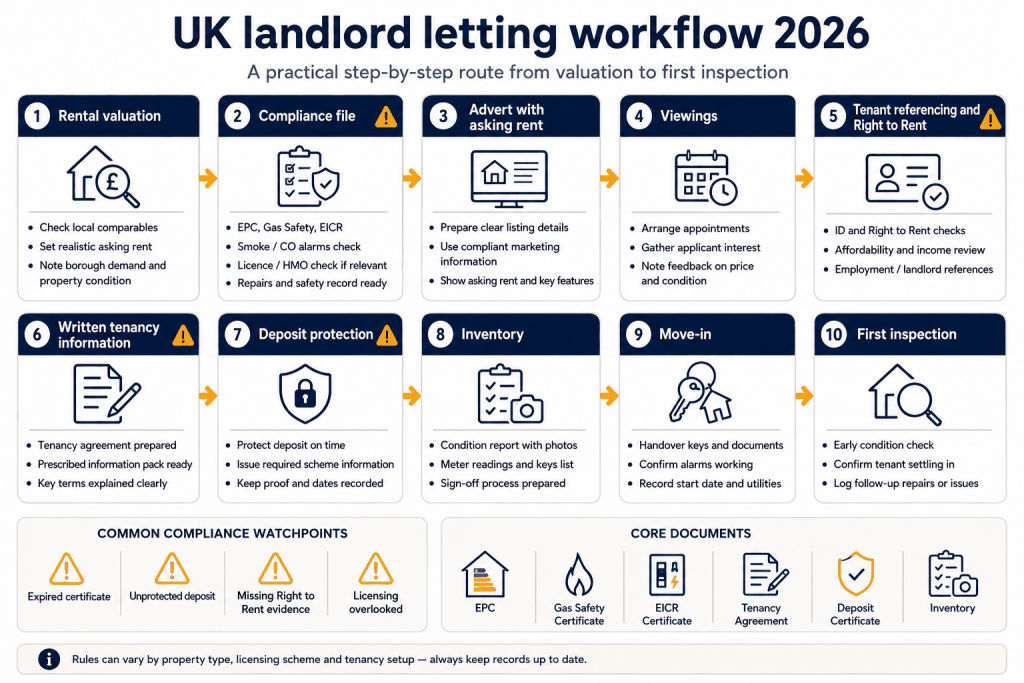
Setting rent is a legal and commercial decision. Written adverts must include a specific asking rent and landlords cannot invite or accept bids above it. That means landlords need to price accurately before marketing, not after a week of viewings.
Tenant applications should be handled consistently: identity, income, affordability, Right to Rent, references and suitability for the property. Keep records of the process, especially where multiple applicants want the same property.
Landlords can use a free rental valuation to compare open-market rent, void risk and guaranteed rent suitability.
Tenancy setup after the Renters Rights Act
Most private tenancies in England are now assured periodic. Old fixed-term AST assumptions should not be copied into new agreements without review. Landlords need to provide certain tenancy information in writing and manage rent increases through the correct legal process.
Tenancy setup should include deposit protection, written terms, inventory, meter readings, alarm test, repair route and a clear rent schedule. The file should be strong enough to support the landlord if arrears or disputes occur later.
This is why letting and management should be connected. A weak setup file creates problems for the manager months later.
Inspections, repairs and access during the tenancy
A managed property should not be inspected only when the tenant complains. Routine inspections check damp, ventilation, leaks, alarms, waste, garden condition, unauthorised occupants, pets and general care compared with the inventory.
Access must be handled properly. Landlords usually need to give at least 24 hours’ notice for inspections or repairs, except in emergencies. Poor access behaviour damages trust and can create complaints.
Repairs should be triaged: emergency, urgent, routine and planned. A professional manager should keep contractor records, invoices, tenant communication and completion evidence.
Rent increases, arrears and possession risk
Rent increases are now limited to the new legal process. A landlord should base proposed increases on evidence and give the required notice, rather than rely on old rent review clauses.
Arrears management should start early. With Section 21 gone, possession depends on valid grounds and evidence. The rent ledger, repair records, inspection notes and communication log matter.
Where arrears are already a problem, use eviction support for landlords rather than informal pressure or DIY eviction.
Self-managing, full management and guaranteed rent
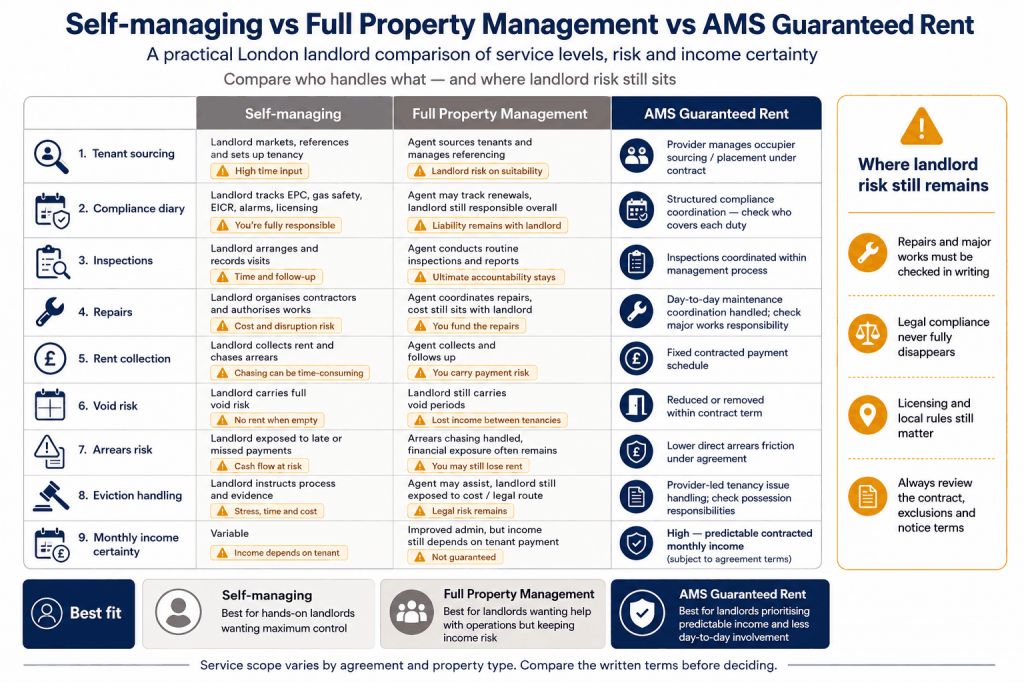
Self-management suits experienced landlords with time, local knowledge and contractors. Let-only suits landlords who only need setup support. Full management suits landlords who want help with tenants, rent, repairs and records. Guaranteed rent suits landlords who want fixed income and less operational exposure.
Under traditional full management, the landlord usually keeps void, arrears and major-cost risk. Under AMS guaranteed rent, the landlord receives a fixed monthly income while AMS manages the operational reality.
Compare the routes annually: rent achieved, voids, fees, repairs, time, compliance and stress. That is the only comparison that matters.
A 30-day handover plan for landlords
- Days 1-3: confirm route and responsibilities.
- Days 4-7: build the compliance file.
- Days 8-10: inspect condition and fix obvious issues.
- Days 11-14: set asking rent and marketing plan.
- Days 15-20: viewings and applications.
- Days 21-25: referencing and Right to Rent.
- Days 26-30: written tenancy information, deposit, inventory and move-in.
HMO and shared-house management is a different job
A shared house is not just a larger single let. It has different fire safety, waste, room-size, communal cleaning, inspection and licensing expectations. A landlord moving from a family let to a shared arrangement needs a new management system.
The wrong manager can make an HMO look profitable on paper but fragile in practice. Missed licence conditions, poor room records, weak fire checks or unmanaged waste can erase the yield advantage quickly.
AMS HMO and licensing support should be considered before the property is marketed as a shared house or student let.
Financial reporting and annual review
A good manager should help the landlord see the property as an annual business, not just a monthly rent receipt. Statements should separate rent, fees, repairs, compliance costs, arrears, voids and one-off works.
At least once a year, landlords should review rent, condition, compliance dates, repair history, tenant stability, insurance, mortgage pressure and whether the current route still fits. A property that was right for self-management three years ago may now need full management or guaranteed rent.
This is especially true after regulatory reform. The cost of weak records, slow repairs and poor possession evidence has increased.
How AMS decides whether a property needs management or guaranteed rent
AMS starts by identifying the landlord’s pressure point. If the landlord only needs a tenant found, lettings support may be enough. If the landlord wants repairs, inspections and records handled, full property management may fit. If the landlord wants fixed income and fewer operational decisions, guaranteed rent may be the right comparison.
The property itself then decides the detail. A simple family let in a stable borough has different management needs from an HMO, a licence-heavy shared house, a leasehold flat with service-charge problems or a landlord property being prepared for sale.
The final test is annual net outcome. A higher gross rent can be weaker if the landlord absorbs voids, fees, arrears and time. A lower fixed rent can be stronger if it removes uncertainty and lets the landlord plan.
The handover documents a new manager should request
When a property transfers into management, the new manager should ask for the tenancy agreement, rent ledger, deposit evidence, EPC, Gas Safety Record, EICR, licence documents, inventory, repair history, insurance details, keys, contractor notes and any live tenant complaints.
If those records are missing, the manager should tell the landlord what the risk is and rebuild the file quickly. Taking over a property without checking the evidence only moves the problem from one inbox to another.
This is where a professional handover differs from a simple agent switch. The aim is to understand the property before the next repair, arrears issue or inspection forces the question.
Management route comparison
| Route | Best suited to | Risk retained |
| Self-managing | Experienced local landlord | All tenant, repair, void and legal risk |
| Let-only | Landlord needing tenant setup only | Ongoing management and compliance diary |
| Full management | Time-poor landlord wanting support | Void, arrears and major cost exposure |
| AMS guaranteed rent | Landlord wanting fixed monthly income | Lower headline rent but stronger certainty |
FAQs
What is property management of rental properties?
It is the practical and legal process of preparing, letting, maintaining, inspecting and financially managing a rented property.
Is self-management cheaper?
It can be cheaper on fees, but only if the landlord has time, knowledge and reliable contractors.
What documents are needed before letting?
EPC, gas safety where relevant, EICR, alarm test evidence, Right to Rent, deposit process, inventory, written tenancy information and licensing check.
How often should landlords inspect?
There is no one rule, but regular inspections with proper notice protect condition and evidence. AMS inspections are typically every 4-6 weeks under managed arrangements.
How does guaranteed rent differ from property management?
Full management charges a fee while the landlord keeps much of the financial risk. Guaranteed rent pays a fixed monthly amount and transfers more operational risk.
Speak to AMS before you commit
If this decision affects rent, compliance, sale timing or tenant risk, speak to AMS Housing Group before committing. AMS is based at 29 Longbridge Road, Barking IG11 8TN and works across all 33 London boroughs and Essex. Call 020 3793 2247 or use the valuation enquiry route to compare the numbers for your own property.