Last updated: February 2026

Table of Contents
The 2024 Autumn Budget changed inheritance tax in ways most property owners still haven’t grasped. The nil-rate band has been frozen at £325,000 until at least 2030/31, over two decades without an increase. With average UK house prices climbing past £290,000 and London properties sitting well above £500,000, more estates than ever are being dragged into IHT territory.
So it’s no surprise that “putting the house in trust” has become the go-to conversation at dinner tables across the country.
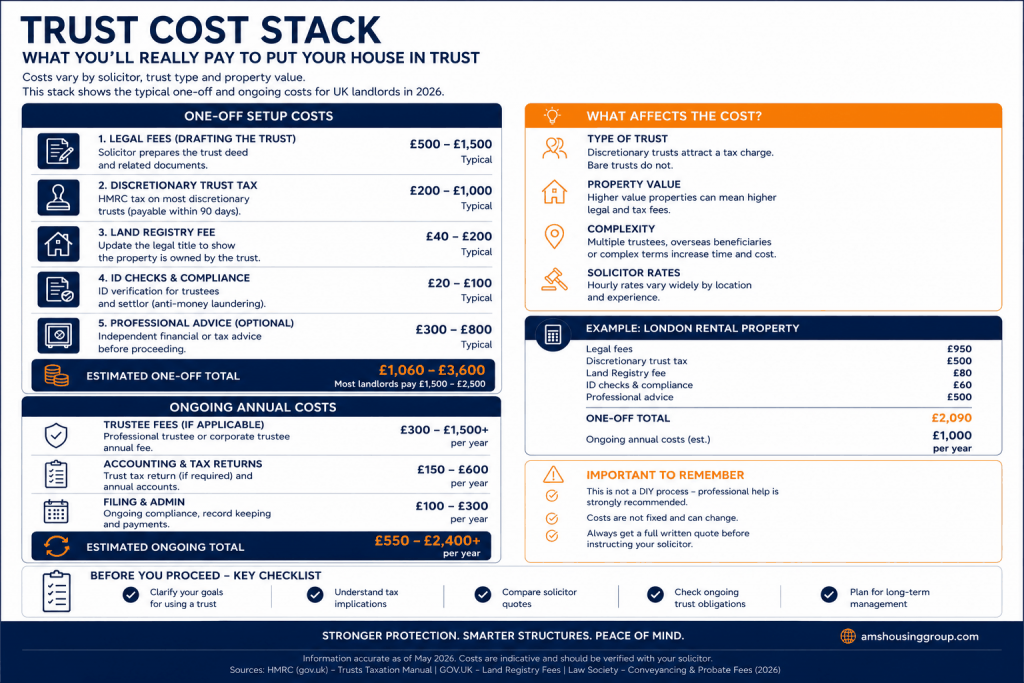
Here’s the short answer: setting up a property trust in the UK costs between £1,000 and £5,000+ depending on the trust type, the solicitor you use, and the complexity of your estate. But the real cost isn’t the setup fee. It’s what happens afterwards. Stamp duty on a discretionary trust transfer alone can run to £20,000 on a £300,000 property. And if you get it wrong, you could lose £175,000 of tax-free allowance per person.
This guide breaks down the costs, tax angles, and traps you need to know about before you sign anything. We’ll be blunt where others aren’t, particularly on the care home fees question, where a lot of money is wasted on schemes that simply don’t work.
The quick answer: property trust costs at a glance
Before we get into the detail, here’s what you’re looking at in terms of raw costs:
| Trust Type | Setup Cost | Annual Running Cost | Best For |
|---|---|---|---|
| Bare trust | £1,000–£1,500 | Minimal | Simple transfers to adult children |
| Life interest trust (in Will) | £1,500–£3,000 | £500–£1,000/year | Blended families, second marriages |
| Life interest trust (lifetime) | £2,000–£5,000 | £500–£1,500/year | Protecting spouse while preserving capital |
| Discretionary trust | £2,000–£5,000+ | £500–£1,500/year | Maximum flexibility, multiple beneficiaries |
| Property protection trust | £1,500–£4,000 | Minimal | Protecting your share of the home |
| Trust wills (single) | From £449 | N/A | Basic trust provisions in a Will |
| Mirror trust wills (couple) | From £849 | N/A | Couples wanting matching trust Wills |
These figures are solicitor fees only. They don’t include stamp duty, Land Registry fees, or ongoing accountancy costs, all of which we’ll cover below.
Regional variations matter too. A trust set up through a Central London firm will typically cost £2,000–£6,000, while the same work in the North West or Midlands might run £1,000–£3,000. It’s worth shopping around, but don’t choose on price alone. Trust law is specialist work, and mistakes here can cost your family tens of thousands.
What is a property trust and how does it work?
A property trust is a legal arrangement where you transfer ownership of your property to trustees, who then hold and manage it for the benefit of your chosen beneficiaries. You set the rules through a document called a trust deed. The Gov.uk trusts and taxes page covers the basics of how trusts work for tax purposes.
The key parties: settlor, trustee, beneficiary
Three roles sit at the centre of every trust:
- Settlor – the person who creates the trust and transfers the property into it (that’s you)
- Trustees – the people or organisations who legally own and manage the property according to the trust deed (often family members, sometimes professionals)
- Beneficiaries – the people who benefit from the property, whether that means living in it, receiving rental income, or inheriting it
You can be both settlor and trustee, though there are tax implications if you also remain a beneficiary.
Trust vs trust fund: what’s the difference?
People often confuse these. A trust is the legal structure. A trust fund is simply the collection of assets held within that structure. When you put your house in a trust, the house becomes the trust fund. There’s no separate pot of cash involved unless you add one.
Types of trusts for UK property owners
Not all trusts are equal. The type you choose affects your setup costs, your tax position, and how much control you retain. Here are the five main options for property owners.
Bare trust
A bare trust is the simplest and cheapest option. The beneficiary has an absolute right to the property and any income it generates once they turn 18. The trustees are holding it as nominees. They can’t withhold it or change the terms.
Setup cost: £1,000–£1,500
Best for: Parents transferring property to adult children
Key advantage: For inheritance tax purposes, the transfer is treated as a Potentially Exempt Transfer (PET). If you survive seven years, it drops out of your estate completely.
Key risk: Once the beneficiary turns 18, they can demand the property. You can’t stop them selling it.
Discretionary trust
The most flexible option, but also the most expensive and heavily taxed. Trustees have complete discretion over how the trust assets are distributed among a class of beneficiaries. Nobody has an automatic right to anything.
Setup cost: £2,000–£5,000+
Best for: Families with multiple beneficiaries, complex situations, or beneficiaries who can’t manage money themselves
Key advantage: Maximum control and flexibility. For buy-to-let properties held in a discretionary trust, a guaranteed rent scheme can provide the trustees with stable, predictable income.
Key risk: A 20% entry charge applies on the value above the nil-rate band (£325,000). There are also 10-year anniversary charges of up to 6%, and exit charges when assets leave the trust.
Life interest trust
Also called an interest in possession trust. One beneficiary (usually a spouse) has the right to live in the property or receive income from it for their lifetime. When they die, the property passes to the remainder beneficiaries (usually children).
Setup cost: £1,500–£5,000, depending on whether it’s set up in a Will or during your lifetime
Best for: Second marriages and blended families where you want your spouse housed but your children to ultimately inherit
Key advantage: Protects the property for the next generation while providing for your partner
Key risk: The life tenant’s use of the property is included in their estate for IHT purposes
Property protection trust
This trust is written into your Will and only takes effect on death. It’s designed to protect the deceased’s share of a jointly owned property, and is particularly useful for couples who own as tenants in common.
Setup cost: £1,500–£4,000
Best for: Married couples or civil partners who want to protect their half of the home
Key advantage: The surviving spouse can continue living in the property, but the deceased’s share is ring-fenced for the children
Key risk: Only protects the first-to-die’s share. The survivor’s share remains vulnerable.
Asset protection trust
A lifetime trust designed primarily to protect assets from future creditor claims, bankruptcy, or divorce settlements. The settlor transfers property during their lifetime, giving up ownership.
Setup cost: £2,000–£5,000
Best for: Business owners, professionals in high-liability fields
Key advantage: If structured properly and set up well in advance, it can shield assets from future claims
Key risk: Transfers made to deliberately avoid existing creditors can be set aside by the courts
Trust type comparison
| Type | Setup Cost | Flexibility | Tax Treatment | Best For |
|---|---|---|---|---|
| Bare trust | £1,000–£1,500 | Low (beneficiary has absolute right) | PET for IHT; beneficiary pays CGT/income tax | Simple transfers to known adult beneficiaries |
| Discretionary trust | £2,000–£5,000+ | High (trustees decide everything) | 20% entry charge above NRB; 10-year/exit charges | Complex families, vulnerable beneficiaries |
| Life interest trust | £1,500–£5,000 | Medium (life tenant has fixed rights) | Property in life tenant’s estate for IHT | Second marriages, protecting both spouse and children |
| Property protection trust | £1,500–£4,000 | Medium (Will-based, fixed terms) | Part of deceased’s estate on first death | Couples protecting their share |
| Asset protection trust | £2,000–£5,000 | Medium-high (lifetime transfer) | PET or CLT depending on structure | Creditor protection, business owners |
Full cost breakdown: what you’ll actually pay

The setup fee your solicitor quotes is only part of the story. Here’s everything that goes into the real cost.
Solicitor fees
Solicitor hourly rates for trust work vary by seniority and location:
- Paralegals and trainee solicitors: £90–£200/hour + VAT
- Qualified solicitors (5+ years PQE): £200–£320/hour + VAT
- Partners and trust specialists: £300–£390/hour + VAT
Most solicitors will quote a fixed fee for straightforward trust work rather than billing hourly. But if your situation is complex (multiple properties, overseas assets, blended families), expect to pay more.
Trust deed drafting
The trust deed is the document that governs how the trust operates. A standard trust deed for a single residential property typically costs £1,500–£2,000 + VAT. More complex deeds involving multiple assets, detailed trustee powers, or sophisticated distribution provisions can push this to £3,000–£5,000 + VAT.
Land Registry fees
When you transfer property into a trust, the title at HM Land Registry needs updating. Current fees for electronic applications:
- Primary residence (no consideration): £30–£50
- Second homes and investment properties: £100–£225 depending on value
These are relatively small in the overall picture, but they’re often forgotten in initial quotes.
HMRC trust registration
All UK trusts with a tax liability must register with HMRC’s Trust Registration Service (TRS). Since 2022, even many non-taxable trusts need to register. The registration itself is free, but most people use their solicitor or accountant to handle it, which adds £200–£500 to the bill.
Ongoing annual costs
Once the trust is up and running, the costs don’t stop:
- Trust tax return preparation: £500–£1,500/year depending on complexity
- Accountancy fees: £300–£800/year for straightforward trusts
- 10-year anniversary IHT calculations: £500–£1,000 (discretionary trusts only)
- Professional trustee fees: £1,000–£5,000/year if you appoint a trust company
Worked example: total first-year cost
Let’s say you’re transferring a £300,000 property into a discretionary trust:
| Cost Item | Amount |
|---|---|
| Solicitor fees (trust deed + advice) | £3,000 |
| VAT on solicitor fees | £600 |
| Land Registry fee | £40 |
| HMRC trust registration (via solicitor) | £300 |
| SDLT (higher rates, see below) | £20,000 |
| Total first-year cost | £23,940 |
That SDLT figure isn’t a typo. It’s the single biggest cost for most discretionary trust transfers, and it catches people off guard. We’ll explain exactly why in the tax section below.
Tax implications: what changed in the 2024 Autumn Budget

This is where most guides on trust costs fall short. They’ll tell you the solicitor fee but gloss over the tax position. And since the Autumn Budget on 30 October 2024, trust taxation has changed in several important ways.
Capital gains tax (CGT): the new 24% rate
From 30 October 2024, the CGT rate for trusts on all chargeable assets (residential property and everything else) is a flat 24%. Before that date, non-residential assets were taxed at 20%.
Key points for property trusts:
- Trust annual exempt amount: Just £1,500 for 2025/26 (compared to £3,000 for individuals). If the settlor has created multiple trusts, this is divided between them, down to a minimum of £300 each.
- Transferring property into a lifetime trust is a disposal for CGT purposes. You’re treated as having sold the property at market value.
- Private Residence Relief is still available if the property is the main home of someone the trust permits to live there. This can eliminate CGT entirely on a qualifying residence.
- Hold-Over Relief can defer CGT when transferring assets into certain trusts (typically discretionary and accumulation trusts). The gain is “held over” and only crystallises when the trustees eventually dispose of the property.
- Will trusts: There is no CGT on death. Assets pass into the trust at their probate value, with no gain to tax.
Practical impact: If you’re transferring an investment property that’s gained £100,000 in value into a discretionary trust, the CGT bill (after the £1,500 exempt amount) would be £23,640, unless you can claim Hold-Over Relief to defer it.
Inheritance tax (IHT): frozen thresholds, rising bills
The nil-rate band is £325,000 and has been frozen there since 2009. The 2024 Autumn Budget extended this freeze until at least 2030/31. That’s over two decades without an increase, while property prices have roughly doubled.
The residence nil-rate band (RNRB) is £175,000 per person, also frozen until 2030/31.
Here’s the warning that most trust marketing materials won’t tell you:
Putting your house into a lifetime trust means you lose the £175,000 residence nil-rate band. The RNRB only applies when a qualifying residence passes to direct descendants on death. Transfer it into a trust during your lifetime, and that allowance vanishes. For a couple, that’s £350,000 of tax-free allowance gone, potentially costing your family £140,000 in extra IHT (£350,000 x 40%).
This single fact makes lifetime property trusts a terrible idea for many families with straightforward estates.
IHT charges on trusts:
- Bare trusts: The transfer is a PET. No immediate charge. If you survive seven years, it falls out of your estate entirely.
- Discretionary trusts: A 20% entry charge on the value above the nil-rate band (£325,000). On a £500,000 property, that’s 20% x £175,000 = £35,000 payable immediately.
- 10-year anniversary charge: Up to 6% of the trust value above the nil-rate band, calculated on each 10th anniversary of the trust.
- Exit charges: Up to 6% when assets are distributed out of the trust, calculated proportionally based on how long until the next 10-year anniversary.
Stamp duty (SDLT) on trust transfers
This is the cost that blindsides people. When you transfer property into a trust, SDLT may be payable. For discretionary trusts, it’s charged at the higher rates (the same surcharge that applies to second home purchases).
From 1 April 2025, the higher SDLT rates are:
| Property Value Band | SDLT Rate (Higher Rates) |
|---|---|
| Up to £125,000 | 5% |
| £125,001–£250,000 | 7% |
| £250,001–£925,000 | 10% |
| £925,001–£1,500,000 | 15% |
| Above £1,500,000 | 17% |
Worked example for a £300,000 property transferred into a discretionary trust:
- 5% on first £125,000 = £6,250
- 7% on £125,001–£250,000 = £8,750
- 10% on £250,001–£300,000 = £5,000
- Total SDLT: £20,000
That’s a substantial bill before you’ve paid a penny in solicitor fees.
Bare trusts are different. Where the beneficiary of a bare trust is identified and the transfer is a gift (no mortgage being assumed), SDLT is generally not payable. This is one reason bare trusts remain popular for simple family transfers.
Non-UK resident surcharge: If the trustees are not UK-resident, an additional 2% surcharge applies on top of all other SDLT rates. This has applied since April 2021.
Pensions and IHT from April 2027
This isn’t directly about property trusts, but it changes the maths for many families considering trust planning.
From 6 April 2027, unused pension funds will be included in your estate for IHT purposes. Previously, pensions sat outside your estate entirely, making them one of the most tax-efficient assets to pass on.
HMRC estimates this will affect around 10,500 estates per year, with the average additional IHT per affected estate sitting at roughly £34,000.
Why does this matter for trust planning? Because many people used their pension as the “IHT-free” asset and considered trusting property to reduce the rest of their estate. With pensions now inside the IHT net, the planning equation changes. You may need to rethink which assets to shelter and how.
Can you put your house in a trust to avoid care home fees?

Let’s be direct. This is the question behind most trust enquiries, and the area where most people get misled.
The deprivation of assets rules
Local authorities in England can look back indefinitely when assessing whether you’ve deliberately deprived yourself of assets to avoid paying for care. There is no fixed time limit. None.
If a council decides that avoiding care fees was a significant motivation for transferring your property into a trust, they can treat the property’s value as “notional capital.” You’ll be assessed for care fees as if you still own it.
The upper capital limit for care fee self-funding is £23,250. If your assets (including notional capital) exceed this, you pay for your own care in full.
The 7-year rule is a myth for care fees
This is the single biggest misunderstanding in trust planning, and it’s actively exploited by some trust companies.
The 7-year rule applies only to inheritance tax. If you make a Potentially Exempt Transfer and survive seven years, it falls out of your estate for IHT purposes.
For care home fee assessments, there is no equivalent time limit. A council can and does look back 10, 15, or 20 years. If they conclude the transfer was motivated by avoiding care costs, the clock never runs out.
As Nelsons Law, a firm that has handled hundreds of these cases, puts it:
“A whole industry has grown up around the sale of these schemes, with charges often starting at around £4,000. All too often the schemes may be promoted by people who are not legally qualified and who are giving information without first considering whether it is appropriate for the client.”
That’s a direct quote from practising solicitors. It should give you pause before paying several thousand pounds for a “care fee protection trust” sold at a seminar.
When a trust might legitimately help
Trusts aren’t useless for care planning. They just don’t work as a blanket shield. Legitimate uses include:
- Property protection trust in a Will – protects the first-to-die’s share of the home. If your spouse later needs care, only their share (not yours, held in trust) is assessed.
- Tenants in common strategy – severing a joint tenancy so each spouse owns a defined share, then protecting the first-to-die’s share through a trust Will.
- Life interest trust – can protect the first spouse’s share while giving the survivor the right to live in the property.
The important point: these arrangements must be set up before any care needs are foreseeable. If you’re already showing signs of declining health when you transfer assets, a deprivation finding becomes far more likely.
Advantages of putting your house in a trust
Despite the costs and complexity, trusts do offer genuine benefits in the right circumstances:
Asset protection from creditors. Once property is properly transferred into an irrevocable trust, it’s no longer yours. Future creditors, bankruptcy proceedings, or divorce settlements generally can’t touch it, provided the transfer wasn’t made to defeat existing claims.
Avoiding probate delays. Trust assets don’t go through probate. While the rest of your estate might take 6-12 months to administer, trust property can pass to beneficiaries immediately.
Protecting assets in blended families. A life interest trust lets your second spouse live in the property while guaranteeing it ultimately passes to your children from a previous relationship. Without this, the surviving spouse could change their Will and leave everything to their own family.
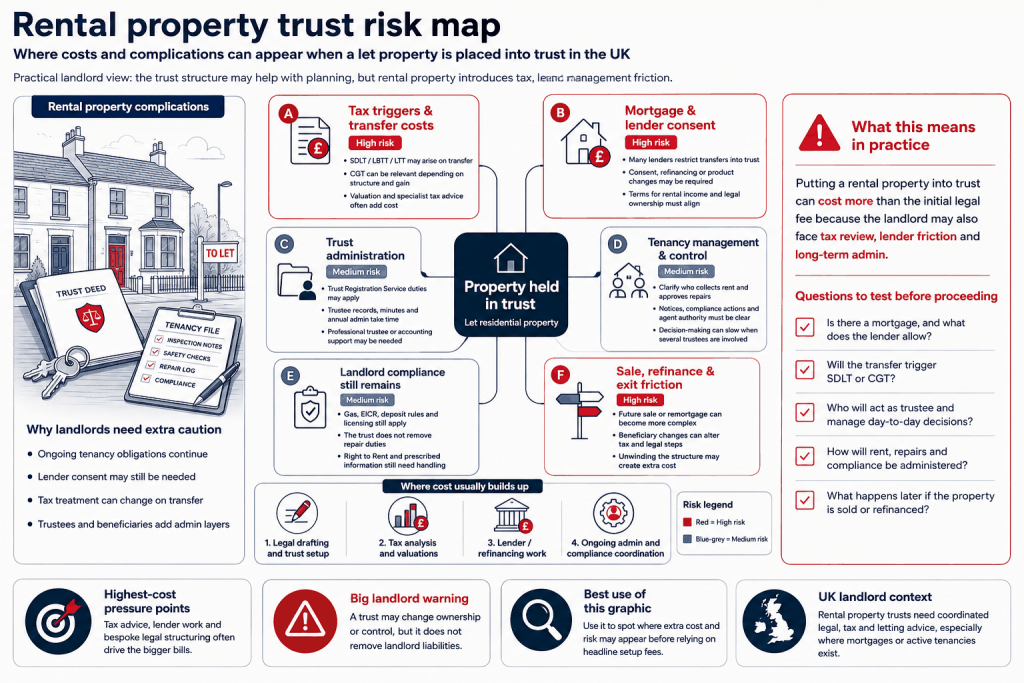
Providing for vulnerable beneficiaries. If you have a child with a disability or someone who struggles with money management, a discretionary trust lets you provide for them without handing over a lump sum they might not be able to manage, or that might disqualify them from means-tested benefits. If the trust holds a rental property, appointing a professional property management service can help trustees meet their duty of care.
Privacy. Wills become public documents once probate is granted. Anyone can request a copy. Trusts are private. The terms, the assets, and the beneficiaries remain confidential.
Maintaining control. By choosing your trustees carefully and drafting a detailed Letter of Wishes, you can influence how the property is used long after you’re gone. A simple gift can’t achieve that.
Potential IHT savings. With a bare trust, if you survive seven years after the transfer, the property falls completely outside your estate. On a £500,000 property above the nil-rate band, that could save your family up to £70,000 in IHT.
Disadvantages of putting your house in a trust
And here are the reasons it might not be right for you, laid out just as plainly:
Loss of the residence nil-rate band. This is the big one. If you transfer your home into a lifetime trust, you lose the £175,000 RNRB. For a couple, that’s £350,000 of tax-free allowance and a potential £140,000 extra tax bill. For many people, this alone makes a lifetime property trust a bad idea.
Upfront costs. Between solicitor fees, trust deed drafting, and professional advice, you’re looking at £1,000–£5,000 before tax even enters the picture.
Stamp duty liability. Discretionary trust transfers attract SDLT at the higher rates. On a £300,000 property, that’s £20,000. On a £500,000 London flat, it’s significantly more.
Higher tax rates inside trusts. Trusts pay income tax at 45% on rental income (above a tiny £1,000 band) and CGT at 24%. Individuals pay 20%/40%/45% income tax and 18%/24% CGT with a £3,000 annual exempt amount. The trust rates are almost always worse.
No reliable protection against care fees. As we’ve covered, the deprivation of assets rules have no time limit. A trust won’t prevent a council from assessing the property as yours if they conclude avoidance was a motivation.
Loss of direct control. Once the property is in trust, it belongs to the trustees, not you. Even if you’re one of the trustees, you’re bound by the trust deed and your fiduciary duties. You can’t just sell the property on a whim or remortgage it without proper trustee decision-making.
Ongoing costs and admin. Annual tax returns, accountancy fees, 10-year anniversary calculations, trustee meetings, and record-keeping. For a discretionary trust, expect to spend £500–£1,500 every year just keeping things compliant.
Complexity. Trusts are not DIY territory. Getting them wrong, whether in drafting, in tax treatment, or in registration, can have serious consequences. You’ll need professional help throughout the life of the trust.
How to put your house in a trust: step by step

If you’ve weighed the pros and cons and decided a trust is right for you, here’s the process:
Step 1: Define your goals. What are you actually trying to achieve? Protect a spouse? Shield assets from a beneficiary’s divorce? Reduce IHT? Provide for a vulnerable child? The answer determines which trust type to use, and whether a trust is even the right tool.
Step 2: Choose the right trust type. Based on your goals, narrow down to the trust structure that fits. A solicitor can advise, but come to the conversation with a clear idea of what matters to you.
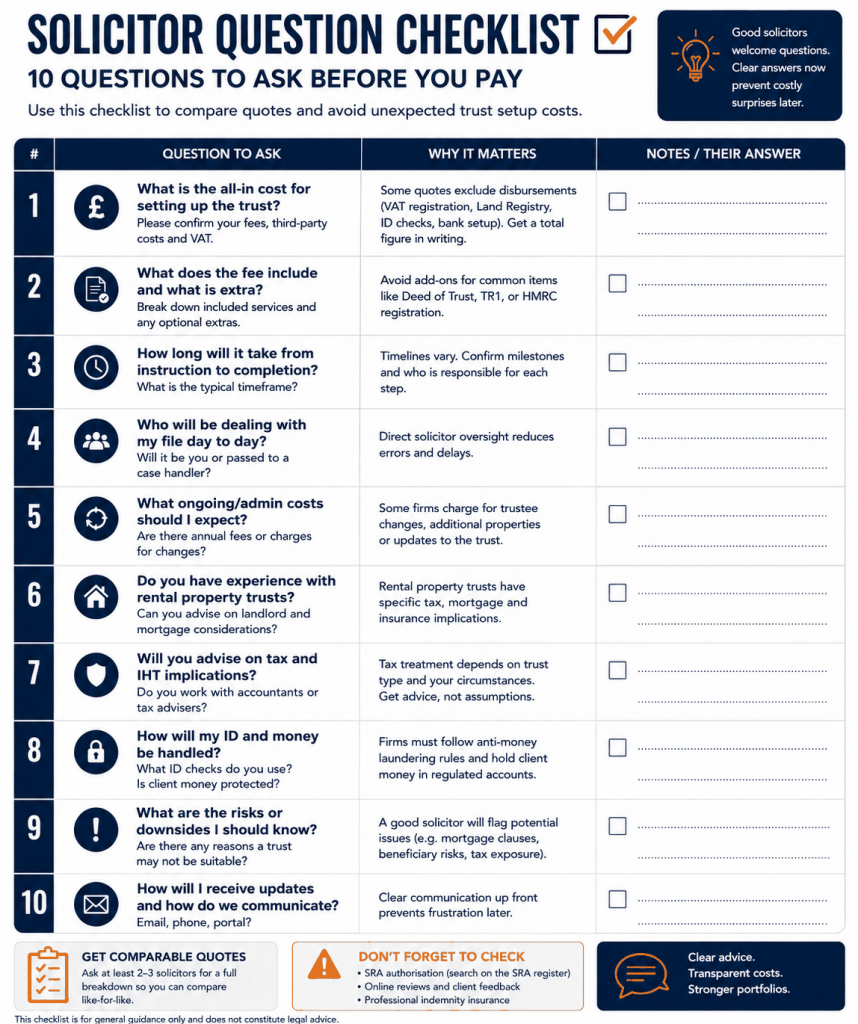
Step 3: Find a specialist trust solicitor. Not every solicitor handles trust work regularly. Check the Solicitors Regulation Authority (SRA) register to verify qualifications. Look for a member of STEP (the Society of Trust and Estate Practitioners).
Step 4: Get your property valued. You’ll need a formal market valuation for tax purposes. An RICS-registered surveyor or qualified estate agent can provide this. The valuation date matters because it sets the base cost for future CGT calculations.
Step 5: Draft the trust deed. Your solicitor prepares the trust deed, which sets out the trustees, beneficiaries, trustee powers, and distribution rules. Read it carefully. Ask questions. This document governs everything.
Step 6: Transfer the property title at Land Registry. Your solicitor handles the transfer of legal title from you (as individual owner) to you (as trustee) or to your chosen trustees. This is done via a TR1 transfer form, and the Land Registry title is updated with a restriction noting the trust.
Step 7: Register with HMRC Trust Registration Service. Most trusts must be registered with HMRC via the TRS, even if no tax is due. The deadline is 90 days from the trust’s creation for taxable trusts. Your solicitor or accountant can handle this.
Step 8: Set up ongoing administration. Appoint an accountant to handle annual trust tax returns. Draft a Letter of Wishes setting out (non-bindingly) how you’d like the trustees to exercise their discretion. Set diary reminders for the 10-year anniversary charge if it’s a discretionary trust.
Should you actually put your house in a trust?
Trusts are a tool. A powerful one, but not the right one for every job.
When it makes sense
- Blended families where you need to balance providing for a spouse against protecting children’s inheritance
- Vulnerable beneficiaries who can’t manage a large inheritance
- Genuine asset protection for business owners or professionals in high-risk fields (set up well before any claims arise)
- Probate avoidance where speed of access matters
- Bare trust transfers where you’re confident of surviving seven years and want to remove a property from your IHT estate
- Landlords with buy-to-let portfolios looking to pass rental properties to the next generation tax-efficiently
When it’s probably not the right choice
- Care fee avoidance – the rules are stacked against you, and the cost of setting up a trust you can’t rely on is money wasted
- Simple estates with a single property passing to direct descendants – the nil-rate band plus RNRB gives a couple up to £1,000,000 tax-free without a trust
- Sole homeowners with direct descendants – you’ll lose the RNRB for no good reason
- Anyone who can’t afford the ongoing costs – a trust that falls into non-compliance creates more problems than it solves
Alternative options worth considering
Before committing to a trust, consider these alternatives:
- Gifting the property outright – simpler, cheaper, and if you survive seven years, it’s outside your estate for IHT. But you give up all control and rights to live there (unless you pay market rent).
- Tenants in common – severing a joint tenancy so each spouse owns a defined share. The first to die can then leave their share to children via a Will while the survivor keeps their share. Simple, cheap, no trust needed.
- Life insurance – a whole-of-life policy written in trust can provide cash to pay the IHT bill without you having to give up your property at all.
- A well-drafted Will – for many people, a properly written Will (possibly including a Will trust that only activates on death) achieves the same goals as a lifetime trust at a fraction of the cost and complexity.
How AMS Housing Group can help
AMS Housing Group doesn’t sell trust services, and we’re not solicitors. That means we can be impartial about whether a trust is right for you.
What we do specialise in is property management across London. If your trust holds rental property, or if you’re considering transferring a buy-to-let into a trust, proper management matters more than ever. Trustees have a legal duty to manage trust assets responsibly, and that includes maintaining rental properties to a high standard and maximising income for beneficiaries.
Here’s where we can help:
- Property valuations – if you need a current market valuation of your rental property for trust purposes, our team can provide one
- Guaranteed rent for trust-owned properties – a fixed monthly income regardless of voids or tenant issues, paid directly to the trustees
- Full property management – from tenant finding and referencing to maintenance, compliance, and rent collection, we handle everything
- HMO management – if the trust property is a house in multiple occupation, we have specialist experience in this area
If you’d like to discuss how we can support a trust-owned property, or if you’re a landlord weighing up your options, get in touch.
Frequently asked questions
How much does it cost to put your house in a trust UK?
Setup costs range from £1,000 for a simple bare trust to £5,000+ for a discretionary trust, plus VAT. But the total cost including SDLT, Land Registry fees, and ongoing administration can be much higher, potentially £20,000+ in the first year for a discretionary trust on a typical property.
Can I still live in my house if it’s in a trust?
That depends on the trust type. With a life interest trust, you can live there as the life tenant. With a bare trust or discretionary trust where you continue to live in the property without paying market rent, HMRC will treat the property as still part of your estate under the Gift with Reservation of Benefit rules, defeating the IHT purpose entirely.
Does putting a house in trust avoid inheritance tax?
Not automatically. A bare trust transfer is a PET that falls outside your estate after seven years. But a discretionary trust triggers an immediate 20% charge above £325,000, plus ongoing anniversary and exit charges. And you lose the £175,000 residence nil-rate band on lifetime transfers, which can actually increase your overall IHT bill.
What is the cheapest type of trust to set up?
A bare trust is the cheapest, typically costing £1,000–£1,500 in solicitor fees. Trust Wills (starting from around £449 for a single Will) are even cheaper if you only need the trust to take effect on death.
Can the council force me to sell my house for care home fees if it’s in a trust?
The council can’t force the sale of a property held in trust. But they can assess the value as “notional capital” under the deprivation of assets rules if they believe the transfer was motivated by avoiding care costs. There is no time limit on how far back they can look. You’d then be assessed as if you still owned it.
Do I lose the residence nil-rate band if I put my house in trust?
Yes, if it’s a lifetime transfer. The RNRB (£175,000 per person) only applies when a qualifying residence passes to direct descendants on death, not when it’s transferred into a trust during your lifetime. For a couple, that’s a potential £350,000 of tax-free allowance lost.
What changed for trusts in the 2024 Autumn Budget?
The main changes: CGT rates for trusts rose to a flat 24% on all assets (from 20% on non-residential), the nil-rate band freeze was extended to 2030/31, and from April 2027 unused pensions will be included in estates for IHT. This changes the planning equation for many families.
How long does it take to put a house in trust?
Typically 4-8 weeks from instruction to completion. The trust deed drafting takes 1-2 weeks, Land Registry transfer takes 2-4 weeks, and HMRC registration can be done within 90 days. Complex situations (multiple properties, disputes about terms, or tax advice requirements) can take longer.
Is it better to put a house in trust or gift it?
It depends on what you’re trying to achieve. An outright gift is simpler and cheaper, and if you survive seven years, it’s fully outside your estate. But you give up all control and all rights. A trust lets you retain some control through the trustee structure and can protect against beneficiary divorce, bankruptcy, or poor decisions. The trade-off is cost and complexity.
Do I pay stamp duty when transferring property into a trust?
For bare trusts where the transfer is a gift with no mortgage, SDLT is generally not payable. For discretionary trusts, SDLT is charged at the higher (additional property) rates: 5% on the first £125,000, 7% on the next £125,000, and so on. On a £300,000 property, that’s £20,000 in SDLT alone.
This article is for general informational purposes only and does not constitute legal, tax, or financial advice. Always consult a qualified solicitor and tax adviser before setting up a trust. Tax rules and thresholds can change. The figures in this article are based on legislation and rates in effect as of February 2026.