What is Rent to Rent? A Complete UK Guide (2026)
Key Takeaways:
- Rent to rent is a property strategy where an operator rents a property from a landlord at a fixed rate, then sublets it to tenants at a higher rate to pocket the difference.
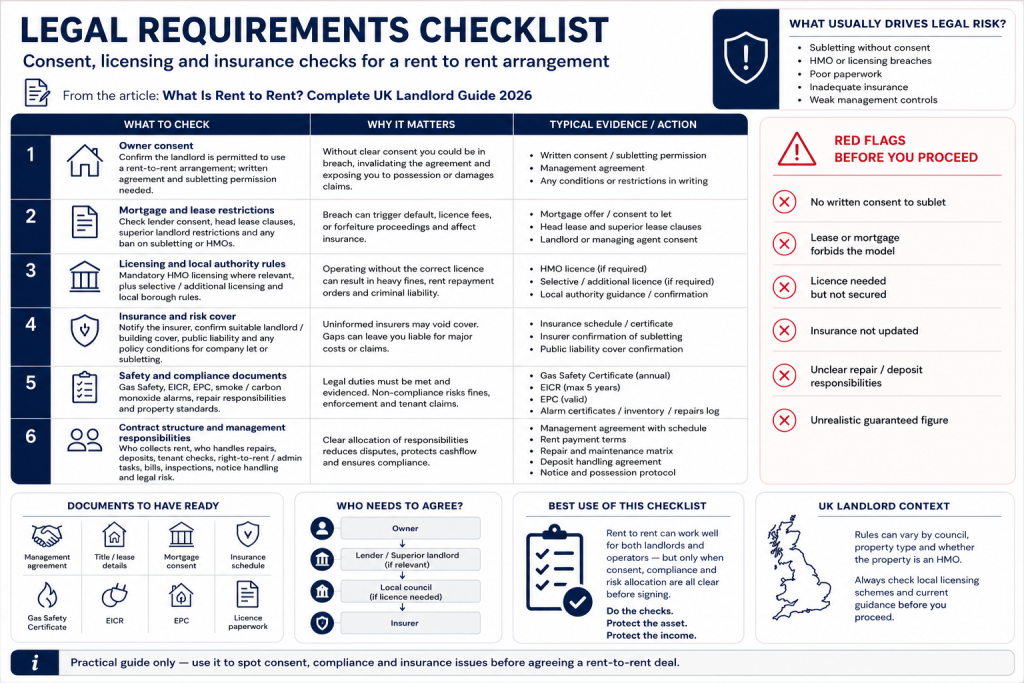
- Rent to rent is legal in the UK, but only when the landlord gives written consent, the operator holds the correct HMO licence, and the arrangement complies with mortgage and insurance terms.
- The Renters’ Rights Act 2025 abolishes Section 21 no-fault evictions from 1 May 2026, making it harder for R2R operators to manage tenant turnover and significantly changing the risk profile for all parties.
- Typical R2R operators target a 20-30% profit margin, but landlords typically receive less income and carry more risk than with a professional guaranteed rent scheme.
- For landlords who want hands-off income without the risks of unregulated operators, a guaranteed rent scheme with an established provider gives you the same benefits with proper insurance, compliance handling, and accountability.
You own a three-bedroom house in East London. A well-dressed stranger knocks on your door, explains he runs a property business, and offers to pay your rent for the next three years — guaranteed, every month, even if the place sits empty. All he needs is your permission to sublet to tenants he’ll find himself. Sounds perfect. Until the council contacts you six months later about an unlicensed HMO, your mortgage lender flags a breach of your loan terms, and your building insurance turns out to have been void since the day the arrangement started.
That scenario plays out across the UK every week. Rent to rent has exploded in popularity over the past decade, but most landlords we speak to don’t fully understand how it works or what can go wrong. Done properly, with the right agreements and compliance in place, it can work. Done badly, it can leave landlords facing unlimited fines, mortgage recalls, and properties damaged beyond recognition.
At AMS Housing Group, we operate a professional guaranteed rent service in East London, so we see both sides of this coin daily. This guide covers everything you need to know about rent to rent in 2026: how it works, when it’s legal, the genuine risks, and how it compares to guaranteed rent from a regulated provider.

What is Rent to Rent?
Rent to Rent Definition
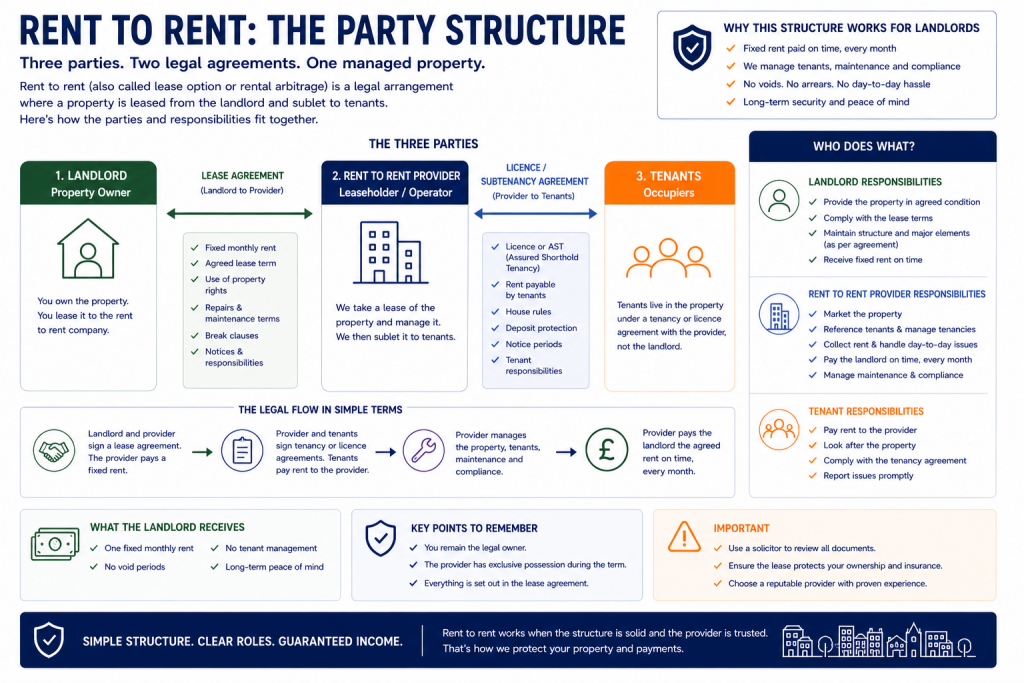
Rent to rent (sometimes written as R2R or rent-2-rent) is a property strategy where a person or company rents a property from a landlord at a fixed monthly rate, then sublets that property to other tenants at a higher rate. The operator keeps the difference as profit.
The operator becomes a middleman between the landlord and the end tenants. The landlord gets a guaranteed income without managing the property. The operator takes on the management responsibility and earns a margin for doing so. The tenants get a place to live.
In practice, rent to rent most commonly involves converting a standard residential property into a House in Multiple Occupation (HMO) — letting individual rooms to separate tenants rather than the whole property to a single household. A three-bedroom house rented from the landlord for £1,500 per month might generate £2,200 when each room is let individually. The operator pockets the £700 difference, minus running costs.
R2R isn’t limited to HMOs. Some operators use properties for serviced accommodation, corporate housing, or student HMO guaranteed rent arrangements. The underlying model is the same: rent from the landlord, sublet to tenants, keep the margin.
Rent to Rent vs Subletting: What is the Difference?
Subletting is when a tenant re-lets part or all of their rented property to someone else. It’s usually small-scale and informal — and most tenancy agreements prohibit it without the landlord’s written consent.
Rent to rent is subletting turned into a business model. The operator doesn’t live in the property. They rent it specifically to sublet it at a profit, often to multiple tenants. The commercial scale and intent are what separate rent to rent from casual subletting.
The legal implications differ too. An operator managing a property with three or more unrelated tenants triggers HMO licensing requirements, fire safety regulations, and compliance duties that don’t apply to simple subletting.
How Does Rent to Rent Work? (Step by Step)
A typical rent-to-rent deal follows six stages.

Step 1: The Operator Finds a Suitable Property
R2R operators look for properties where the gap between what the landlord wants and what tenants will pay is wide enough to generate profit. They target areas with strong room-rental demand, landlords tired of managing tenants, and properties with layouts that convert well into multi-lets.
Step 2: Negotiating and Signing the Lease Agreement
A well-structured R2R deal uses a commercial lease or management agreement rather than a standard Assured Shorthold Tenancy (AST). Key terms include fixed monthly rent to the landlord (usually 70-85% of market rate), lease duration (commonly 3-5 years), permission to sublet, and responsibility for maintenance, licensing, and compliance.
The landlord’s mortgage lender and insurer must be notified and must consent. This step is skipped far too often — and it’s where the majority of legal problems originate.
Step 3: Property Conversion or Improvement
Many operators invest £3,000-£15,000 in setup costs before subletting: converting reception rooms into bedrooms, installing en-suites, adding fire doors and smoke alarms, and furnishing to a lettable standard. This upfront investment is one reason R2R deals run for 3-5 years — the operator needs time to recoup their outlay.
Step 4: Subletting to Tenants
The operator advertises individual rooms and finds tenants. Each tenant signs a tenancy agreement with the operator — not with the landlord. If the operator disappears or fails, those subtenants are still occupying the landlord’s property, and removing them becomes the landlord’s problem and cost.
Step 5: Ongoing Management and Compliance
The operator handles day-to-day management: collecting rent, coordinating repairs, managing tenant turnover, and maintaining compliance. For HMOs, this includes annual gas safety certificates, EICRs every 5 years, fire risk assessments, minimum room sizes, and Right to Rent checks on every tenant.
Whether operators actually maintain full compliance is another matter — and one of the biggest risks landlords face.
Step 6: End of Term and Handover
When the lease expires, the property is returned to the landlord. Three to five years of multi-occupancy use takes a toll. Operators may have made unapproved alterations. Deposit disputes with subtenants may be unresolved. And if the operator has gone out of business, the landlord inherits whatever state the property is in.
Is Rent to Rent Legal in the UK?
The short answer: yes, rent to rent is legal — but only when specific conditions are met. Cross certain lines and it becomes a criminal offence.
When Rent to Rent is Legal
Rent to rent is lawful when all of the following apply:
- The landlord gives explicit written consent to subletting
- The mortgage lender consents (most buy-to-let mortgages prohibit R2R arrangements)
- Appropriate insurance is in place — standard landlord insurance won’t cover multi-occupancy
- The correct licences are held — if the property qualifies as an HMO, the operator must hold a valid licence
- Planning permission has been obtained where required
- All safety regulations are met — gas, electrical, fire safety, minimum room sizes
- Tenant deposits are protected in a government-approved scheme
When Rent to Rent Becomes Illegal
Rent to rent crosses into illegality when operators sublet without consent, operate an unlicensed HMO (unlimited fines under the Housing Act 2004), breach mortgage terms, fail to protect tenant deposits, overcrowd the property, or fail to conduct Right to Rent checks (fines up to £3,000 per tenant).
Local authorities can issue Rent Repayment Orders forcing the operator or landlord to repay up to 12 months’ rent. In the worst cases, criminal prosecution follows.
Renters’ Rights Act 2025: What Changes in 2026
The Renters’ Rights Act 2025 rewrites the rules for private renting in England, with core provisions taking effect on 1 May 2026. Here’s what matters for rent to rent:
Section 21 no-fault evictions are gone. All evictions must use Section 8, requiring specific grounds. R2R operators who relied on Section 21 to manage tenant turnover no longer have that option.
Fixed-term tenancies are abolished too. All private tenancies become rolling periodic tenancies. Subtenants can leave with two months’ notice at any time, which undermines the income predictability R2R models depend on.
Rent increases are limited to once per year via Section 13, challengeable at tribunal. Pre-agreed escalation clauses are voided.
The Decent Homes Standard now extends to private rentals. Awaab’s Law requires hazards like damp and mould to be addressed within set timescales.
A Private Rented Sector Database launches in late 2026. Landlords must register. Civil penalties for non-compliance range from £7,000 to £40,000.
These changes make rent to rent considerably more complex for all parties. Understanding the full scope of new landlord rules is now essential.
Rent to Rent: A Worked Example
Here’s a realistic worked example based on a three-bedroom terraced house in Barking, East London.
Property: 3-bed terraced house | Market rent: £1,800/month | R2R operator pays landlord: £1,400/month (78% of market rate)
The operator converts the property into a 4-room HMO and lets each room individually.
| Income/Expense | Monthly | Annual |
|---|---|---|
| Room 1 rent | £650 | £7,800 |
| Room 2 rent | £625 | £7,500 |
| Room 3 rent | £600 | £7,200 |
| Room 4 rent | £575 | £6,900 |
| Total rental income | £2,450 | £29,400 |
| Rent to landlord | -£1,400 | -£16,800 |
| Council tax | -£180 | -£2,160 |
| Utilities (gas, electric, water, broadband) | -£280 | -£3,360 |
| HMO licence (amortised over 5 years) | -£25 | -£300 |
| Insurance | -£45 | -£540 |
| Maintenance/repairs | -£120 | -£1,440 |
| Furnishing/setup (amortised over 3 years) | -£200 | -£2,400 |
| Total expenses | -£2,250 | -£27,000 |
| Net profit | £200 | £2,400 |
That £200 per month assumes 100% occupancy. One void month in one room costs £600+. One major repair or non-paying tenant eliminates the margin entirely. The operator also carries all the management burden, compliance risk, and financial liability.
Landlord’s position with R2R: £1,400/month, zero management — but carrying risks around licensing, mortgage compliance, insurance validity, and property condition at the end of the lease.
Landlord’s position with a professional guaranteed rent scheme: Similar fixed income (typically 80-90% of market rate), but with proper insurance, regulatory compliance handled by an established company, membership of a property redress scheme, and professional property management. See our guide on how guaranteed rent is calculated for a deeper look at the figures.

Rent to Rent vs Guaranteed Rent: What is the Difference?
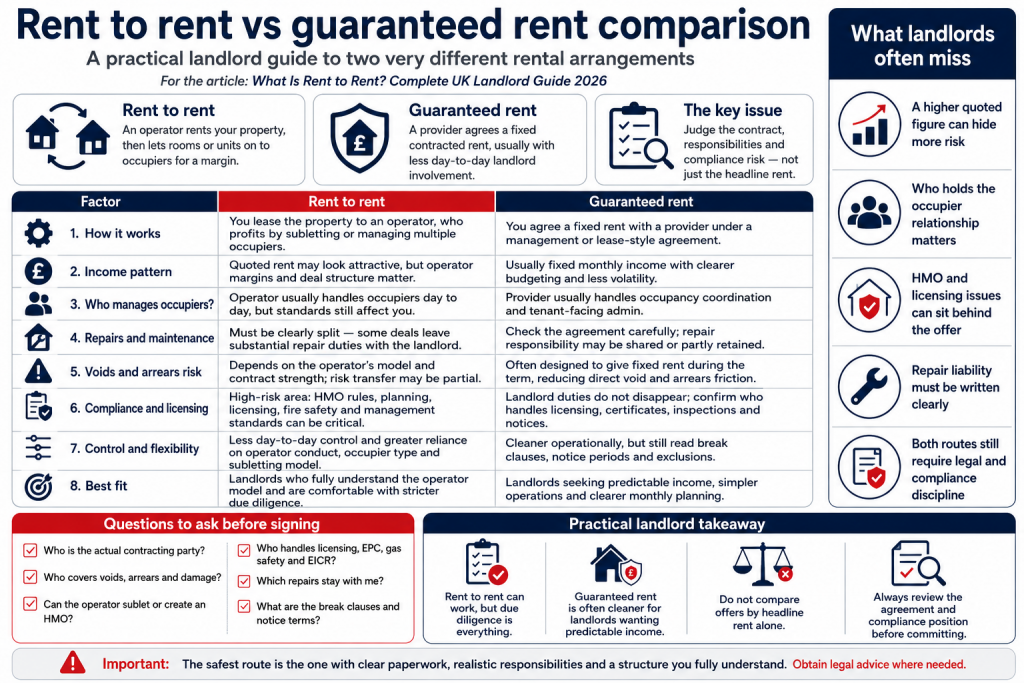
This is the comparison that matters most for landlords weighing their options. Both models share the same basic structure: someone rents your property and sublets it. But the way they do it, and what protections you get, are completely different.
How Guaranteed Rent Schemes Work
With a guaranteed rent scheme, a professional property management company leases your property for a fixed term (typically 1-5 years) and pays you a set monthly rent from day one. The company handles tenant sourcing, management, compliance, and maintenance, all at their own cost.
Think of it this way: a professional guaranteed rent provider is to an R2R operator what a regulated financial adviser is to someone who says he’s good with money.
Key Differences Between R2R and Guaranteed Rent
| Factor | Rent to Rent (Informal Operator) | Guaranteed Rent (Professional Provider) |
|---|---|---|
| Who you’re dealing with | Individual or small unregulated business | Established company with verifiable track record |
| Insurance | Often inadequate or non-existent | Comprehensive landlord and public liability cover |
| Redress scheme membership | Rarely | Required — Property Redress Scheme or equivalent |
| Client money protection | Rarely | Industry standard |
| Compliance handling | Quality varies wildly | All licensing, safety certs, and legal compliance managed |
| Deposit protection | Sometimes neglected | Protected in government-approved scheme |
| Rent level | 70-80% of market rate | 80-90% of market rate |
| Contract transparency | Often informal or poorly drafted | Professional contracts reviewed by solicitors |
| Maintenance | Variable quality | Scheduled inspections, professional contractors |
| What happens if they fail | You inherit tenants, damage, and compliance gaps | Company obligations, insurance, regulatory accountability |
Why Many Landlords Prefer Guaranteed Rent
The landlords who come to us after a bad R2R experience always say the same thing: “I thought I was getting guaranteed rent.” The operator promised a fixed monthly payment, but that’s where the similarity ended.
A professional provider gives you verified financial backing, regulatory accountability through ombudsman schemes, proper insurance, regular inspections, and compliance handling that keeps you out of trouble with the council.
Many landlords find that net returns from guaranteed rent match or beat traditional letting once voids, agent fees, and maintenance are factored in. Our guide on how much guaranteed rent costs breaks down the real numbers. For a broader comparison, read our article on guaranteed rent vs traditional letting.
What Are the Risks of Rent to Rent?
Rent to rent concentrates risk in ways that aren’t always obvious at the outset.
Risks for Landlords
Your insurance probably won’t cover it. Standard buy-to-let policies don’t cover HMO use or commercial subletting. If the operator converts your property into a multi-let without updated insurance, any claim gets rejected.
Your mortgage lender might call in the loan. Most buy-to-let mortgages explicitly prohibit R2R. Discovery can trigger immediate full repayment. Lenders actively monitor for this.
You could be liable for HMO licensing failures. Licensing obligations often fall on the property owner, not the operator. If the operator fails to obtain the required HMO licence, you face unlimited fines, Rent Repayment Orders, and potential criminal prosecution.
The property takes a beating. Multi-occupancy generates heavy wear. At the end of a 3-5 year lease, remediation costs of £5,000-£20,000 are common. Understanding typical landlord costs helps put these figures in perspective.
The operator might disappear. If they go bust, you inherit tenants you didn’t choose, didn’t vet, and have no agreements with. Removing them through the eviction process can take 6-12 months.
Risks for Tenants
If the operator loses the lease or stops paying the landlord, tenants can face eviction despite paying their own rent on time. Their tenancy status is often unclear.
Some operators fail to protect deposits in government-approved schemes, leaving tenants without legal protections when they move out.
Operators on thin margins cut corners on repairs. Slow response times and deferred maintenance are common complaints.
Risks for Rent-to-Rent Operators
Net profit of £200/month on a four-room HMO is typical. One void period or major repair eliminates it.
Years of management work, and the property still belongs to the landlord. No equity, no asset.
With Section 21 abolished from May 2026, removing non-paying subtenants takes 6-9 months through the courts. The operator keeps paying the landlord throughout.
Legal Requirements for Rent to Rent in the UK
Every R2R arrangement must meet these legal requirements. Skip any of them and you’re exposed.
HMO Licensing
Any property with 3+ people from 2+ households sharing facilities is an HMO. Mandatory licensing applies to HMOs with 5+ occupants, and many councils run additional schemes covering smaller HMOs. Licence costs: £500-£2,000. Penalties for operating without one: unlimited fines plus Rent Repayment Orders up to 12 months’ rent.
In East London, Barking and Dagenham, Newham, and Waltham Forest all operate extensive selective licensing schemes.
Planning Permission
Converting from C3 (dwelling) to C4 (small HMO, 3-6 occupants) may require planning permission depending on local Article 4 directions. Larger HMOs (7+ occupants) almost always require consent. This risk falls on the property owner.
Mortgage Lender Consent
Most buy-to-let mortgages prohibit R2R. Written consent from the lender is essential. Proceeding without it can trigger immediate loan recall.
Insurance Requirements
Standard landlord insurance doesn’t cover multi-occupancy, commercial subletting, or third-party management. Both landlord and operator need appropriate policies. Rent guarantee insurance is a separate product that covers different risks.
Deposit Protection
Every subtenant deposit must be protected in a government-approved scheme within 30 days. Penalties for non-compliance: 1-3x the deposit amount per tenant.
Safety Certificates and Compliance
R2R properties need annual gas safety certificates, EICRs every 5 years, a minimum EPC rating of E, fire safety measures (fire doors, alarms, emergency lighting for HMOs), legionella risk assessments, and furniture fire resistance compliance. For a full overview, read our guide to UK landlord responsibilities.
Right to Rent Checks
Every adult occupant must have their right to rent verified before moving in. Fines: up to £3,000 per tenant (first offence), £10,000 for repeat offences.

How Landlords Can Protect Themselves
Due Diligence Checklist Before Agreeing to Rent-to-Rent
Before signing anything, verify the operator’s company registration and trading history, ask for landlord references, inspect their insurance certificates, confirm redress scheme membership, assess their financial capacity to pay during voids, check their licensing knowledge, and confirm your own mortgage lender consent and insurance compatibility.
If the operator can’t satisfy every item on this list, walk away. For guidance on what to look for in a professional provider instead, read our guide on choosing a rent guarantee provider.
What to Include in a Rent-to-Rent Agreement
A robust agreement should cover permitted use, maximum occupancy, licensing obligations, maintenance responsibilities, inspection rights, insurance requirements, deposit handling, a detailed property condition schedule with photographs, end-of-term reinstatement obligations, break clauses, assignment restrictions, and regular compliance reporting.
Use a solicitor experienced in commercial property. A template downloaded from the internet won’t protect you when things go wrong.
The Safer Alternative: Working with a Guaranteed Rent Provider
For many landlords, the due diligence, legal complexity, and ongoing monitoring that R2R demands simply aren’t worth it — especially when a professional guaranteed rent scheme delivers the same core benefit (fixed income, zero management) with far greater protection.
At AMS Housing Group, we handle tenant sourcing, compliance, maintenance, and evictions, and we pay your rent on time, every month, regardless of occupancy. We carry full insurance, we’re members of recognised industry bodies, and we’ve been doing this in East London long enough that our reputation speaks for itself.
Want to know what your property could earn? Get a free valuation — no obligation, no pressure.

Frequently Asked Questions About Rent to Rent
What is rent to rent?
Rent to rent is a property strategy where an operator rents a property from a landlord at a fixed rate, then sublets it to tenants at a higher rate. The operator keeps the difference as profit and handles all management and compliance.
Is rent to rent legal in the UK?
Yes, provided the landlord gives written consent, the mortgage lender approves, appropriate insurance is in place, correct HMO licences are obtained, tenant deposits are protected, and all safety regulations are met. Operating without these can result in unlimited fines and criminal prosecution.
How does rent to rent work?
An operator leases a property (typically at 70-85% of market rent), prepares it for multi-occupancy letting, sublets individual rooms, manages day-to-day operations, and returns the property at end of term. Profit comes from the gap between what they pay the landlord and collect from tenants.
What is the difference between rent to rent and guaranteed rent?
Both involve a third party renting and subletting your property. Rent to rent typically involves unregulated individuals. Guaranteed rent is provided by established companies with insurance, redress scheme membership, and regulatory accountability. Providers also typically pay 80-90% of market rate versus 70-80%.
What are the risks of rent to rent for landlords?
Insurance invalidation, mortgage breach, HMO licensing liability, property damage, regulatory non-compliance, and operator failure. If an operator goes bust, the landlord inherits tenants they didn’t vet and compliance breaches they didn’t cause.
Do you need a licence for rent to rent?
If the property houses 3+ people from 2+ households, it’s an HMO requiring a local authority licence. Costs range from £500 to £2,000. Operating without one carries unlimited fines.
Can you do rent to rent with a mortgage?
Only with the lender’s explicit written consent. Most buy-to-let mortgages prohibit it. Proceeding without consent can trigger immediate loan recall.
Is rent to rent the same as subletting?
Related but different. Subletting is when a tenant re-lets their property informally. Rent to rent is subletting as a deliberate business model — commercial scale, profit motive, and additional licensing and regulatory requirements.
Is Rent to Rent Worth It?
Rent to rent can work when operators are professional, well-capitalised, properly insured, and fully compliant. But the low barrier to entry means the market is flooded with inexperienced operators running on thin margins with inadequate protections. The Renters’ Rights Act 2025, taking effect from 1 May 2026, raises the bar further.
For landlords, the real question isn’t “is rent to rent worth it?” It’s “is the person proposing to rent my property trustworthy, competent, and properly set up?” If you’ve done thorough due diligence and the answer is yes, R2R can be viable.
But if you want guaranteed income, zero management, and someone else handling compliance — without the risks of an unregulated operator — then a professional guaranteed rent scheme is the smarter choice. Read about whether guaranteed rent is worth it from landlords who’ve made the switch, or explore the common myths about rent guarantees that might be holding you back.
At AMS Housing Group, we offer guaranteed rent to landlords across East London and beyond. Fixed monthly payments from day one, full property management, complete compliance handling, and a company with a proven track record standing behind every agreement.
Ready to find out what your property could earn? Get a free valuation today or get in touch to speak with our team.

{
“@context”: “https://schema.org”,
“@type”: “Article”,
“headline”: “What is Rent to Rent? A Complete UK Guide (2026)”,
“description”: “Complete guide to rent to rent in the UK. Learn how R2R works, when it’s legal, the risks for landlords, legal requirements, and how it compares to professional guaranteed rent schemes.”,
“author”: {
“@type”: “Organization”,
“name”: “AMS Housing Group”,
“url”: “https://www.amshousinggroup.com”
},
“publisher”: {
“@type”: “Organization”,
“name”: “AMS Housing Group”,
“logo”: {
“@type”: “ImageObject”,
“url”: “https://www.amshousinggroup.com/wp-content/uploads/2016/08/logo@2x.webp”
}
},
“datePublished”: “2017-04-24”,
“dateModified”: “2026-03-12”,
“mainEntityOfPage”: “https://www.amshousinggroup.com/what-is-rent-to-rent/”,
“image”: “https://www.amshousinggroup.com/wp-content/uploads/2026/03/r2r-london-terraces-scaled.webp”
}
{
“@context”: “https://schema.org”,
“@type”: “HowTo”,
“name”: “How Rent to Rent Works: 6 Steps”,
“description”: “A step-by-step breakdown of how a typical rent-to-rent deal is structured, from finding a property to end-of-term handover.”,
“step”: [
{
“@type”: “HowToStep”,
“name”: “Find a Suitable Property”,
“text”: “The R2R operator identifies properties where the gap between what the landlord wants and what tenants will pay is wide enough to generate profit. They target areas with strong room-rental demand, landlords tired of managing tenants, and properties with layouts that convert well into multi-lets.”
},
{
“@type”: “HowToStep”,
“name”: “Negotiate and Sign the Lease Agreement”,
“text”: “A well-structured R2R deal uses a commercial lease or management agreement rather than a standard AST. Key terms include fixed monthly rent to the landlord (usually 70-85% of market rate), lease duration (commonly 3-5 years), permission to sublet, and responsibility for maintenance, licensing, and compliance. The landlord’s mortgage lender and insurer must consent.”
},
{
“@type”: “HowToStep”,
“name”: “Property Conversion or Improvement”,
“text”: “Many operators invest u00a33,000-u00a315,000 in setup costs before subletting: converting reception rooms into bedrooms, installing en-suites, adding fire doors and smoke alarms, and furnishing to a lettable standard.”
},
{
“@type”: “HowToStep”,
“name”: “Sublet to Tenants”,
“text”: “The operator advertises individual rooms and finds tenants. Each tenant signs a tenancy agreement with the operator, not with the landlord. If the operator disappears or fails, those subtenants are still occupying the landlord’s property.”
},
{
“@type”: “HowToStep”,
“name”: “Ongoing Management and Compliance”,
“text”: “The operator handles day-to-day management: collecting rent, coordinating repairs, managing tenant turnover, and maintaining compliance including annual gas safety certificates, EICRs every 5 years, fire risk assessments, minimum room sizes, and Right to Rent checks on every tenant.”
},
{
“@type”: “HowToStep”,
“name”: “End of Term and Handover”,
“text”: “When the lease expires, the property is returned to the landlord. Three to five years of multi-occupancy use takes a toll. Operators may have made unapproved alterations, deposit disputes with subtenants may be unresolved, and the landlord inherits whatever state the property is in.”
}
]
}
{
“@context”: “https://schema.org”,
“@type”: “FAQPage”,
“mainEntity”: [
{
“@type”: “Question”,
“name”: “What is rent to rent?”,
“acceptedAnswer”: {
“@type”: “Answer”,
“text”: “Rent to rent is a property strategy where an operator rents a property from a landlord at a fixed rate, then sublets it to tenants at a higher rate. The operator keeps the difference as profit and handles all management and compliance.”
}
},
{
“@type”: “Question”,
“name”: “Is rent to rent legal in the UK?”,
“acceptedAnswer”: {
“@type”: “Answer”,
“text”: “Yes, provided the landlord gives written consent, the mortgage lender approves, appropriate insurance is in place, correct HMO licences are obtained, tenant deposits are protected, and all safety regulations are met. Operating without these can result in unlimited fines and criminal prosecution.”
}
},
{
“@type”: “Question”,
“name”: “How does rent to rent work?”,
“acceptedAnswer”: {
“@type”: “Answer”,
“text”: “An operator leases a property (typically at 70-85% of market rent), prepares it for multi-occupancy letting, sublets individual rooms, manages day-to-day operations, and returns the property at end of term. Profit comes from the gap between what they pay the landlord and collect from tenants.”
}
},
{
“@type”: “Question”,
“name”: “What is the difference between rent to rent and guaranteed rent?”,
“acceptedAnswer”: {
“@type”: “Answer”,
“text”: “Both involve a third party renting and subletting your property. Rent to rent typically involves unregulated individuals. Guaranteed rent is provided by established companies with insurance, redress scheme membership, and regulatory accountability. Providers also typically pay 80-90% of market rate versus 70-80%.”
}
},
{
“@type”: “Question”,
“name”: “What are the risks of rent to rent for landlords?”,
“acceptedAnswer”: {
“@type”: “Answer”,
“text”: “Insurance invalidation, mortgage breach, HMO licensing liability, property damage, regulatory non-compliance, and operator failure. If an operator goes bust, the landlord inherits tenants they didn’t vet and compliance breaches they didn’t cause.”
}
},
{
“@type”: “Question”,
“name”: “Do you need a licence for rent to rent?”,
“acceptedAnswer”: {
“@type”: “Answer”,
“text”: “If the property houses 3 or more people from 2 or more households, it is an HMO requiring a local authority licence. Costs range from u00a3500 to u00a32,000. Operating without one carries unlimited fines.”
}
},
{
“@type”: “Question”,
“name”: “Can you do rent to rent with a mortgage?”,
“acceptedAnswer”: {
“@type”: “Answer”,
“text”: “Only with the lender’s explicit written consent. Most buy-to-let mortgages prohibit it. Proceeding without consent can trigger immediate loan recall.”
}
},
{
“@type”: “Question”,
“name”: “Is rent to rent the same as subletting?”,
“acceptedAnswer”: {
“@type”: “Answer”,
“text”: “Related but different. Subletting is when a tenant re-lets their property informally. Rent to rent is subletting as a deliberate business model with commercial scale, profit motive, and additional licensing and regulatory requirements.”
}
}
]
}
{
“@context”: “https://schema.org”,
“@type”: “BreadcrumbList”,
“itemListElement”: [
{
“@type”: “ListItem”,
“position”: 1,
“name”: “Home”,
“item”: “https://www.amshousinggroup.com/”
},
{
“@type”: “ListItem”,
“position”: 2,
“name”: “Guaranteed Rent”,
“item”: “https://www.amshousinggroup.com/guaranteed-rent/”
},
{
“@type”: “ListItem”,
“position”: 3,
“name”: “What is Rent to Rent?”,
“item”: “https://www.amshousinggroup.com/what-is-rent-to-rent/”
}
]
}