Key Takeaways:
- Check Companies House registration, filing history, and director stability before signing with any guaranteed rent provider
- The Renters’ Rights Act 2025 abolishes Section 21 from 1 May 2026, making provider selection more critical than ever
- Red flags include upfront fees, above-market-rate offers, no physical office, and refusal to share a sample contract
- Use the 10-point checklist and 10 interview questions below to compare providers objectively
- Guaranteed rent and rent guarantee insurance are completely different products — make sure you know which one you need
A landlord in Lewisham recently told us he’d signed a three-year guaranteed rent contract with a company that folded eighteen months in. No rent. No communication. Just a registered letter from a liquidator and a property full of tenants he’d never vetted. He spent four months and over £6,000 sorting out the mess.
That story isn’t unusual. The guaranteed rent market in London has grown rapidly, and with it, the number of operators who lack the financial backing or operational capability to deliver on their promises. Some are well-established firms with decades of experience. Others are one-person outfits working from a laptop in a spare bedroom. From the outside, their websites can look almost identical.
This guide gives you a structured, practical framework for telling the difference. Whether you’re considering guaranteed rent for the first time or switching from a provider that’s let you down, the 10-point checklist below will help you evaluate any company and make a confident decision.
Guaranteed Rent vs Rent Guarantee Insurance — Know the Difference First
Before anything else, let’s clear up a confusion that trips up landlords constantly. Guaranteed rent and rent guarantee insurance sound similar but are fundamentally different products. Mixing them up leads to wrong expectations and poor decisions.
| Guaranteed Rent Company | Rent Guarantee Insurance | |
|---|---|---|
| What it is | A property management arrangement — the company becomes your tenant | An insurance policy you purchase annually |
| How you get paid | Fixed monthly rent paid directly to you, every month, regardless of occupancy | You submit a claim when a tenant falls into arrears — payout depends on policy terms |
| Void periods | Covered — you’re paid even when the property is empty | Not covered — insurance only kicks in when a tenant stops paying |
| Property management | Fully managed — the company handles tenants, maintenance, compliance | You manage everything yourself (or pay a letting agent separately) |
| Tenant sourcing | The company finds and vets tenants | You find your own tenants |
| Typical cost | You receive slightly below market rent (the difference is the company’s margin) | 2–5% of annual rent as a premium |
| Contract length | 1–5 years typically | 12 months, renewed annually |
| Best for | Landlords who want hands-off, hassle-free income | Landlords who self-manage but want a safety net against arrears |
If you’re looking for an insurance policy to cover tenant arrears, we’ve written a separate guide to rent guarantee insurance in the UK that covers providers, costs, and alternatives.
This article focuses entirely on choosing a guaranteed rent company — the type that takes over management of your property and pays you a fixed monthly rent.
The 10-Point Checklist for Choosing a Guaranteed Rent Company
Print this out or save it to your phone. When you’re sitting across from a guaranteed rent provider, these ten points will tell you whether they’re worth your time.
1. Company Registration and History
Start with the basics. Every legitimate guaranteed rent company should be registered at Companies House. Search for them at gov.uk/get-information-about-a-company and check:
- Incorporation date — How long have they been operating? Companies with five or more years of trading history have survived at least one market cycle.
- Filing history — Are their annual accounts and confirmation statements up to date? Late filings suggest poor administration.
- Director history — Have directors changed frequently? That can indicate instability.
- Active status — Sounds obvious, but check the company hasn’t been dissolved or is facing a strike-off action.
A company that’s been operating since 2009 or 2010 has weathered the post-financial-crisis rental market, the pandemic, and the current cost-of-living pressures. That longevity says something about their business model and financial resilience.
2. Physical Office Location
Visit in person if you can. A guaranteed rent company is going to manage your property — potentially for years. You need to know they have a real operational base, not just a virtual office address.
Look for:
- A permanent office you can visit (not a serviced address or PO box)
- Staff who work on-site and can answer operational questions
- Proximity to your property — local knowledge matters for tenant sourcing and maintenance response
A company based in your property’s area will have better relationships with local councils, tradespeople, and tenant networks. That makes a real difference to occupancy rates and maintenance response times.
3. Property Portfolio Size
Ask directly: how many properties does the company currently manage? A larger portfolio generally means:
- Financial stability — Revenue is spread across hundreds of properties, not dependent on a handful
- Operational experience — They’ve dealt with every scenario, from problem tenants to emergency repairs
- Economies of scale — Maintenance and compliance costs per property are lower
- Established processes — Systems for rent collection, inspections, and reporting are already in place
A company managing 500+ properties operates at a fundamentally different level to one managing 20. Both might offer guaranteed rent, but the risk profile for you as a landlord is vastly different.
4. Contract Terms
The contract is where guaranteed rent arrangements succeed or fail. Read every clause. Better yet, have a solicitor review it. Key areas to scrutinise:
- Contract length — Most providers offer 1–5 year agreements. Shorter contracts give you flexibility; longer ones give you certainty.
- Break clauses — Can either party exit early? Under what conditions? What notice is required?
- Renewal terms — Does the contract auto-renew? What’s the process for renegotiating rent at renewal?
- Termination notice — How much notice must you give, and what happens to existing tenants when the contract ends?
A provider who won’t show you a sample contract before you commit is not a provider you should be dealing with. Full stop.
5. What’s Included
The best guaranteed rent schemes are genuinely all-inclusive. That should mean:
- Tenant sourcing and vetting
- Rent collection (though with guaranteed rent, this is the company’s problem, not yours)
- Day-to-day maintenance and repairs
- Gas safety certificates, EPC, and electrical safety checks
- Inventory and check-in/check-out reports
- Regular property inspections (every 4–6 weeks is a good benchmark)
- Full property management at zero commission
Get this in writing. “We handle everything” means nothing unless it’s specified in the contract.

6. What’s NOT Included
Equally important: what costs still fall to you? Common exclusions include:
- Structural repairs (roof, subsidence, exterior walls)
- Boiler replacement (as opposed to boiler repair)
- Major appliance replacement
- Building insurance
- Mortgage payments (obviously, but worth stating)
- Service charges and ground rent on leasehold properties
The key question is where the line falls between “maintenance” (their responsibility) and “capital expenditure” (yours). Get a clear definition, ideally with a monetary threshold written into the contract. Understanding the full picture of landlord costs will help you work out what you’ll actually net each month.
7. Rent Review Mechanism
Is the guaranteed rent fixed for the entire contract term, or is it reviewed periodically? Both approaches have merits:
- Fixed for the full term — Maximum certainty. You know exactly what you’ll receive for the next 3–5 years. But if market rents rise sharply, you miss out.
- Annual review — The rent adjusts to reflect market conditions. Protects against inflation, but introduces some uncertainty.
Ask what happens if market rents fall. Can the company reduce your guaranteed rent at review? If so, is there a floor — a minimum amount below which it can’t drop? Understanding how guaranteed rent is calculated will help you evaluate whether any offer is reasonable.
8. Property Condition Requirements
Most guaranteed rent companies will inspect your property before making an offer. They need the property to meet a certain standard because they’re taking on the financial risk of tenanting it. Expect them to assess:
- General condition and decoration
- Kitchen and bathroom standards
- Heating and hot water systems
- Electrical installation condition
- Any outstanding compliance issues (landlord licensing, HMO requirements, fire safety)
A good provider will tell you upfront what work is needed — if any — and factor this into their offer. Some will even carry out minor works themselves as part of the onboarding. Be wary of any company that offers guaranteed rent without inspecting the property first. If you own a student HMO, the property condition bar tends to be even higher due to additional licensing and safety standards.
9. References and Reviews
Do your homework the same way you’d vet a tenant:
- Google Reviews — Look for patterns, not individual complaints. Every business gets the odd bad review. What matters is the overall picture and how the company responds.
- Trustpilot — Check their rating and read recent reviews specifically from landlords (not tenants, whose experience may differ).
- Landlord references — Ask the company for two or three landlord references you can contact directly. A confident provider will have no problem arranging this.
- Online forums — Property118, the NRLA forum, and landlord Facebook groups often have threads discussing specific guaranteed rent providers.
If a company has been operating for years with consistently positive feedback from landlords, that’s about as close to a guarantee as you’ll get — beyond the rent itself.
10. Accreditations and Partnerships
Professional accreditations signal that a company meets industry standards and submits to external oversight:
- ARLA Propertymark — The gold standard for letting agents and property managers. Members must hold client money protection insurance and meet ongoing training requirements.
- NRLA membership — Shows engagement with the landlord community and awareness of regulatory changes.
- The Property Ombudsman (TPO) — Membership means there’s an independent complaints process if things go wrong. This matters because guaranteed rent itself is largely unregulated — there’s no specific FCA or government regulator for these companies, which makes voluntary oversight all the more important.
- Local authority partnerships — Companies that work with councils on housing placement have passed institutional due diligence. Councils don’t partner with unreliable operators.
A company working with multiple London boroughs has, in effect, been vetted by public bodies with strict procurement standards. That’s a meaningful endorsement.
Red Flags: Signs of a Bad Guaranteed Rent Provider
Over the years, we’ve heard enough horror stories to identify the warning signs. Walk away from any provider that:
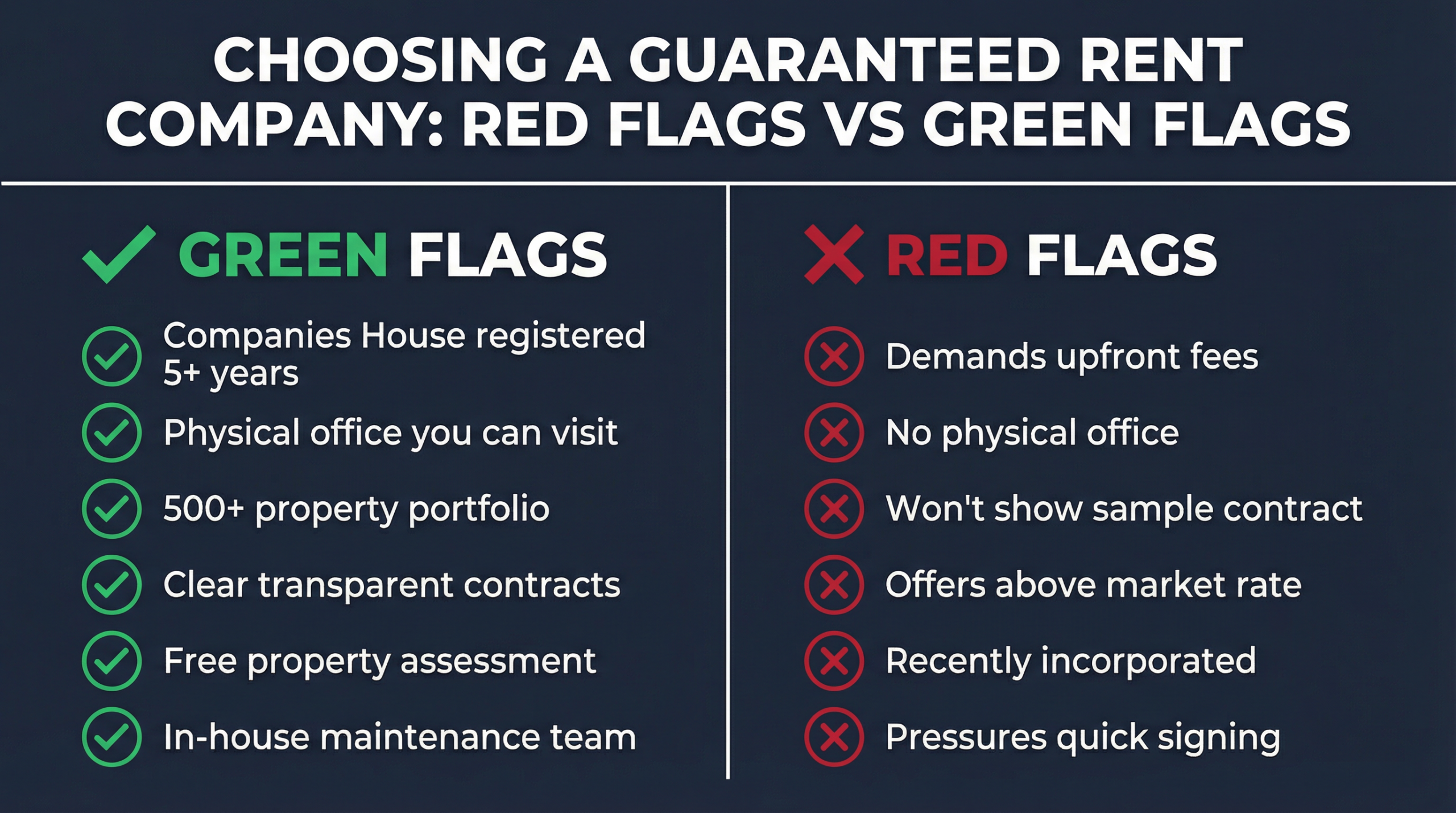
- Demands upfront fees before signing — Legitimate guaranteed rent companies don’t charge landlords to join. Their margin comes from the difference between what they pay you and what they collect from tenants.
- Has no physical office or named point of contact — If you can’t visit their premises or get a direct phone number for a specific person, that’s a problem.
- Won’t show you a sample contract before commitment — Any pushback on this is an immediate disqualifier.
- Offers guaranteed rent above market rate — This is the biggest red flag of all. If a company is promising you more than the property would fetch on the open market, ask yourself: where’s their margin coming from? Above-market offers are unsustainable and often signal a rent-to-rent operator who’ll overcrowd your property or disappear when the numbers stop working.
- Has no clear maintenance or compliance policy — Ask them: who handles emergency repairs at 2am on a Sunday? If they can’t give you a straight answer, they don’t have the infrastructure.
- Was recently incorporated with no track record — A company registered six months ago promising to guarantee your rent for five years hasn’t demonstrated it can survive five months.
- Pressures you to sign quickly without inspecting the property — Reputable providers always inspect first. They need to assess condition, estimate maintenance costs, and determine a sustainable rent. Anyone who skips this step is guessing — with your property.
- Has no ombudsman or redress scheme membership — Without membership of The Property Ombudsman or a similar body, you have no independent recourse if things go wrong. Given that the guaranteed rent industry has no dedicated regulator, this voluntary accountability is one of the few safeguards available.
Green Flags: What Good Providers Do
Conversely, here’s what sets reliable guaranteed rent companies apart:
- Free property assessment before quoting — They visit, inspect, and give you an honest appraisal before committing to a figure.
- Clear, transparent contract with no hidden fees — Everything is spelled out. No ambiguity about who pays for what.
- In-house maintenance team — Companies with their own tradespeople respond faster and control quality better than those who outsource everything.
- Council partnerships — Working with local authorities shows institutional trust and a stable tenant pipeline. This matters for your occupancy rates.
- Named account manager for your property — You should have a single point of contact who knows your property and can answer questions without putting you on hold.
- Regular property inspection reports — You should receive documented reports with photos after every inspection, typically every 4–6 weeks.
- Compliance handling included — The best providers handle compliance inspections, gas safety, electrical testing, and EPC renewals as part of their service so you don’t have to chase certificates yourself.
For instance, AMS Housing Group has operated since 2009, manages over 500 properties across London, and partners with more than 10 London borough councils. They’re a member of The Property Ombudsman, operate from a permanent office in Barking, have an in-house maintenance team, and charge zero upfront fees or commission. That kind of profile — long track record, institutional partnerships, physical presence, and scale — is what you should be benchmarking every provider against.

10 Questions to Ask Before Signing a Guaranteed Rent Contract
Sit down with your shortlisted providers and ask these questions. Pay close attention to how they answer — hesitation, vagueness, or deflection tells you as much as the answers themselves.
- “How long has your company been operating, and how many properties do you currently manage?”
Good answer: A specific number of years and a specific portfolio size. “Since 2009, currently managing over 500 properties.” Vague answers like “quite a few years” or “a good number” are not acceptable.
- “Can I visit your office and meet the team who’d manage my property?”
Good answer: “Absolutely, here’s the address. Come any weekday.” Any reluctance is a red flag.
- “Can I see a sample contract before we go any further?”
Good answer: They email it to you within 24 hours, no strings attached. Providers who won’t share a contract template until you’ve “committed in principle” are hiding something.
- “What happens if I want to end the agreement early?”
Good answer: Clear break clause terms — specific notice period, specific conditions, no punitive exit fees.
- “Who handles maintenance, and what’s your average response time for emergencies?”
Good answer: “We have an in-house team. Emergency response within 4 hours, routine repairs within 48 hours.” Ask for evidence — maintenance logs or tenant satisfaction data.
- “Which councils do you work with, and can I verify this?”
Good answer: They name specific boroughs and offer to provide contact details. Council partnerships aren’t something companies lie about — they’re too easy to verify.
- “What costs remain my responsibility during the contract?”
Good answer: A clear, specific list. Typically: building insurance, mortgage, service charges on leasehold, and major structural works above a defined threshold. Everything else should be covered.
- “How often do you inspect the property, and will I receive reports?”
Good answer: Every 4–6 weeks, with written reports and photographs sent to you. Regular inspections protect your property and demonstrate the provider takes asset management seriously.
- “What happens at the end of the contract — can I get my property back, and in what condition?”
Good answer: The property is returned in the condition documented at check-in (allowing for fair wear and tear), with vacant possession on the agreed date. Any tenants are the provider’s responsibility to relocate.
- “How are you preparing for the Renters’ Rights Act changes?”
Good answer: They demonstrate specific knowledge of the Act, explain how their processes are adapting, and show they’ve already updated their tenancy agreements and eviction procedures. Blank looks or dismissive responses suggest they haven’t done the work.
The Renters’ Rights Act 2025: Why Your Choice of Provider Matters More Than Ever
The Renters’ Rights Act 2025 represents the biggest change to English tenancy law in a generation. From 1 May 2026, Section 21 “no-fault” evictions are abolished entirely. Every assured shorthold tenancy will convert to a periodic assured tenancy. Fixed-term tenancies, as landlords currently know them, are going away.
What does this mean for your choice of guaranteed rent provider? Quite a lot.
Eviction capability becomes critical. Without Section 21, removing a problematic tenant requires a Section 8 possession claim — which means proving specific grounds (rent arrears, antisocial behaviour, property sale, or landlord occupation). Your guaranteed rent provider needs to understand these grounds inside out and have the legal infrastructure to act on them. A provider that’s historically relied on Section 21 as a quick fix for difficult tenancies will struggle under the new regime. If you want to understand the full process, read our guide on how to evict a tenant in the UK.
Compliance obligations are increasing. The Act introduces a new Private Rented Sector Database, a reformed Decent Homes Standard for the private sector, and strengthened enforcement powers for local authorities. Your provider needs to be on top of all of this — not scrambling to catch up after the fact. Staying current on new landlord rules and UK landlord responsibilities is no longer optional.
Rent increases are more regulated. Under the new rules, rent can only be increased once per year through a Section 13 notice, and tenants can challenge “above market” increases through a First-tier Tribunal. Providers who understand how guaranteed rent pricing works within this framework will be better positioned to offer you sustainable, long-term rates.
The bottom line: a guaranteed rent provider that hasn’t adapted to the Renters’ Rights Act is a liability, not a partner. Ask them directly how they’re preparing. If the answer doesn’t inspire confidence, keep looking.
Council Guaranteed Rent vs Private Guaranteed Rent
Some landlords have the option of entering a guaranteed rent arrangement directly with their local council rather than a private company. Both routes have advantages, and the right choice depends on your priorities.
| Council Guaranteed Rent | Private Guaranteed Rent | |
|---|---|---|
| Rent level | Typically at or below LHA (Local Housing Allowance) rates — often 10–20% below market rent | Closer to market rent — typically 5–15% below, depending on the provider |
| Payment reliability | Very high — backed by public funds | Depends on the provider’s financial stability |
| Flexibility | Less flexible — councils have rigid processes and longer response times | More flexible — private companies can adapt faster and negotiate terms |
| Tenant type | Council-nominated tenants, often from housing waiting lists | Mix of private and council-referred tenants, depending on the provider |
| Contract length | Typically 2–5 years | 1–5 years, often more negotiable |
| Management quality | Variable — depends on the borough’s housing team resources | Depends on the provider — use the checklist above to evaluate |
Many private guaranteed rent companies actually work alongside councils, managing properties on behalf of borough housing teams. This hybrid model can give you the payment security of a council-backed scheme with the responsiveness of private management. For a deeper look at the council route, read our guide on how to rent your property to the council.
Frequently Asked Questions
Can I switch guaranteed rent providers mid-contract?
It depends on your current contract terms. Most guaranteed rent agreements include a notice period (commonly 2–3 months) and may have break clauses that allow early termination under specific conditions. Review your contract carefully, and consider getting legal advice before making a switch. If your current provider is breaching the terms of your agreement — for example, consistently paying late or failing to maintain the property — you may have grounds to terminate early regardless of break clauses.
What happens if my guaranteed rent provider goes bust?
This is the scenario every landlord dreads, and it’s why the checklist above emphasises financial stability and company history. If your provider enters liquidation, the guaranteed rent payments stop. You’ll need to establish the status of any tenants in your property (they may have legal rights to remain), recover possession if necessary, and find alternative management arrangements. A provider registered with The Property Ombudsman must hold client money protection insurance, which provides some safeguard. Choosing a well-established company with a large portfolio and a proven track record is the best protection against this risk.
Should I get legal advice before signing a guaranteed rent contract?
Yes. Always. A guaranteed rent agreement is a legally binding contract that governs your property for potentially several years. A solicitor experienced in property law can review the terms, flag any unfavourable clauses, and ensure your interests are protected. The cost of a contract review — typically £300–£500 — is negligible compared to the potential cost of being locked into a bad agreement.
How do I compare guaranteed rent offers from different companies?
Don’t compare on rent alone. A higher monthly figure from one provider might come with more exclusions, shorter contract terms, or weaker maintenance commitments. Create a spreadsheet comparing: monthly rent offered, contract length, what’s included, what’s excluded, break clause terms, inspection frequency, accreditations, and portfolio size. The 10-point checklist above is designed exactly for this comparison. Our guide on how much guaranteed rent costs breaks down the pricing factors in more detail.
Do I need to tell my mortgage lender about a guaranteed rent arrangement?
Yes. Most buy-to-let mortgages require you to notify your lender about any change in how your property is managed or let. A guaranteed rent arrangement — where a company becomes your tenant and sublets the property — may require specific consent from your lender. Some lenders have specific clauses about subletting. Failing to disclose could put you in breach of your mortgage terms. Speak to your lender before signing any guaranteed rent agreement.
Can I use guaranteed rent for a leasehold flat?
Yes, but you’ll need to check your lease terms first. Some leases restrict subletting or require freeholder consent for any letting arrangement. A guaranteed rent setup involves subletting (the company lets to its own tenants), which some leases specifically prohibit or charge a fee for. Review your lease, notify your freeholder or management company, and confirm there are no restrictions before proceeding.
Is guaranteed rent the same as rent to rent?
Not exactly, though they share a similar structure. Both involve a company renting your property and then subletting it to tenants. The difference lies in regulation, accountability, and professionalism. A reputable guaranteed rent company will be registered at Companies House, hold relevant accreditations, carry appropriate insurance, and operate with transparent contracts. A rent-to-rent operator may be an individual or small outfit with fewer safeguards. The checklist in this guide will help you distinguish between a professional guaranteed rent provider and a rent-to-rent arrangement that carries more risk.
Who pays council tax during a guaranteed rent agreement?
In most guaranteed rent arrangements, the guaranteed rent company — as the occupier or manager of the property — takes responsibility for council tax. This should be specified in your contract. When the property is occupied by tenants, council tax typically falls to the tenants. During void periods, the guaranteed rent company is usually liable since they’re still paying you rent and effectively controlling the property. Always confirm this in writing before signing, because council tax responsibility during voids can vary between providers.
Is guaranteed rent worth it, or should I just manage the property myself?
It depends on your priorities. If you value certainty, minimal involvement, and protection against void periods and problem tenants, guaranteed rent is often worth the trade-off of slightly lower monthly income. If you’re hands-on, live near the property, and have experience managing tenants, self-management gives you higher returns but more risk and more work. There’s a separate consideration too: under the Renters’ Rights Act, the compliance burden on landlords is increasing. A guaranteed rent company absorbs that burden for you.
Are there common myths about guaranteed rent I should know about?
Several. Some landlords believe guaranteed rent companies will damage their property, that the rent offered is always far below market value, or that they’ll lose control of their asset entirely. Most of these myths about rent guarantees stem from bad experiences with unregulated operators — which is precisely why using the checklist in this guide matters so much.
Ready to Compare Guaranteed Rent Providers?
You now have a structured framework for evaluating any guaranteed rent company in the market. Use the 10-point checklist, ask the 10 questions, and watch for the red flags.
If you’d like to see how AMS Housing Group measures up against the checklist, we’re happy to walk you through it — no pressure and no obligation. We’ve been offering guaranteed rent across London since 2009, we manage over 500 properties, and we work in partnership with more than 10 London borough councils. We’re a member of The Property Ombudsman, and we’ll give you a free property valuation and a sample contract before you commit to anything.
Even if you’re comparing us with other providers, we’d rather you made the right decision than a quick one.
Get a free guaranteed rent valuation:
- Call 020 3793 2247
- Visit our online valuation form
- Or explore our guaranteed rent scheme in detail