Key Takeaways:
– Guaranteed rent is a legitimate business model where companies profit from the margin between what they pay landlords and what tenants pay — not a scam, though rogue rent-to-rent operators have damaged its reputation.
– Landlords typically receive 10-20% below market rent, but after void periods, agent fees, and maintenance costs, the net annual income often exceeds what self-managing landlords take home.
– The Renters’ Rights Act 2025 abolishes Section 21 no-fault evictions from May 2026, making professional management through guaranteed rent more attractive than at any point in the last decade.
– Guaranteed rent, rent guarantee insurance, and rent guarantors are three completely different products — confusing them leads to poor decisions and wasted money.
– Always verify a provider’s Companies House registration, physical office, filed accounts, and portfolio size before signing anything — red flags include recently formed companies, no office, and promises of above-market rent.
You’ve probably seen the Property118 thread. The one from 2013 that still ranks on page one of Google, warning landlords that guaranteed rent is basically a scam dressed up in a suit.
You’ve also seen the forum posts. The horror stories about overcrowded properties, vanishing operators, and landlords left holding the bill. They’re real stories. They happened.
But here’s what those posts don’t tell you: thousands of London landlords receive their guaranteed rent on the first of every month without a single issue. They haven’t dealt with a void period in years. They don’t chase late payments. They don’t field calls about broken boilers at midnight.
So what’s the truth? The guaranteed rent industry has a trust problem — not because the model is broken, but because bad operators have poisoned the well. Rogue rent-to-rent operators took advantage of low barriers to entry, burned landlords, and the resulting horror stories drowned out everything else.
We’ve provided guaranteed rent in London since 2009, managing over 500 properties from our office in Barking. We’ve heard every objection, every myth, and every “my mate got burned” story going. Here are the seven most persistent myths about guaranteed rent — and why they don’t hold up.
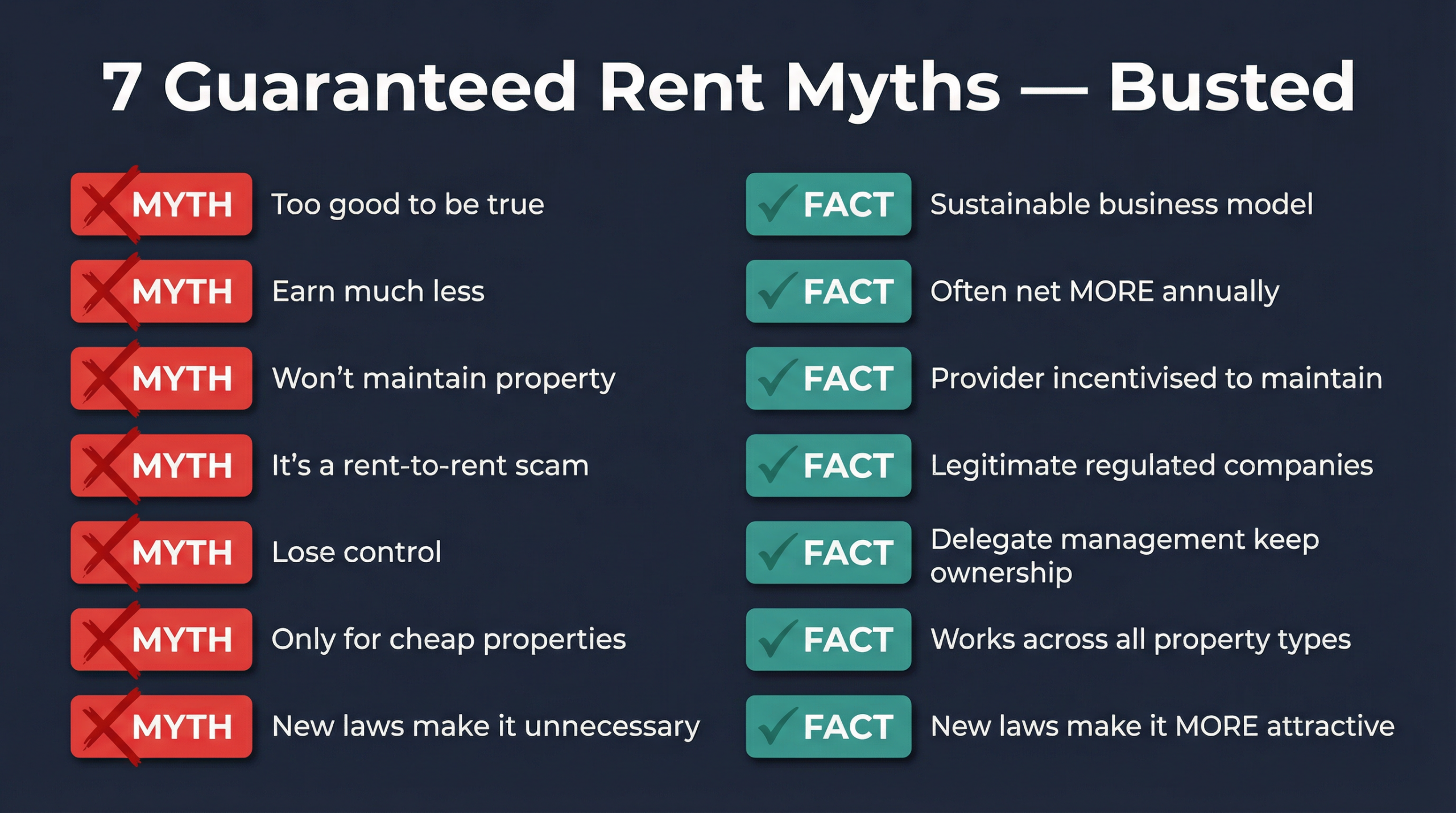
Myth 1: “Guaranteed Rent Is a Scam”
The myth: Guaranteed rent schemes are scams designed to take control of your property, overcrowd it, trash it, and leave you picking up the pieces. If it sounds too good to be true, it probably is.
The reality: Guaranteed rent is not a scam. It is a legitimate, established business model used by thousands of UK landlords and mirrored by council leasing schemes that have operated successfully for decades. But landlords are right to ask the question — because some operators in this space genuinely are dishonest.
The confusion comes from conflating two very different things: legitimate guaranteed rent providers and rogue rent-to-rent operators.
A legitimate provider signs a formal company let, manages your property professionally, handles all landlord compliance obligations, and pays you a fixed monthly rent from a business that’s been trading for years. A rogue operator takes your property with minimal paperwork, sublets it to as many people as possible, and disappears when things go wrong.
The Property118 landlord forum has documented cases of operators folding after just months of trading, leaving landlords with damaged properties and subtenants they never approved. These stories are real. But they indict specific operators, not the entire model — in the same way one cowboy builder doesn’t make all construction fraudulent.
How to Tell the Difference
The difference between a legitimate provider and a scam comes down to due diligence. A company with a verifiable Companies House registration, a physical office you can visit, filed accounts showing years of trading, and references from existing landlords is not running a scam. They’re running a property management business with a different revenue model to a traditional letting agent.
Here are the warning signs that should make you walk away:
- No Companies House registration, or incorporated within the last 12 months with no filed accounts
- No physical office — just a mobile number and a Gmail address
- Promises of rent at or above market rate (they’ll need to overcrowd your property to make the numbers work)
- Requests for upfront fees from the landlord
- Vague contracts or pressure to sign before you’ve had time to read the terms
- No verifiable portfolio of properties under management
And here’s what a trustworthy provider looks like:
- Years of trading history with filed accounts you can check at Companies House
- A physical office you can visit and a team you can meet
- A portfolio of properties under management, with landlords willing to provide references
- Clear, written contracts with inspection rights, maintenance obligations, and defined exit terms
- Transparent pricing with no hidden fees
Our guide on how to choose a guaranteed rent provider covers the full 10-point checklist every landlord should run through before signing anything.
Myth 2: “It’s Too Good to Be True — No Company Can Afford to Pay You Every Month”
The myth: No company can genuinely promise to pay your rent every month whether there’s a tenant in the property or not. There must be a catch somewhere.
The reality: The model works because of portfolio economics, not magic. And you can check the maths yourself.
A guaranteed rent provider pays you a fixed monthly amount — typically 10-20% below open-market rent. They then find tenants, manage the property, and charge rent at market rate. The difference between what they pay you and what tenants pay them covers tenant sourcing, property management, maintenance, compliance, and their profit margin.
It’s the same principle behind council leasing schemes, where local authorities lease properties from private landlords and house tenants from their waiting lists. Councils have run these programmes for decades. The private sector model works identically — the delivery just comes from companies rather than councils.
Where individual properties create unpredictable risk — a three-week void here, an emergency boiler replacement there — providers spread that risk across hundreds of properties. One property sitting empty for a fortnight barely registers across a portfolio of 500. The maths works in aggregate, even when individual properties have costly months.
If you want to understand the full mechanics, our step-by-step guide to how guaranteed rent works breaks down the entire process from initial valuation to monthly payment. And for a detailed look at what determines your guaranteed figure, see our guide on how guaranteed rent is calculated.
Myth 3: “It’s Just Rent-to-Rent by Another Name”
The myth: Guaranteed rent and rent-to-rent are the same thing. Both involve someone subletting your property. The only difference is marketing.
The reality: They can look similar on paper, but the operational differences are enormous — and they’re the differences that determine whether you’re protected or exposed.
| Feature | Legitimate Guaranteed Rent | Rogue Rent-to-Rent |
|---|---|---|
| Operator | Registered company with years of trading history | Individual or recently formed company |
| Contract | Formal company let with clear terms | Vague or verbal agreements |
| Property management | Professional, with regular inspections | Minimal oversight, maximum occupancy |
| Compliance | Handles gas safety, EICRs, licensing | Often ignores regulations entirely |
| Your risk | Protected by contract and company assets | Exposed to fines, damage, legal liability |
| Office | Physical premises you can visit | Mobile number and a Gmail address |
The rent-to-rent model itself isn’t illegal. But it attracts operators who cut corners because the barriers to entry are practically non-existent. Someone with no property management experience, no capital, and no accountability can approach a landlord, promise above-market rent, cram tenants into every room, and pocket the difference until the whole arrangement collapses.
Legitimate guaranteed rent works differently at every level. The company becomes your contractual tenant. They carry insurance. They have staff, systems, and a reputation built over years. If they mismanage your property, you have legal recourse against a registered business with assets.
Our guide to what rent-to-rent actually means explains the model in full and covers how to distinguish it from professional guaranteed rent arrangements.

Myth 4: “You’ll Earn Far Less Than Market Rent”
The myth: Guaranteed rent pays so far below market rate that you’re throwing money away. You’d always be better off with a letting agent.
The reality: Yes, guaranteed rent typically pays 10-20% below open-market rent. But that figure in isolation is misleading, because it ignores every cost that comes with the alternative.
Let’s compare a London property with a market rent of £1,800 per month.
Self-managing at market rent:
– Gross annual rent: £21,600
– Minus one void period (23 days average in England): -£1,380
– Minus letting agent fees (10% + VAT): -£2,426
– Minus average maintenance and repairs: -£1,200
– Net annual income: approximately £16,594
Guaranteed rent at 15% below market:
– Guaranteed monthly rent: £1,530
– Gross annual rent: £18,360
– Minus void periods: £0
– Minus agent fees: £0
– Minus maintenance costs: £0
– Net annual income: £18,360
The landlord on guaranteed rent nets £1,766 more per year — while doing nothing. No tenant calls at midnight. No chasing late payments. No coordinating tradespeople. No navigating new landlord regulations.
The average void period in England reached 23 days at the end of 2025. In London, it’s higher. Add letting agent fees, emergency repairs, and the occasional eviction process running into thousands, and that “below market rate” looks very different once you run the actual numbers.
For a detailed breakdown of every variable, our guide on how much guaranteed rent costs walks through the full picture.
Myth 5: “You Lose All Control of Your Property”
The myth: Signing a guaranteed rent agreement means handing over your property to a company and losing all say in what happens to it.
The reality: You keep full ownership. You remain on the title deeds, receive mortgage statements, pay your tax obligations, and make all decisions about your asset’s long-term future. What you’re delegating is the day-to-day operational work — tenant sourcing, rent collection, maintenance management, regulatory compliance.
It’s no different from appointing a managing agent, except you also get the security of guaranteed income on top.
Most guaranteed rent contracts include provisions for:
- Landlord inspections with reasonable notice (typically 24-48 hours)
- Regular written reports on property condition
- Consultation before any works or alterations beyond routine maintenance
- Clear exit terms at the end of the agreement period
The trade-off is real: you won’t be choosing individual tenants or fielding calls about dripping taps. But for most landlords, that’s not “losing control.” That’s the entire point.
If your contract doesn’t include inspection rights and written maintenance obligations, that’s a red flag about the provider, not the model itself. A reputable company puts these terms in writing because they have nothing to hide.
Myth 6: “Guaranteed Rent Is the Same as Rent Guarantee Insurance”
The myth: Guaranteed rent and rent guarantee insurance are basically the same product with different branding. One’s just more expensive than the other.
The reality: These are completely different products solving different problems. Confusing them leads to poor decisions and wasted money. And while we’re at it, a rent guarantor is a third thing entirely.
Here’s how they actually differ:
Rent guarantee insurance is an insurance policy. You pay an annual premium (typically 3-5% of annual rent). If your tenant stops paying, you make a claim. There’s usually an excess period of 30-60 days before payouts begin, a cap on the total claim amount, and you must prove the tenant has defaulted. You’re still managing the property yourself — finding tenants, handling maintenance, dealing with compliance. It’s a safety net, not a management solution.
Guaranteed rent is a management arrangement. A company leases your property, pays you every month regardless of what tenants do, and handles everything: tenant sourcing, rent collection, maintenance, compliance, and void periods. There’s no claim process because there’s nothing to claim against. You receive a fixed payment on the same date every month.
A rent guarantor is a person (usually a family member or friend) who agrees to cover a tenant’s rent if they default. It’s a personal guarantee, not a commercial product.
The key differences at a glance:
- Who manages the property? Insurance: you. Guaranteed rent: the provider.
- When do you get paid? Insurance: only after a claim, with an excess period. Guaranteed rent: every month, no exceptions.
- Void periods covered? Insurance: no. Guaranteed rent: yes.
- Maintenance included? Insurance: no. Guaranteed rent: yes.
Our guide on how rent guarantee insurance works covers the insurance option in detail if that’s better suited to your situation.
Myth 7: “The Renters’ Rights Act Makes Guaranteed Rent Pointless”
The myth: New legislation will stabilise the rental market and make professional management unnecessary. Guaranteed rent is a product for a pre-regulation era — landlords won’t need it once the market settles down.
The reality: The Renters’ Rights Act 2025 is the strongest argument for guaranteed rent that’s emerged in years. Every major change in the Act makes self-managing harder, more time-consuming, and more legally risky.
Here’s what landlords face from May 2026:
- Section 21 abolished entirely. No-fault evictions are gone. Removing a tenant now requires specific Section 8 grounds, longer notice periods, and court proceedings that can drag on for months.
- All tenancies become periodic from day one. No more fixed terms. Tenants can leave with two months’ notice at any point, creating unpredictable voids that no amount of planning can prevent.
- Rent increases limited to once per year via formal Section 13 notice, with tenants able to challenge increases at tribunal.
- Awaab’s Law extended to the private sector. Landlords must respond to damp and mould reports within 14 days and complete repairs within strict deadlines or face enforcement action.
- Mandatory Property Portal registration and a new Landlord Ombudsman handling tenant complaints.
- Doubled Rent Repayment Orders for non-compliant landlords.
Each of these changes adds complexity, cost, and legal exposure. The landlord who previously served a Section 21 notice when things went wrong now faces a lengthy Section 8 process. The landlord who raised rent to cover increasing landlord costs now faces tribunal challenges from tenants who disagree.
With guaranteed rent, the provider absorbs all of this. They handle Section 8 proceedings if a tenant needs removing. They manage Awaab’s Law timelines. They deal with the Property Portal and Ombudsman requirements. Your rent arrives on the same date every month regardless.
Far from making guaranteed rent pointless, the Renters’ Rights Act makes it more relevant than at any point in the past decade. Our dedicated guide on how guaranteed rent works after the Renters’ Rights Act covers the full legislative impact in detail.

When Guaranteed Rent Goes Wrong: Lessons From Real Cases
No honest article about guaranteed rent pretends every provider delivers. Some don’t. Understanding why is what protects you.
The most common failure pattern isn’t fraud — it’s undercapitalisation. A small operator takes on properties, pays landlords for a few months, fails to fill voids quickly enough, and runs out of cash. The landlord is left with subtenants they didn’t approve and a company that’s ceased trading. In some cases, the operator has converted a single property into an unlicensed HMO to maximise income, leaving the landlord liable for licensing violations they knew nothing about.
Property118’s landlord forums contain multiple threads from landlords burned by operators who traded for less than two years before disappearing. The common thread in every case: the operators were newly formed companies with no financial reserves, no track record, and no physical premises.
There’s also a second failure pattern worth knowing about: operators who don’t fold but gradually reduce the quality of their service. They stop conducting inspections. They delay maintenance. They let small problems become expensive ones. By the time the landlord discovers the state of the property, the damage is done. This is why ongoing communication matters as much as the initial vetting — and why contract clauses around inspections and maintenance timelines aren’t optional extras.
The lesson isn’t “avoid guaranteed rent.” It’s “vet your provider properly.” The checks that protect you are straightforward:
- Search their company at Companies House. Look for at least three years of filed accounts and active status.
- Visit their office. If they don’t have one, ask yourself why.
- Ask for references from landlords who’ve been with them for more than two years.
- Read the full contract before signing. If anything is vague, get it clarified in writing.
- Check they carry appropriate insurance and can demonstrate financial stability.
A provider operating since 2009 with 500+ properties under management, filed accounts, and a physical office in Barking carries a fundamentally different risk profile from someone who registered a company last quarter. Our full guide on how to choose a guaranteed rent provider gives you the complete 10-point vetting checklist.
Frequently Asked Questions
Is guaranteed rent legal in the UK?
Yes, completely. Guaranteed rent is a legal commercial arrangement where a company leases your property under a standard company let agreement. The same structure is used by council leasing schemes across the country. There are no restrictions on entering these agreements, provided they comply with tenancy law and any mortgage lender requirements you may have.
Is guaranteed rent a scam?
Guaranteed rent itself is not a scam — it’s a recognised business model in the UK property market. However, some dishonest rent-to-rent operators have given the industry a poor reputation by taking on properties and mismanaging them. The key is vetting your provider: check their Companies House registration, visit their office, verify their portfolio, and speak to existing landlords before signing.
What happens if a guaranteed rent company goes into administration?
The lease agreement would typically terminate and the property reverts to your direct management — you’d become the landlord to any existing subtenants. This is why choosing an established provider matters. Check their Companies House filings for consistent revenue and filed accounts. Providers operating for over a decade carry significantly lower administration risk than newly formed companies.
Is guaranteed rent the same as rent guarantee insurance?
No. Rent guarantee insurance is an insurance policy that pays out if your tenant defaults — after an excess period and subject to caps. You still manage the property yourself. Guaranteed rent is a management arrangement where a company pays you directly every month regardless of tenant behaviour and handles everything on your behalf. They solve different problems.
Can I cancel a guaranteed rent agreement early?
This depends on your contract terms. Most agreements include break clauses allowing either party to exit with a specified notice period, typically three to six months. Some contracts may include early termination fees. Understand the exit terms fully before signing — a reputable provider will be transparent about this upfront.
How quickly can I set up a guaranteed rent agreement?
With an established provider, it’s straightforward. After a property assessment and valuation, contracts can be signed within days. At AMS, most landlords receive their first guaranteed rent payment within two weeks of their initial enquiry, though timescales vary depending on property condition and any works needed.
Do guaranteed rent companies accept any property?
Not necessarily. Most providers have minimum standards for property condition, location, and safety compliance (gas certificates, EICRs, EPC ratings). Properties needing significant works may not be accepted immediately, though some providers will arrange works and deduct costs from guaranteed rent over time. Criteria vary by provider, so it’s worth getting a free property valuation to find out where you stand.
Will guaranteed rent still work after the Renters’ Rights Act?
Yes — and most industry professionals argue it works better. The Act abolishes Section 21, introduces periodic tenancies from day one, and adds new compliance requirements that make self-managing more complex. Under guaranteed rent, your provider handles all of this on your behalf while your monthly payment stays the same. Read our full guide on guaranteed rent and the Renters’ Rights Act for a detailed breakdown.
Get Your Free Guaranteed Rent Valuation
Every month spent deliberating is a month of unnecessary risk. Void periods, problem tenants, midnight maintenance calls, shifting regulations — guaranteed rent removes all of it.
AMS Housing Group has provided guaranteed rent across London since 2009. Over 500 properties under management. Landlords paid on time, every month. Zero voids. Zero hidden fees. Zero commission.
Now that you know the myths from the facts, the next step is finding out whether guaranteed rent is worth it for your specific situation. Or, if you’re ready to move forward, get a free valuation and see what your property could earn.
- Request a valuation online: Get Your Free Valuation
- Call us directly: 020 3793 2247
- Visit us: 29 Longbridge Road, Barking, IG11 8TN